
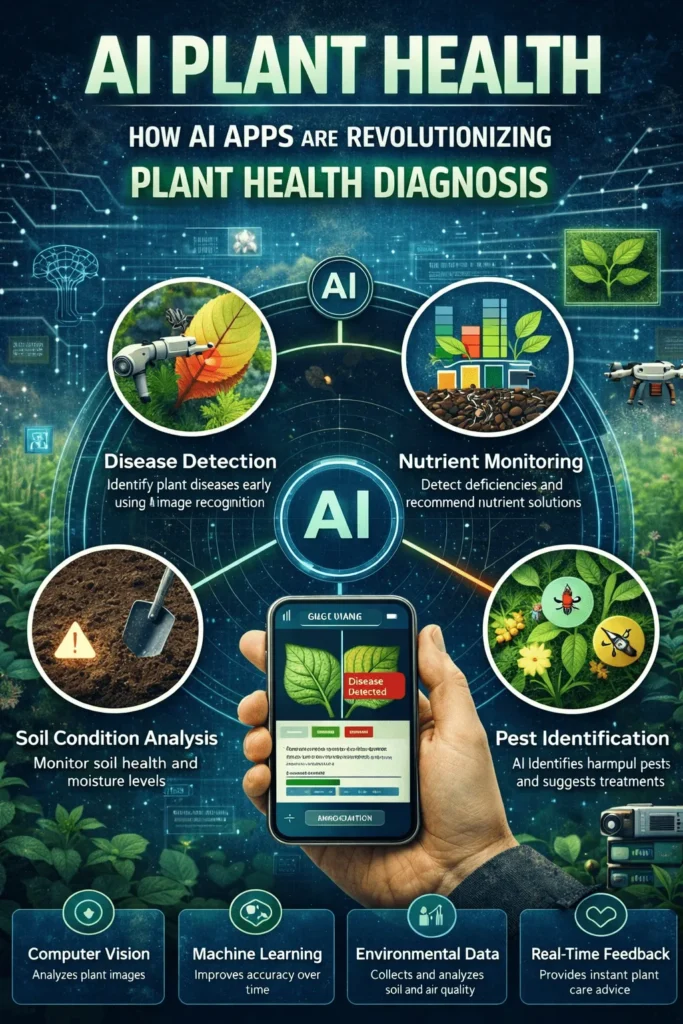
In the ever-evolving landscape of agricultural technology, a groundbreaking development has emerged that promises to revolutionize plant disease diagnosis. Researchers have introduced Chat Demeter, a multi-agent system that leverages deep learning to identify and classify plant diseases with remarkable accuracy. This innovation, detailed in a recent study published in *Frontiers in Plant Science*, could significantly impact the agriculture sector by enhancing crop health monitoring and reducing losses.
Chat Demeter operates by capturing real-time images of leaves using camera devices. The system then employs a sophisticated CNN-Transformer model to perform instance segmentation and object detection, enabling it to automatically identify diseased leaves and classify the types of diseases present. “The integration of CNN and Transformer models allows for a more comprehensive analysis of leaf images, improving the accuracy and efficiency of disease detection,” explains lead author Sainan Zhang.
One of the standout features of Chat Demeter is its natural language interface, which allows users to upload images and receive automated diagnostic results and treatment suggestions. This user-friendly approach not only simplifies the diagnostic process but also makes it more accessible to farmers and agricultural professionals. “By providing immediate and actionable insights, we aim to empower users to take proactive measures in managing plant health,” Zhang adds.
The system’s performance is impressive, achieving an accuracy of 99.50% and an AUC of 99.91% on the validation dataset. These results highlight its potential to become a vital tool in the fight against plant diseases, which remain a significant challenge in global agricultural production. “Accurate and efficient disease detection is crucial for reducing crop losses, controlling agricultural costs, and improving yields,” Zhang notes.
The commercial implications of Chat Demeter are substantial. By enabling early and precise disease diagnosis, the system can help farmers implement timely interventions, thereby minimizing crop damage and enhancing overall productivity. This could lead to significant cost savings and improved profitability for the agriculture sector.
Moreover, the integration of multi-agent systems in agriculture represents a feasible pathway for future developments. As the industry continues to advance toward digitalization and intelligent transformation, the application of artificial intelligence technologies is becoming increasingly important. Chat Demeter sets a precedent for future systems that could further optimize agricultural practices and enhance industrial competitiveness.
The study, led by Sainan Zhang and published in *Frontiers in Plant Science*, underscores the potential of deep learning and multi-agent systems in transforming plant disease diagnosis. As the agriculture sector embraces these technological advancements, the future of crop health monitoring looks increasingly promising.