
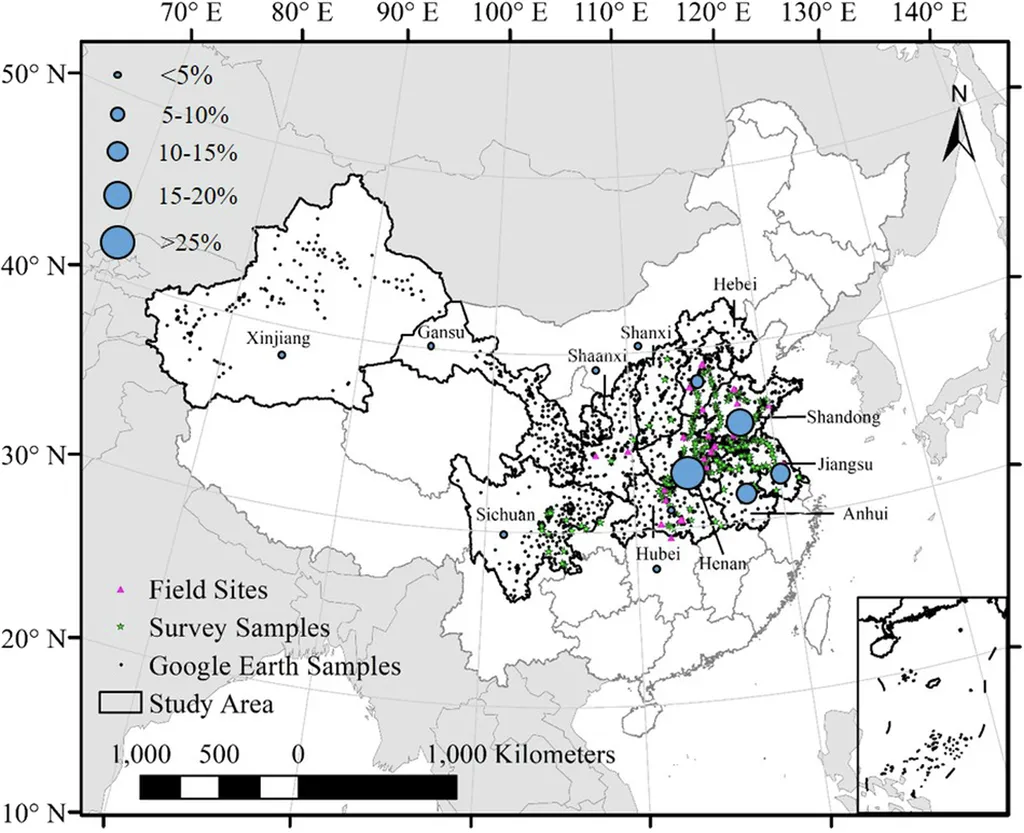
In a significant leap forward for agricultural monitoring and food security assessments, researchers have developed a high-resolution dataset that promises to revolutionize wheat mapping in China. Published in *Earth System Science Data*, the study introduces CN_Wheat10, a 10-meter resolution dataset that tracks the distribution of both spring and winter wheat across China from 2018 to 2024. This breakthrough addresses critical gaps in existing remote sensing products, offering unprecedented accuracy and spatial coverage.
Wheat, a staple food crop, is integral to global agricultural trade patterns. China, as the world’s largest producer and consumer of wheat, boasts extensive cultivation areas and diverse planting systems. However, previous remote sensing efforts often overlooked the significant variations in wheat growth cycles across different agro-ecological zones. “Current methods rely on uniform phenological feature variables, which don’t adequately account for the diverse growth patterns of wheat in China,” explains lead author M. Liu from the State Key Laboratory of Information Engineering in Surveying, Mapping and Remote Sensing at Wuhan University.
The CN_Wheat10 dataset overcomes these limitations by integrating time-series remote sensing data with crop distribution products. The researchers employed a cross-regional training sample generation method and a province-level, differentiated feature selection strategy to enhance regional adaptability and classification performance. This innovative approach has resulted in a dataset that achieves mapping accuracies above 0.93 for winter wheat and above 0.91 for spring wheat.
The commercial implications of this research are substantial. Accurate and comprehensive wheat mapping is crucial for agricultural monitoring, trade, and food security assessments. “By providing detailed spatial distribution information on both spring and winter wheat harvested areas, CN_Wheat10 offers more comprehensive data support for agricultural management in China,” Liu notes. This dataset not only expands the spatial coverage but also includes both crop types, filling a significant gap in existing products that primarily focus on winter wheat.
The dataset’s high accuracy and spatial resolution can enhance decision-making processes for farmers, agribusinesses, and policymakers. It enables precise monitoring of wheat cultivation patterns, facilitating better resource allocation, pest management, and yield prediction. Moreover, the dataset’s accessibility—freely available at https://doi.org/10.6084/m9.figshare.28852220.v2—ensures that stakeholders can leverage this valuable resource for informed decision-making.
Looking ahead, the CN_Wheat10 dataset sets a new standard for agricultural monitoring. Its success highlights the potential of integrating advanced remote sensing techniques with comprehensive training samples. As the agriculture sector continues to evolve, such high-resolution datasets will be instrumental in shaping future developments, from precision agriculture to sustainable food security strategies. This research not only addresses current challenges but also paves the way for more innovative and effective agricultural monitoring solutions.