
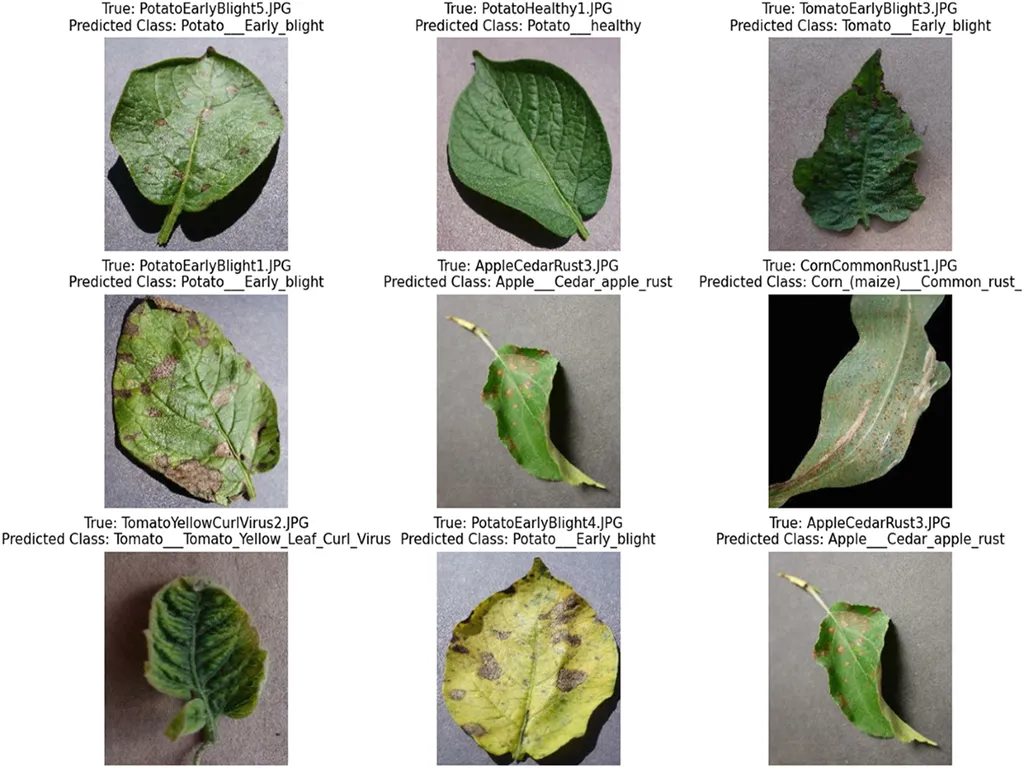
In the heart of modern agriculture, where precision and efficiency are paramount, a groundbreaking development is set to revolutionize how farmers detect and manage crop diseases. Researchers have harnessed the power of deep learning to create a highly accurate system for identifying crop diseases, potentially transforming the agricultural landscape.
The study, published in *Discover Computing*, introduces a novel approach using the EfficientNetB0 architecture, a deep learning model renowned for its ability to extract intricate features from large datasets. This model has been fine-tuned through transfer learning to adapt to the specific characteristics of crop diseases, making it a powerful tool for precision agriculture.
“Our model achieved an impressive 99.51% test accuracy with a loss of 0.0165,” said Muhammad Subhan, lead author of the study and a researcher at the Department of Computer Engineering, University of Engineering and Technology Taxila (UET). “This level of accuracy is crucial for early detection, allowing farmers to take timely action and minimize crop losses.”
The implications for the agriculture sector are profound. Early detection of crop diseases is a game-changer, enabling farmers to respond quickly and effectively. This not only supports sustainable disease management but also contributes to yield protection, which is vital given the global need to increase food production by 70% by 2050.
The EfficientNetB0 model’s ability to identify subtle patterns and features associated with crop diseases makes it an invaluable tool for precision agriculture. By integrating this model into agricultural workflows, farmers can monitor their fields more effectively, making data-driven decisions that enhance crop health and productivity.
“This research underscores the importance of utilizing advanced algorithms based on deep learning to identify crop diseases,” Subhan added. “It highlights the transformative impact of technology on modern agriculture, paving the way for more resilient and sustainable food systems.”
As the world grapples with the challenges of feeding a growing population, innovations like this are more critical than ever. The EfficientNetB0 model represents a significant step forward, empowering farmers to grow crops more efficiently and maximize their yield potential.
The study’s findings open up new possibilities for the future of agriculture. As technology continues to evolve, the integration of deep learning models into agricultural practices could become standard, leading to more efficient and sustainable farming methods. This research not only shapes the future of crop disease detection but also sets a precedent for the broader application of advanced algorithms in agriculture.
In an era where technology and agriculture intersect, the EfficientNetB0 model stands as a testament to the power of innovation in addressing global food security challenges. As farmers embrace these technological advancements, the path to a more sustainable and productive future becomes clearer.