
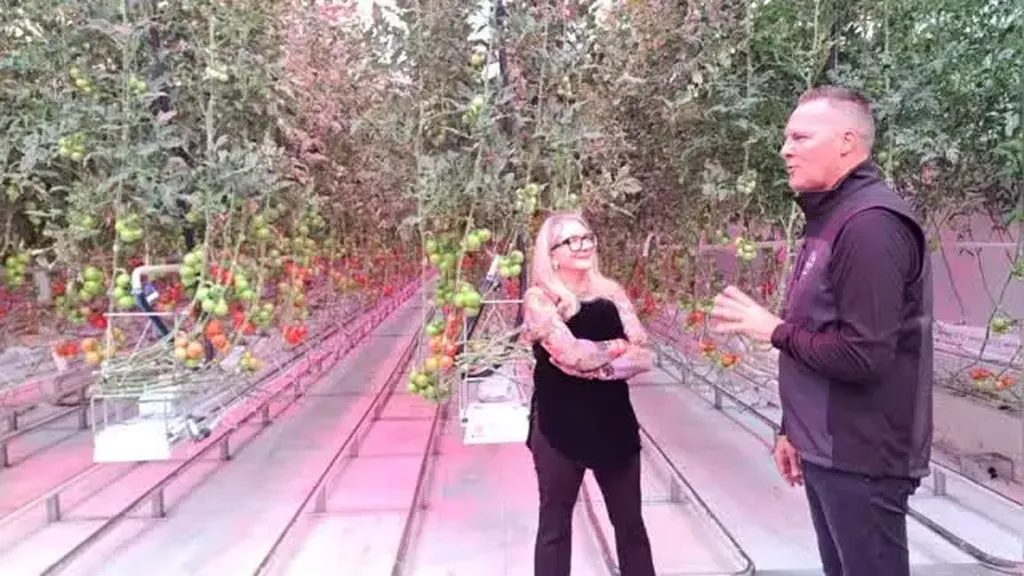
In a significant stride towards bolstering food security and fostering the agritech sector, a new smart-farming project has been launched in Delta, British Columbia. This initiative is set to fortify the province’s food supply chain while equipping individuals with the essential skills to thrive in the burgeoning agritech industry.
The project, spearheaded by Delta-based Windset Farms with the backing of the B.C. Centre for Agritech Innovation (BCCAI), aims to revolutionize farming practices through the integration of advanced technology. By employing sensors that monitor plant stress and efficient greenhouse crop management, the project seeks to automate decision-making processes. This is expected to enhance production systems by optimizing climate control, nutrient uptake, and early disease detection in hydroponic tomatoes. The use of advanced data analytics and machine learning is anticipated to drive these improvements, ensuring a more resilient and efficient food production system.
“With a changing climate and uncertainty from the U.S., it’s critical that two of British Columbia’s greatest strengths, technology and agriculture, come together to ensure British Columbians can rely on healthy food grown here at home,” said Ravi Kahlon, Minister of Jobs and Economic Growth. “Through our Look West plan, we are connecting innovators with industry partners to turn made-in-B.C. ideas into real-world solutions that create jobs and drive our economy forward in a sustainable future.”
The project is a collaborative effort involving Simon Fraser University (SFU), Koidra, Vivent, and Wageningen University & Research (WUR) in the Netherlands. It stems from a 2023 letter of intent between SFU and WUR to collaborate on future research programs and address agricultural sustainability challenges, including food production and climate change.
In addition to the smart-farming initiative, two new training programs are being developed to support the agritech sector. Kwantlen Polytechnic University (KPU) is leading a program focused on drought-resilient crop production systems. This initiative will train participants in dry farming, a method that uses specific agro-ecological measures to cultivate crops with minimal additional water. The program is a collaboration between the Ministry of Agriculture and Food’s Regional Extension Program, KPU’s Institute for Sustainable Food Systems, local growers, and industry groups.
“BCCAI’s support, along with the B.C. Ministry of Agriculture and Food, enables us to establish collaborative dry-farming extension, applied research and demonstration projects on three farms,” said Kent Mullinix, director of KPU’s Institute for Sustainable Food Systems. “We’re engaging dozens of farmers, professionals and students on soil health, agro-ecology, soil and weather data collection, and advancing drought-resilient farming.”
Meanwhile, the University of the Fraser Valley (UFV) is developing a training program to demonstrate new robotic-weeding technology. This initiative aims to address the significant challenge of weeds for fruit and vegetable producers in B.C. By training farmers and students on robotic weeding technologies, the program seeks to reduce labor reliance, minimize herbicide use, and improve sustainability through efficient resource management.
“The partnership with BCCAI enables new opportunities for students on current agricultural issues and shows them the types of skills and work opportunities available in agricultural robotics, such as the robotic-weeder demonstration,” said Renee Prasad, department head, associate professor, agriculture technology, UFV. “BCCAI serves an important role in supporting open dialogue by bringing technology and producers, current and future, together.”
The three new projects and training programs represent a total investment of approximately $658,000, with $280,000 from BCCAI, $204,000 from industry, and an in-kind industry contribution valued at $174,000. These initiatives are expected to provide advanced training to more than 350 people in areas such as horticulture, regenerative agriculture, data management, and agri-business management. Additionally, they are anticipated to create three new jobs and increase business opportunities through commercialization.
“B.C.-developed technology is helping our farmers increase production and make our food supply more resilient to climate change,” said Lana Popham, Minister of Agriculture and Food. “Using the latest tech to monitor plant growth and health, as well as maximize water and nutrient efficiency, is resulting in more sustainably grown, local food being produced for B.C. families and a better bottom line for farmers.”
These projects are part of the Province’s Look West plan for jobs and industry, which aims to deliver jobs and opportunities by strengthening the workforce and developing a more independent economy. The investment by Pacific Economic Development Canada (PacifiCan) in BCCAI is scaling up homegrown innovation and boosting B.C. business growth, key steps in building a strong Canadian economy.
Gregor Robertson, federal Minister of Housing and Infrastructure and Minister responsible for Pacific Economic Development