
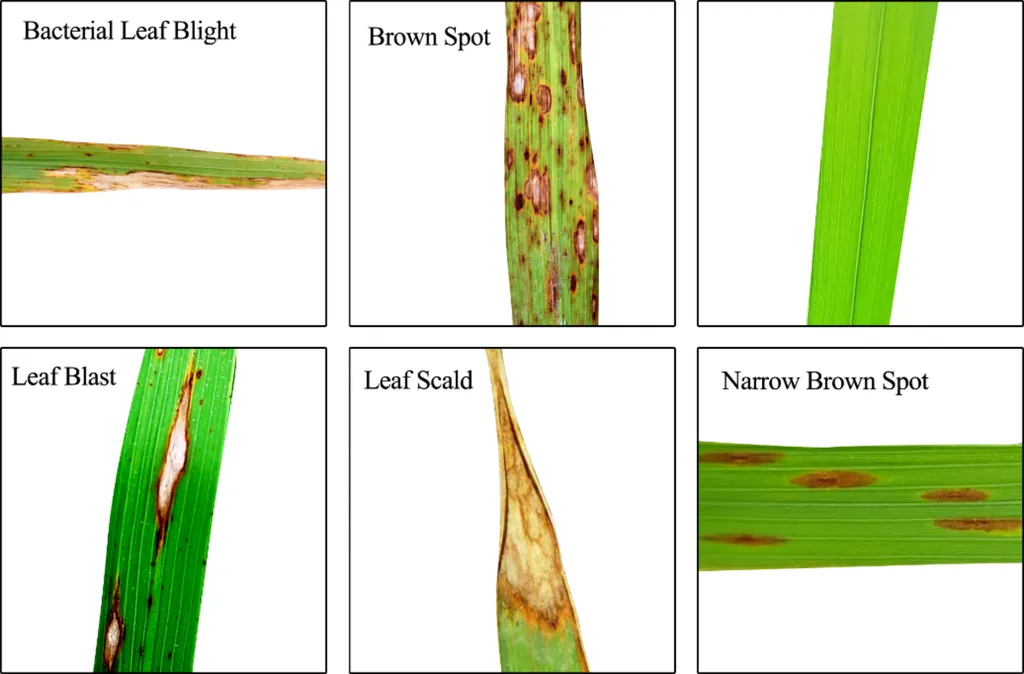
In the relentless pursuit of safeguarding global food security, early and accurate detection of rice diseases stands as a critical frontier. A recent study published in *Franklin Open* has made significant strides in this area, offering a novel approach that could revolutionize how farmers and agritech companies manage rice crop health. The research, led by Farida Siddiqi Prity from the Department of Computer Science and Engineering at Netrokona University in Bangladesh, introduces a hybrid feature extraction algorithm that promises to enhance the precision and efficiency of rice disease classification.
Rice diseases, such as bacterial leaf blight, stemborer, and tungro, pose a substantial threat to crop productivity. Traditional methods of disease detection often fall short in terms of timeliness and accuracy, leading to significant yield losses. Artificial Neural Networks (ANNs) have emerged as a promising tool in this domain, but existing methods using single feature extraction or direct imaging have limitations. These include poor generalization, high computational costs, and limited interpretability.
Prity’s research addresses these challenges head-on. The study proposes a hybrid feature extraction algorithm named GreyTexFWave, which integrates multiple feature extraction techniques: Gray Level Co-occurrence Matrix (GLCM), Gray Level Dependence Matrix (GLDM), Texture, Fast Fourier Transform (FFT), and Discrete Wavelet Transform (DWT). This comprehensive approach captures both spatial and frequency-domain characteristics of rice leaf images, providing a more robust and accurate representation of disease symptoms.
The extracted features are then classified using a Feed-Forward Neural Network (FFNN). Experiments conducted on a balanced dataset of rice leaf images demonstrated the superior performance of the GreyTexFWave-based FFNN. The model achieved an average accuracy of 94.84 ± 0.04%, with impressive sensitivity, precision, and F-measure scores. “The results clearly show that hybrid feature extraction substantially enhances rice disease classification performance,” Prity noted. “This approach offers a practical and interpretable solution for early rice disease detection, supporting precision agriculture and reducing yield losses through timely disease management.”
The commercial implications of this research are profound. For the agriculture sector, the ability to accurately and swiftly identify rice diseases can lead to more targeted and effective disease management strategies. This can translate into significant cost savings for farmers, as they can avoid the indiscriminate use of pesticides and other treatments. Moreover, the enhanced accuracy of disease detection can lead to better crop yields, ensuring food security and economic stability for farming communities.
The study also highlights the potential for further advancements in the field. As Prity explains, “The comparative effectiveness of hybrid feature extraction strategies remains insufficiently explored. Our research opens up new avenues for developing more sophisticated and efficient algorithms for disease detection.” This could pave the way for the integration of advanced machine learning techniques into agricultural practices, fostering a new era of precision farming.
In conclusion, the research published in *Franklin Open* represents a significant step forward in the fight against rice diseases. By leveraging the power of hybrid feature extraction and advanced neural networks, the study offers a promising solution for early and accurate disease detection. As the agriculture sector continues to embrace technology, such innovations will be crucial in ensuring sustainable and productive farming practices. The work of Farida Siddiqi Prity and her team not only advances scientific knowledge but also holds the potential to transform the agricultural landscape, benefiting farmers and consumers alike.