
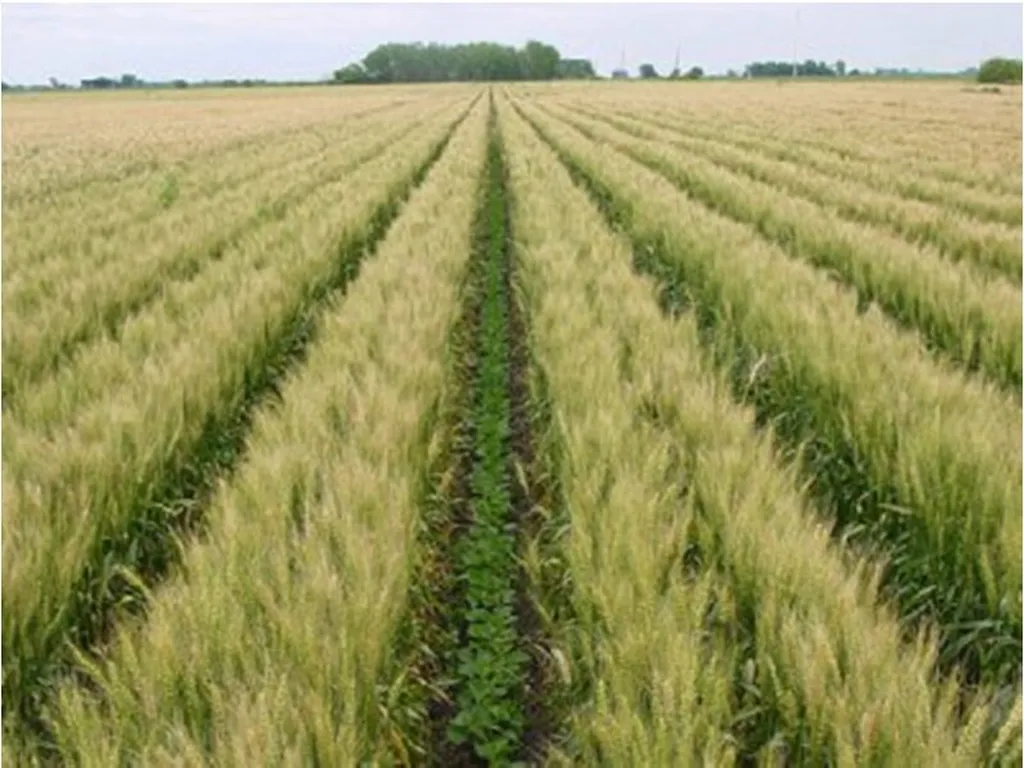
In a significant stride towards sustainable agriculture, researchers have uncovered a promising pathway to boost global crop production without expanding cropland. The study, published in *npj Sustainable Agriculture*, leverages a novel global meta-analysis and machine learning to dissect the intricate dynamics of intercropping, a practice that has long been touted but not fully exploited for its potential.
Intercropping, the practice of growing two or more crop species in proximity, has been a cornerstone of ecological intensification. However, its widespread adoption has been hindered by the unpredictable nature of yield benefits, which emerge from complex interspecific interactions. The research, led by Marie Ruillé from CIRAD, UMR CIRED, analyzed 4,195 partial Land Equivalent Ratio (pLER) observations from 334 studies across 60 countries. The findings reveal a substantial untapped potential to increase the production of major cereals—maize, barley, and wheat—through optimized intercropping strategies.
The study identified key levers for optimizing intercropping performance, including relative planting density (RD), temporal niche differentiation (TND), and relative height difference. “Despite reduced planting density in intercropping, the mean partial Land Equivalent Ratio of 0.79 indicates that yield reductions for component species are proportionally smaller than the decrease in density, revealing consistent beneficial interactions,” Ruillé explained. This suggests that intercropping can enhance yields even when planting density is reduced, a finding that could have profound implications for agricultural practices.
The research also unveiled a predictable trade-off governed by asymmetric competition. By manipulating RD and TND, farmers can selectively benefit either taller or shorter species, providing a mechanistic insight into how interspecific dynamics shape intercropping success. This finding offers a scalable and ecologically grounded pathway to increase global crop production without cropland expansion.
The commercial impacts of this research are substantial. Farmers can adopt optimized intercropping strategies to enhance yields without the need for additional land, reducing the pressure on natural ecosystems. This approach aligns with the growing demand for sustainable agricultural practices that minimize environmental impact while maximizing productivity.
Moreover, the study’s quantitative framework provides a robust tool for agricultural researchers and practitioners to design and implement intercropping systems tailored to specific agroecosystems. This could lead to the development of new crop varieties and management practices that further enhance the benefits of intercropping.
As the global population continues to grow, the need for sustainable and productive agricultural systems becomes increasingly urgent. This research offers a promising avenue for achieving food security while conserving biodiversity and natural resources. By harnessing the power of intercropping, farmers and researchers can pave the way for a more sustainable and productive future in agriculture.
The study, led by Marie Ruillé from CIRAD, UMR CIRED, and published in *npj Sustainable Agriculture*, provides a groundbreaking framework for optimizing intercropping practices, offering a scalable and ecologically grounded pathway to increase global crop production without cropland expansion. This research not only advances our understanding of intercropping dynamics but also opens new avenues for sustainable agricultural intensification, with significant commercial impacts for the agriculture sector.