
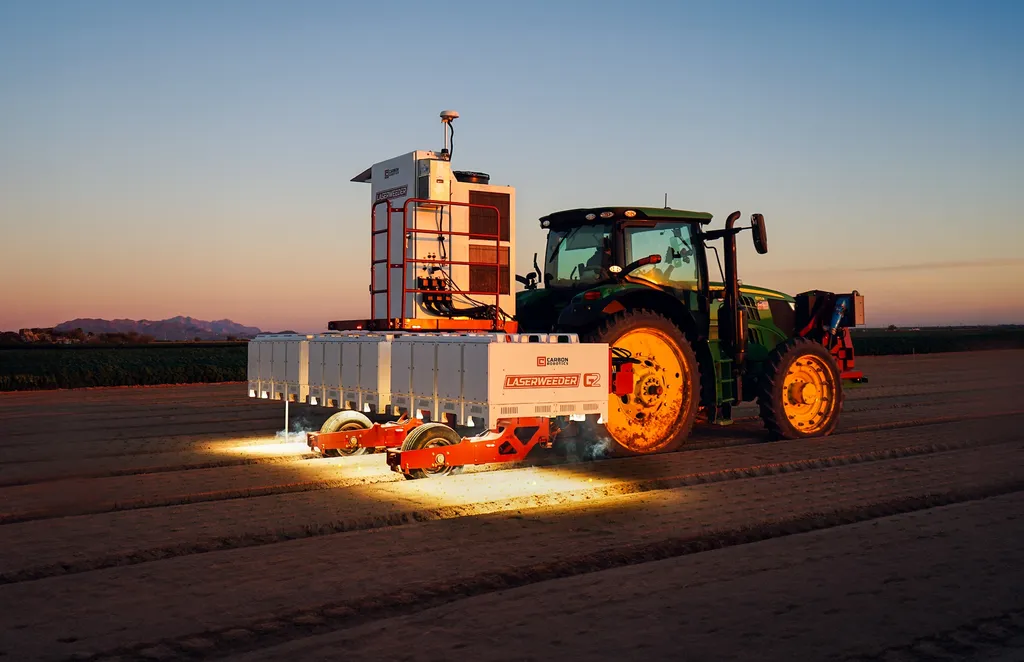
The landscape of precision agriculture is evolving rapidly, with laser weeders emerging as a groundbreaking innovation in the fight against weeds. Two years ago, the market was dominated by a single supplier, but today, Dutch growers have at least eight options to choose from. This surge in competition is not only expanding choices but also driving innovation and accessibility in the agricultural technology sector.
The rapid growth in the availability of laser weeders was evident at the recent Agritechnica trade fair in Hanover, Germany. Companies like Rumex and Digital Workbench, both from Germany, showcased their concepts and plans for future laser weeding technologies. Rumex, known for its spot sprayers, presented a preliminary design for a 3-point linkage laser weeder expected to hit the market by 2027. Digital Workbench, the manufacturer of the autonomous Tipard tool carriers, plans to start testing laser modules next year with a market release slated for late 2026. Other companies, such as Nature Robots and Luxeed Robotics, are also in the development stages, although their timelines remain uncertain.
One of the standout players in this market is the Greek company Terra Robotics, which already offers a mounted laser weeder in various configurations. Their system, available with 2, 3, or 4 modules, each equipped with 2 lasers, represents a significant leap in technology. The 3-module version, for instance, is priced between €250,000 and €300,000, highlighting the premium nature of this cutting-edge technology.
Carbon Robotics, the pioneer in this field, has undergone significant evolution since its inception. Initially launching an autonomous field robot, the company transitioned to a (semi-)mounted machine and has now introduced its second-generation LaserWeeder, the G2. This new model features infrared diode lasers, which are more powerful, robust, and energy-efficient compared to the previous CO₂ lasers. The shift to diode lasers reduces the risk of damage and wear, thereby increasing the system’s capacity and efficiency.
The choice of laser technology is crucial and depends on several factors, including wavelength, absorption by weed plants, safety, and cost. Matthias Lautenschläger, a network manager for PhytoPhotonik at the German consultancy EurA, explains that while CO₂ lasers were initially popular, the industry is now shifting towards thulium fibre lasers, holmium-YAG lasers, and infrared diode lasers. These newer technologies offer better efficiency and safety profiles, making them more suitable for modern agricultural applications.
The implications of this technological shift are profound. Laser weeders offer a precise and environmentally friendly alternative to traditional herbicides, reducing chemical usage and minimizing environmental impact. This is particularly relevant in the Netherlands, a country at the forefront of sustainable agriculture. The Dutch market’s interest in these technologies is evident, as a Dutch vegetable grower was the first in Europe to purchase a Carbon Robotics LaserWeeder.
However, the adoption of laser weeders is not without its challenges. The effectiveness of laser weeding depends on various factors, including the type of crop, weed pressure, and the specific algorithms used for weed detection. Suppliers emphasize the importance of considering the type of business, farm size, and crop type when investing in laser weeding technology. Additionally, the cost of service and maintenance contracts must be factored into the overall investment.
As the market continues to evolve, growers have a plethora of options to choose from, each with its unique features and benefits. The detailed overview provided by Future Farming highlights the capabilities and limitations of each system, helping growers make informed decisions. The rapid advancements in laser weeding technology are set to revolutionize weed management, offering sustainable and efficient solutions for modern agriculture.