
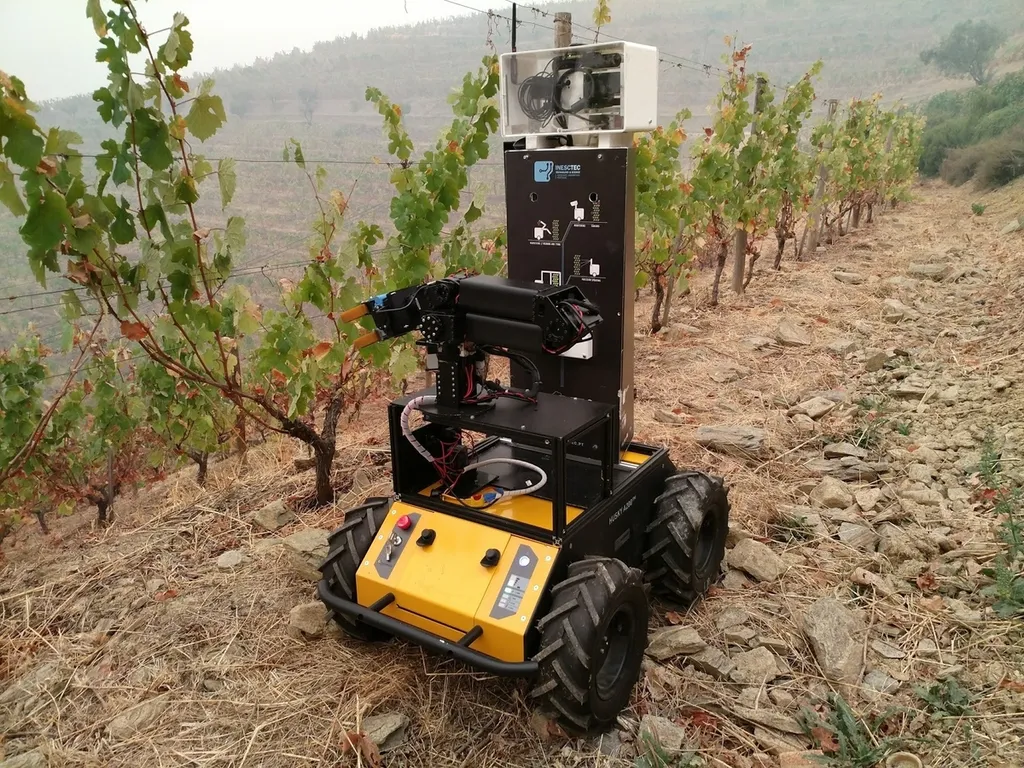
In the heart of agricultural innovation, a new modular robotic platform is making waves, promising to revolutionize soil monitoring and intra-plant logistics. Developed by a team led by Vadim S. Popryadukhin at Melitopol State University, this adaptable system is not just a technological marvel but a beacon of hope for sustainable and efficient farming practices.
The robotic platform, detailed in a recent study published in the Siberian Journal of Life Sciences and Agriculture, is built on the “robot-constructor” principle. This means it’s designed with standardized interfaces, allowing for quick adaptation to specific needs. Imagine a robot that can switch from a wheeled to a tracked base, or one that can easily swap out sensor modules to monitor different soil parameters. This is not just a robot; it’s a toolkit for the modern farmer.
“The platform demonstrates particular practical value in agro-ecological monitoring,” Popryadukhin explains. “The modular architecture allows for the rapid adaptation of sensor equipment for analyzing key soil parameters.” This adaptability is a game-changer for the agriculture sector, where soil conditions can vary greatly from one field to another, and even within a single field.
The platform’s sensor module is equipped with multispectral cameras, humidity, temperature, pH, and nutrient sensors, along with a sampling device. This array of tools allows for comprehensive soil analysis, providing farmers with the data they need to make informed decisions about crop management and soil health.
But the benefits don’t stop at soil monitoring. The platform’s modular design also makes it an ideal solution for automating intra-plant logistics. With its ability to quickly adapt to different tasks and environments, it can streamline operations and increase efficiency in small and medium-sized enterprises.
The platform’s software platform is ROS 2 Humble (Python 3.10), with key nodes including vision_node for marker recognition, navigation_node for route construction and correction, control_node for engine control with adaptive PID adjustment, and telemetry_node for data export and integration with ERP/MES via REST API. This sophisticated software ensures precise navigation and control, making the platform a reliable and efficient tool for various agricultural tasks.
The study confirmed the fundamental feasibility and high efficiency of the modular robotic platform as a tool for converging the Aeronet and Technet NTI roadmaps. The developed solution successfully combines the characteristics of technological sovereignty, economic affordability, and functional flexibility.
The practical significance of the project is due to its dual purpose: as an import-substituting industrial solution for the automation of intra-plant logistics at small and medium-sized enterprises, and as a multifunctional educational and research platform that forms a personnel reserve in the field of robotics, AI, and digital manufacturing.
This research is not just about a new tool; it’s about a new approach to agriculture. It’s about using technology to understand and respect the natural environment, to work with it rather than against it. It’s about creating a sustainable future for farming, one where efficiency and ecological responsibility go hand in hand.
As we look to the future, the potential applications of this modular robotic platform are vast. From precision agriculture to automated logistics, it’s a versatile tool that can adapt to the changing needs of the agriculture sector. It’s a testament to the power of innovation and a promising step towards a more sustainable and efficient future for farming.