
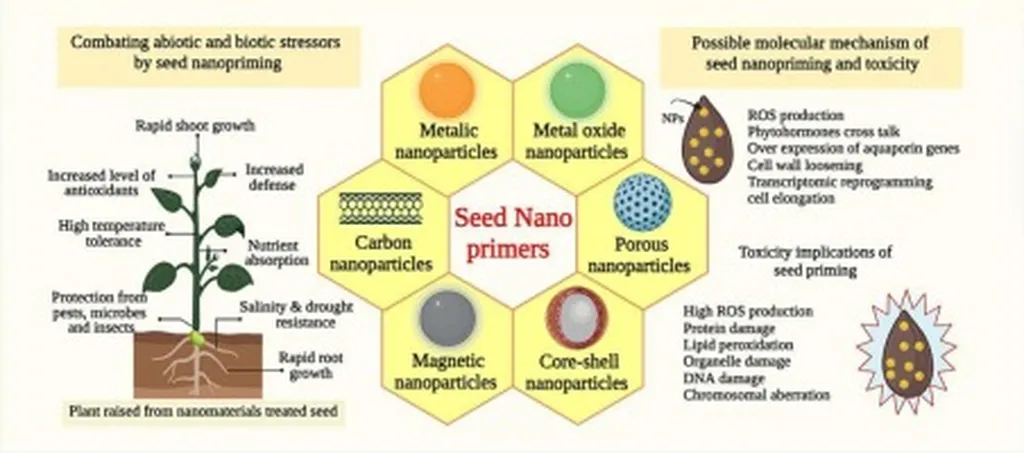
In the ever-evolving world of agriculture, the humble seed remains a critical player, and the techniques used to enhance its performance are gaining traction. A recent study published in the *European Journal of Horticultural Science* sheds light on the often-misunderstood concept of seed priming, a pre-sowing treatment that could hold the key to more synchronized germination and robust seedling vigour. The research, led by Elisa Monteze Bicalho of the Laboratory of Ecophysiology of Seeds at the Universidade Federal de Viçosa in Brazil, aims to clarify the precise definitions and applications of seed priming, a technique that has seen its terminology muddled in recent years.
Seed priming is a process where seeds are partially hydrated to kickstart metabolic processes before being dried back to their original moisture content. This controlled hydration phase is designed to enhance germination rates and seedling vigour, ultimately leading to better crop establishment in the field. However, the term “priming” has been increasingly misapplied to describe other techniques, leading to confusion and potential misapplication in agricultural practices.
“Using an accurate and standardized concept of priming is essential to prevent misunderstanding and ensure clarity within the scientific literature,” Bicalho emphasizes. The study highlights the importance of precise terminology, as the misapplication of the term “priming” can compromise the reproducibility of methodologies and lead to suboptimal results in the field.
The commercial implications of this research are significant. Seed enhancement treatments (SET) represent a growing market, with specialized products continually being developed to improve seed performance. For horticultural species, in particular, the accurate application of seed priming can lead to enhanced seed quality and improved yields. Conversely, the misapplication of the term and technique can result in reduced seed quality or yield losses, impacting the bottom line for farmers and seed companies alike.
The study also addresses the broader implications of seed priming, including its role in seed memory and the physiological effects of controlled hydration and drying. By understanding these processes, researchers and agricultural practitioners can better optimize seed treatments to suit specific crops and environmental conditions.
As the agricultural sector continues to grapple with challenges such as climate change and the need for sustainable practices, the precise application of techniques like seed priming becomes ever more crucial. This research serves as a call to action for the scientific community to adopt clear and consistent terminology, ensuring that the benefits of seed priming are fully realized.
In the words of Bicalho, “For horticultural species in particular, such ambiguity may lead to suboptimal application and, consequently, to reduced seed quality or yield losses.” By clarifying the concept of seed priming, this study paves the way for more effective and efficient agricultural practices, ultimately contributing to a more sustainable and productive future for the sector.