
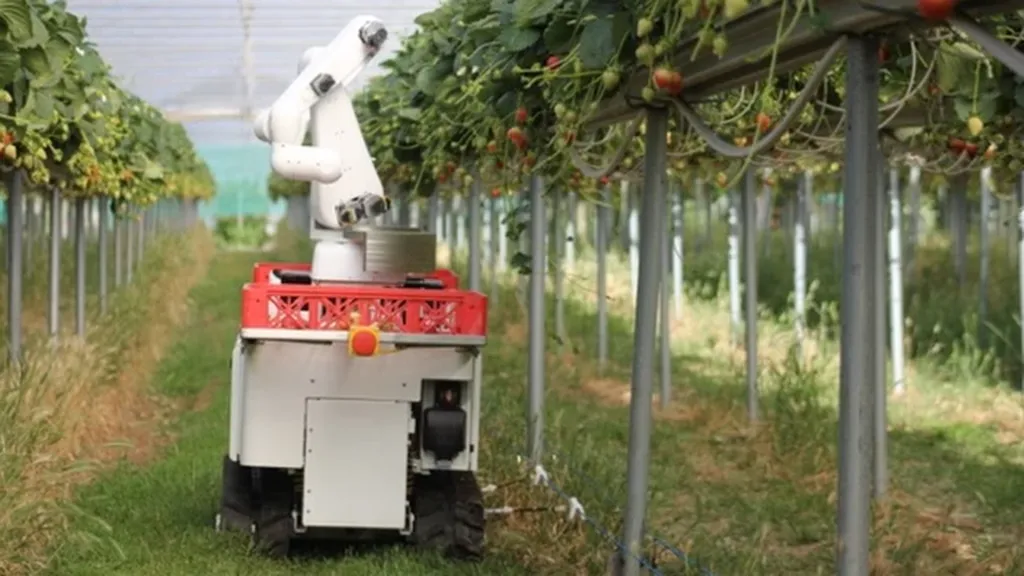
The agricultural industry is on the cusp of a technological revolution, and the recent unveiling of the Dogtooth picking robot for strawberry harvesting is a testament to this transformation. The English company Dogtooth showcased its innovative robot during Strawberry Day on January 7, marking a significant milestone in the integration of robotics into agriculture.
The robot presented is specifically designed for harvesting on pipe rail systems, a common setup in modern strawberry farms. This initial model is custom-built for an English strawberry grower but is also adaptable to the standard Dutch rail spacing of 55 centimeters. According to Daniel Stockill of Dogtooth, the company plans to introduce models on wheels and tracks starting from 2027, further expanding the robot’s versatility and application.
The robot’s design is both sophisticated and efficient. Equipped with two robot arms mounted on the chassis, it picks strawberries by clamping the stem just above the fruit and cutting it with a razor blade. The arms then place the fruit into a unit where five cameras assess the strawberry from all sides, evaluating size and quality. This comprehensive assessment includes checking for rot, powdery mildew, deformation, and other quality metrics. The data collected is used to determine the fruit’s grading, ensuring that only the best strawberries are selected for market.
The selection process is equally impressive. As the robot drives along the row, cameras scan the strawberries, and the two arms can perform seven different actions. The requirements for picking can be entered and adjusted via a computer interface, allowing for customization based on specific quality standards.
While the robot’s picking capacity is currently lower than manual labor—averaging 12.5 kilos per hour compared to the 24 kilos per hour that can be picked by hand—its ability to operate 24 hours a day significantly compensates for this. Stockill notes that the robot can harvest between 200 and 300 kilos per day. Additionally, the robot requires an operator to move it to the next row and handle the logistics of the harvested strawberries, including changing crates.
In terms of efficiency, Stockill suggests that one operator can manage up to 12 robots, making the system both scalable and economical. For a farm of 12 hectares, for instance, 12 robots and one operator would be the most efficient setup. The cost of each robot is £30,000 (€34,500), with an estimated payback period of two years, making it a viable investment for larger farms.
The commercial introduction of the robot in the United Kingdom followed eight years of development and began in 2025. Dogtooth plans to scale up production gradually, with 50 units available in 2026, 200 in 2027, 800 in 2028, and an ambitious target of 4,000 units by 2029. This gradual scale-up underscores the company’s commitment to quality and reliability as it ramps up production.
The implications of this technological advancement are profound. For strawberry growers, the Dogtooth picking robot offers a solution to labor shortages and the need for consistent, high-quality harvesting. The robot’s ability to operate continuously provides a significant advantage over manual labor, potentially increasing overall productivity and profitability.
Moreover, the integration of robotics into agriculture aligns with the broader trend towards precision farming. By using advanced technology to monitor and manage crops, farmers can achieve higher yields, better quality, and more sustainable practices. The Dogtooth robot is a prime example of how innovation can address longstanding challenges in the agricultural sector, paving the way for a more efficient and productive future.
As the agricultural industry continues to evolve, the adoption of such technologies will likely become more widespread. The Dogtooth picking robot is not just a tool for harvesting strawberries; it is a harbinger of a new era in farming, where technology and innovation play a central role in shaping the future of agriculture.