
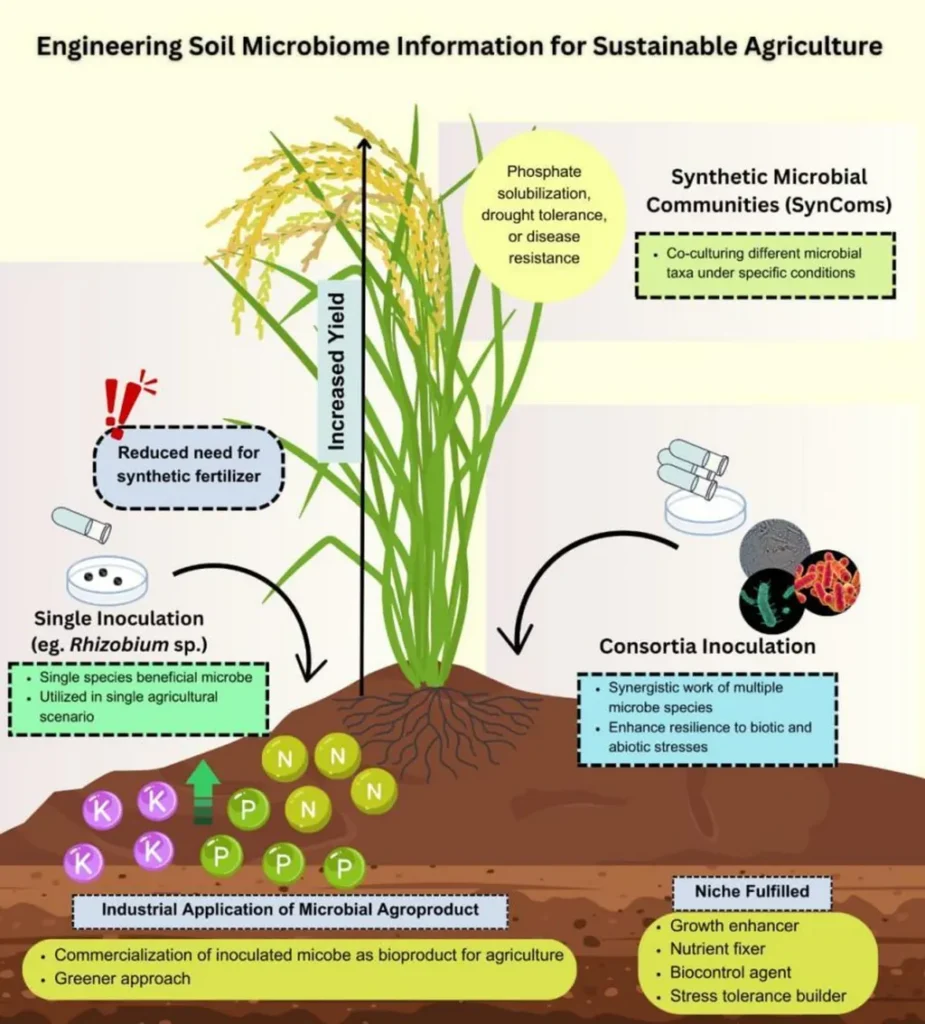
In the heart of every rice seed lies an unseen world of microorganisms, quietly influencing the plant’s growth and resilience. A recent study published in *Frontiers in Plant Science* has shed light on these tiny allies, revealing their potential to revolutionize sustainable agriculture. Led by Ruimin Lao from the Medical School at Kunming University of Science and Technology, the research delves into the diverse communities of seed endophytic bacteria in rice varieties, offering promising insights for enhancing nitrogen use efficiency (NUE).
Nitrogen is a critical nutrient for crop growth, but its excessive use in agriculture has led to environmental concerns. Improving NUE is therefore a top priority for sustainable farming. The study employed both culture-independent and culture-dependent approaches to analyze the community composition and functional traits of seed endophytic bacteria in four rice varieties with contrasting NUE.
The results were intriguing. While the Shannon indices, which measure community diversity, ranged from 2.95 to 3.23 across the varieties, significant compositional differences were observed. Rare taxa, accounting for over 51% of operational taxonomic units (OTUs) in each variety, were found to be the primary drivers of community diversity and differentiation. In contrast, core taxa, which were highly conserved across varieties, contributed to community stability.
“These core taxa are like the backbone of the microbial community,” explained Lao. “They are abundant and occupy central positions in co-occurrence networks, ensuring the community’s stability.”
The study also identified five representative strains that exhibited diverse plant growth-promoting (PGP) traits, including siderophore production, phosphate solubilization, and indole-3-acetic acid (IAA) synthesis. These functions were partially redundant, but individual strains exhibited distinct strengths, indicating functional complementarity.
Inoculation experiments demonstrated that all strains improved rice growth, nitrogen accumulation, and NUE, with their effectiveness modulated by both strain identity and nitrogen availability. This suggests that these endophytes could be harnessed to develop next-generation biofertilizers, reducing the need for chemical fertilizers and promoting sustainable agriculture.
The commercial implications of this research are substantial. With the global biofertilizer market projected to reach $4.4 billion by 2026, the development of effective biofertilizers based on seed endophytes could significantly impact the agriculture sector. Farmers could benefit from improved crop yields and reduced input costs, while the environment would benefit from reduced nitrogen pollution.
This study not only reveals the potential of rice seed endophytic bacteria as “natural microbial allies” but also paves the way for future research into the role of these microorganisms in plant growth and adaptation. As Lao put it, “Understanding these microbial communities is the first step towards harnessing their potential for sustainable agriculture.”
The findings could shape future developments in the field, driving the creation of innovative biofertilizers and contributing to a more sustainable and productive agriculture sector. The study, published in *Frontiers in Plant Science*, marks a significant step forward in our understanding of these tiny, yet powerful, allies in the heart of every rice seed.