
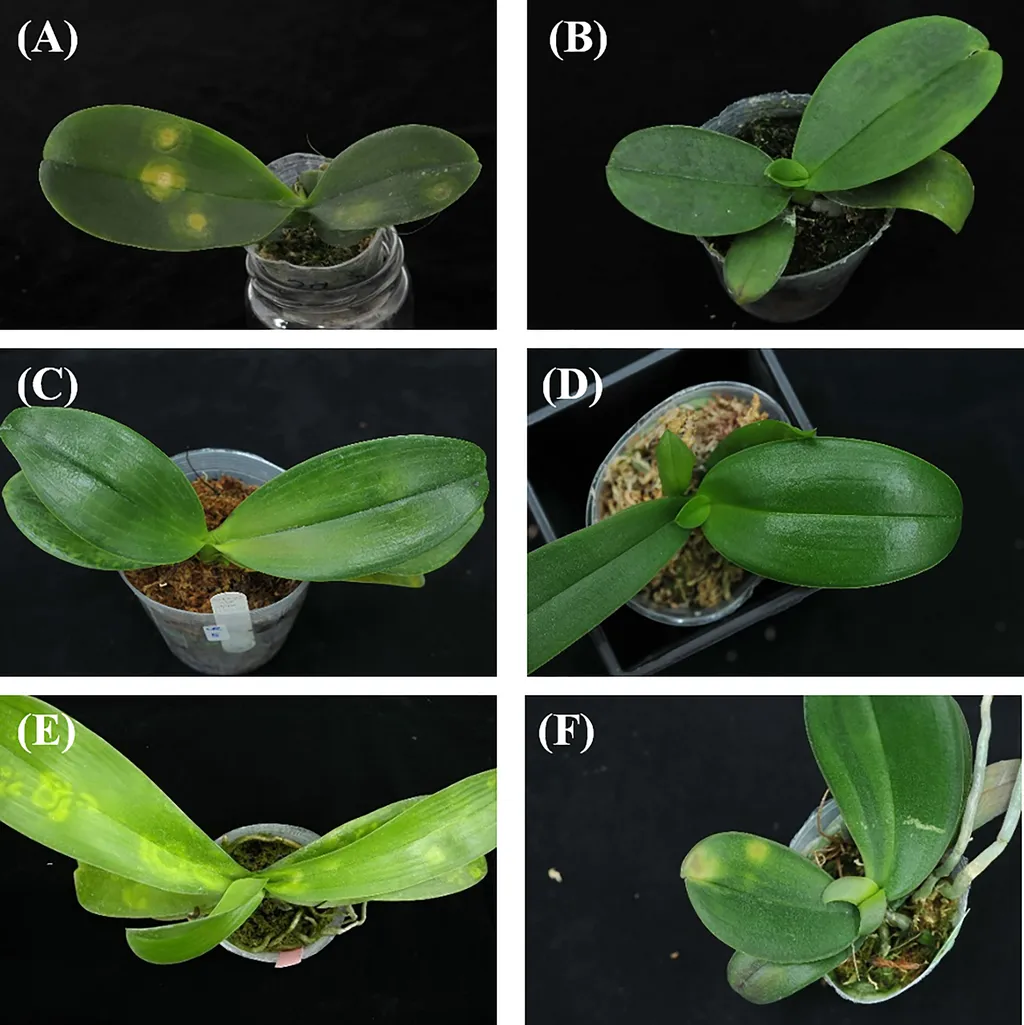
In the world of precision agriculture, early detection of plant diseases is crucial for minimizing economic losses and ensuring sustainable crop production. A recent study published in the *IEEE Journal of Selected Topics in Applied Earth Observations and Remote Sensing* introduces a groundbreaking approach to detecting Fusarium wilt in Phalaenopsis orchids using hyperspectral imaging and a novel deep learning architecture. The research, led by Ling-Wei Wu from the Department of Electrical Engineering at National Chung Hsing University in Taiwan, presents EE-CSPNet, a lightweight deep learning model designed to revolutionize disease detection in the agricultural sector.
Fusarium wilt is a highly contagious disease that poses a significant threat to Phalaenopsis orchid cultivation, leading to substantial economic losses. Traditional methods of disease detection often involve manual inspection and laboratory analysis, which can be time-consuming and destructive. The EE-CSPNet model addresses these challenges by enabling end-to-end learning of full-band spectral features directly from pixel-level hyperspectral data, eliminating the need for manual preprocessing.
The model integrates blueprint separable convolutions and cross-stage partial fusion to enhance gradient flow and parameter efficiency. A novel entropy-enhanced attention module, composed of spectral feature attention and spectral-pooling attention, emphasizes spatial-spectral features with high information uncertainty. “This approach allows us to capture the most relevant spectral information, improving the accuracy and efficiency of disease detection,” explains Ling-Wei Wu.
Experimental results demonstrate that EE-CSPNet achieves an impressive 98.12% accuracy on VNIR (Visible and Near-Infrared) and 97.64% on SWIR (Shortwave Infrared) datasets. Compared to a conventional Darknet-53 baseline, the model reduces the parameter count by 97% and achieves a 4–15% improvement in recall over conventional attention modules. This makes EE-CSPNet more suitable for real-time deployment, offering a compact, accurate, and nondestructive solution for early-stage disease detection.
The commercial implications of this research are substantial. Early detection of Fusarium wilt can prevent the spread of the disease, reducing crop losses and increasing profitability for orchid growers. The model’s efficiency and accuracy make it a valuable tool for precision agriculture, where timely and accurate disease detection is crucial for maintaining crop health and yield.
The research highlights the potential of hyperspectral imaging and deep learning in transforming agricultural practices. As Ling-Wei Wu notes, “The integration of advanced technologies like EE-CSPNet can significantly enhance our ability to monitor and manage plant health, paving the way for more sustainable and efficient agricultural systems.”
Looking ahead, the success of EE-CSPNet opens up new avenues for research and development in the field of precision agriculture. The model’s lightweight architecture and high accuracy make it a promising candidate for deployment in various agricultural applications, from disease detection to crop monitoring. As the technology continues to evolve, it is likely to play a pivotal role in shaping the future of agriculture, ensuring food security and sustainability for generations to come.
The study, published in the *IEEE Journal of Selected Topics in Applied Earth Observations and Remote Sensing*, represents a significant step forward in the fight against plant diseases. With its innovative approach and impressive results, EE-CSPNet is poised to make a lasting impact on the agricultural sector, offering a powerful tool for growers and researchers alike.