
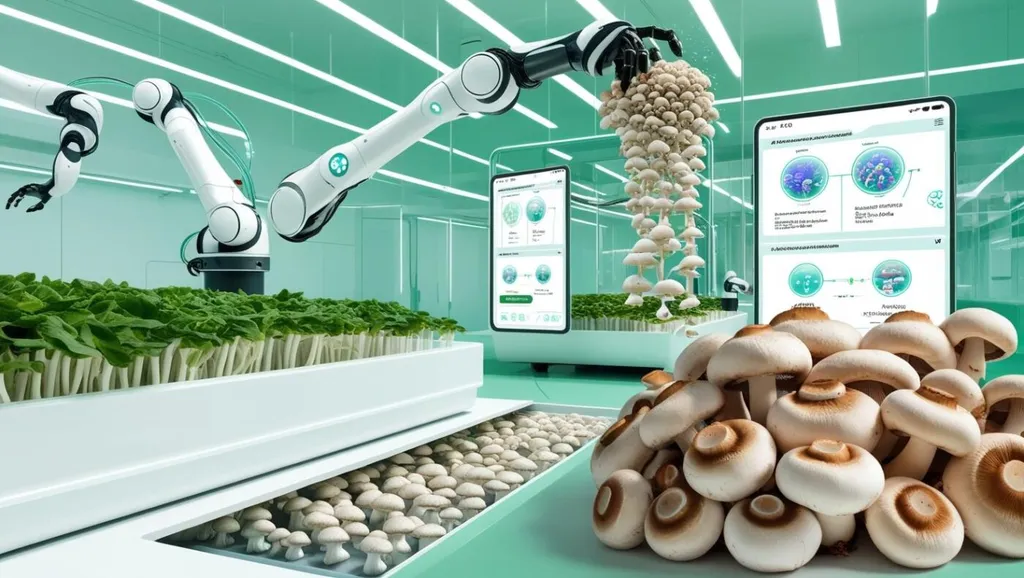
In the rapidly evolving world of smart agriculture, a groundbreaking study published in *Smart Agricultural Technology* is set to revolutionize mushroom cultivation. Researchers have developed a lightweight, yet powerful, framework that not only detects the growth stages of oyster mushrooms but also predicts their full-maturity time with remarkable accuracy. This innovation, led by Wanpeng Fan from the Department of Mechanical Engineering at Monash University Malaysia, promises to optimize yield, improve labor efficiency, and streamline harvest scheduling.
The study addresses a critical gap in existing vision-based methods, which primarily focus on stage classification without considering temporal prediction. “Our goal was to create a comprehensive solution that integrates both detection and prediction, providing a closed-loop pipeline for smart mushroom cultivation,” explains Fan. The proposed framework, dubbed YOLO-Pulmonarius (YOLO-P), combines a Swin Transformer v2 module with the YOLOv12 detector to enhance feature modeling and robustness against common challenges like glare, occlusion, and overlapping fruiting bodies.
One of the standout features of this research is its ability to predict full-maturity time using logistic curve fitting coupled with recursive Gaussian fusion. This approach incorporates area normalization and dynamic priors for adaptive temporal modeling, ensuring high accuracy in predictions. The framework was trained on a substantial dataset of 3,867 annotated images across three growth stages of grey oyster mushrooms, demonstrating an impressive average mean average precision (mAP@50) of 97.2%.
The commercial implications of this research are substantial. Accurate growth stage detection and maturity prediction can significantly enhance labor efficiency by automating the monitoring process. This means farmers can allocate resources more effectively, reducing the need for constant manual checks and ensuring that mushrooms are harvested at their peak, maximizing yield and quality.
Moreover, the lightweight architecture of the YOLO-P framework allows for deployment on edge devices, making it a practical solution for real-time monitoring in smart cultivation environments. “This technology has the potential to transform the agriculture sector by providing a scalable and efficient tool for mushroom farmers,” says Fan. “It’s not just about improving yield; it’s about creating a more sustainable and efficient farming practice.”
The study’s findings also highlight the importance of adaptive temporal modeling in agricultural technologies. By understanding the growth patterns and inflection points of mushrooms, farmers can make data-driven decisions that optimize their operations. The mean absolute error of 0.42 days and a Pearson correlation of 0.86 achieved by the YOLO-P framework underscore its reliability and accuracy, outperforming ablation variants without area normalization and dynamic priors.
As the agriculture sector continues to embrace smart technologies, research like this paves the way for more innovative solutions. The integration of deep learning and vision-based models in mushroom cultivation is just the beginning. Future developments may see similar frameworks applied to other crops, further enhancing the efficiency and sustainability of agricultural practices.
In conclusion, the research led by Wanpeng Fan from Monash University Malaysia represents a significant leap forward in smart agriculture. By combining advanced detection and prediction capabilities, the YOLO-P framework offers a practical and scalable solution for mushroom farmers. Its potential to optimize yield, improve labor efficiency, and streamline harvest scheduling makes it a valuable tool in the quest for more sustainable and efficient farming practices. As the agriculture sector continues to evolve, such innovations will play a crucial role in shaping the future of smart cultivation.