
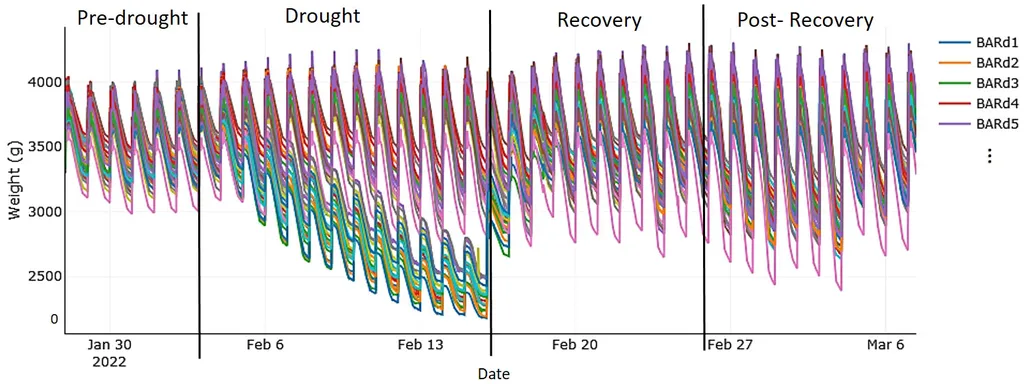
In the face of escalating climate change, farmers are grappling with increasingly frequent and severe droughts. A recent study published in *Frontiers in Plant Science* offers a nuanced look at how barley, a staple crop worldwide, responds to varying levels of drought priming, providing insights that could revolutionize agricultural practices.
The research, led by Zohreh Salehi Soghadi from the Department of Agricultural Sciences at BOKU University in Austria, delves into the complex adaptations of spring barley to recurrent drought-rehydration cycles during its vegetative stages. Unlike previous studies that focused on single drought events, this work explores the plant’s resilience to intermittent and persistent drought conditions.
The study subjected barley plants to five different watering regimes in a glasshouse setting, ranging from full irrigation to severe drought conditions. The findings revealed that persistent drought consistently reduced water-use efficiency across all growth stages. However, intermittent drought showed a more nuanced impact, enhancing water-use efficiency during the tillering stage, a critical phase for plant development.
“Stomatal conductance was particularly telling,” explains Salehi Soghadi. “Plants under persistent drought showed the lowest conductance, indicating severe transpiration limitation. Interestingly, intermittent drought maintained higher conductance during the seedling and tillering stages, suggesting a more adaptive response.”
The study also highlighted a dynamic recovery response under intermittent drought, contrasting with a conservative, high-cost strategy under persistent drought. This suggests that applying more severe cyclic drought early in the plant’s life cycle, followed by milder stress later, could optimize stomatal function and productivity.
For the agriculture sector, these findings could be a game-changer. As water scarcity becomes an increasingly pressing issue, understanding how to optimize water use in crops is crucial. The insights from this research could inform new irrigation strategies that enhance crop resilience and productivity under water-limited conditions.
“Our findings suggest that a strategic approach to water management, tailored to the plant’s developmental stages, could significantly improve resource-use efficiency,” says Salehi Soghadi. This could translate to higher yields and more sustainable farming practices, even in the face of drought.
The research also opens up new avenues for further exploration. Future studies could delve deeper into the biochemical mechanisms underlying these adaptive responses, potentially leading to the development of drought-resistant crop varieties.
In an era where climate change is reshaping agricultural landscapes, this study offers a beacon of hope. By understanding and leveraging the natural adaptive strategies of crops like barley, farmers and agronomists can better navigate the challenges posed by water scarcity. The findings from this research could pave the way for more resilient and sustainable agricultural practices, ensuring food security in an increasingly uncertain climate.