
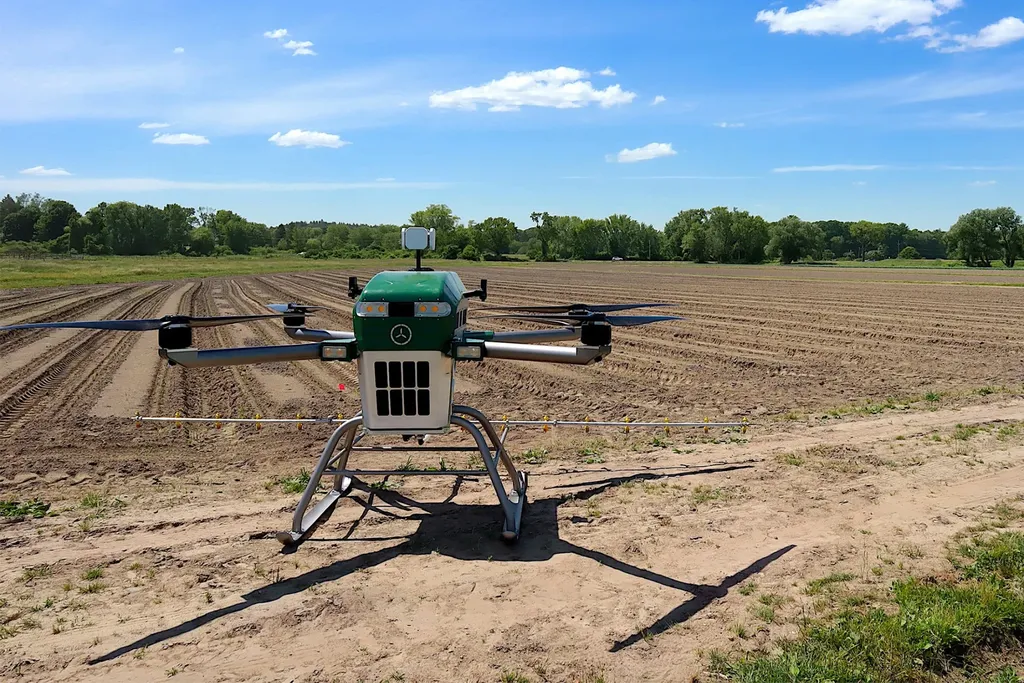
Drones are rapidly becoming an indispensable tool for growers, revolutionizing tasks such as seeding cover crops, crop scouting, and monitoring livestock. However, one of the most promising applications is in the precise delivery of crop protection products, including fungicides. As technology and reliability improve, researchers at Beck’s Hybrids have been investigating whether drones can match the effectiveness of traditional methods like ground rigs, helicopters, or planes.
Over the past two years, Beck’s Hybrids has conducted extensive trials and found that drones perform just as well, if not better, than ground rigs. This has sparked considerable interest among growers, who are now considering the logistical aspects of drone usage, such as optimal spraying times, battery management, and maintenance. Despite these considerations, drones are undoubtedly expanding the agricultural toolkit.
Luke Schulte, a field agronomist for Beck’s in Ohio, shared his enthusiasm: “If someone says to me, ‘I need to spray and I have a choice between the drone, plane, and a ground rig.’ I’m going to say, ‘They all work. Go for it.’ I’m not ready to tell anybody to buy a drone yet, but I’m surprised, shocked, and pleasantly happy that drones work just as well.”
The trials conducted by Beck’s in Indiana, central Illinois, and Ohio revealed some surprising results. In 2025, researchers experienced heavy disease pressure, which initially raised concerns about the drones’ performance. Control plots without fungicide yielded 227 bushels per acre. Corn treated with a ground rig applying fungicides at 10-20 gallons per acre yielded 235 bushels, while drone-applied fungicides at 2-3 gallons per acre produced 237 bushels. With corn prices at $4.42 per bushel and fungicide costs around $26 per acre, the effectiveness of drones became evident.
Further trials demonstrated that drone applications could yield higher returns. In one instance, drone-applied fungicides produced 248 bushels per acre, surpassing the 247 bushels achieved by ground rigs and 246 bushels by planes. The return on investment (ROI) for drones was $13.17 compared to $8.44 for ground rigs and $3.13 for planes. The superior performance of drones was attributed to canopy disturbance, which helps move droplets deeper into the plant canopy.
Beck’s also compared drone performance against helicopters in a three-year multi-location study. All three methods—drones, helicopters, and ground rigs—produced approximately 259 bushels per acre, with drones showing a slightly higher ROI of $16.53 compared to $8.48 for helicopters and $14.10 for ground rigs.
For soybeans, researchers examined the efficacy of ground rigs versus drones and the impact of chemical pH on application performance. In a three-year study with mostly light disease pressure, soybeans treated with no fungicide yielded 81 bushels per acre. Ground rig applications at 20 gallons per acre yielded 83 bushels, while drone applications at 2 gallons per acre produced nearly the same yield. The addition of a pH buffer, Alpha Shot, to lower the pH to 5.2, did not significantly affect yield but reduced the already negative ROI further. Overall, drone applications provided a $12.26 advantage per acre compared to a $1.88 loss for ground rigs.
A key difference in drone applications is the use of atomizers, which produce smaller, more uniform droplet sizes. This technology is particularly suited for low-volume applications. In a study comparing atomizers to nozzles, atomizers showed a slight advantage, with a 21 to 24 bushel-per-acre increase over control strips with no fungicides. The ROI for atomizers was $100 per acre compared to $89 for nozzles.
Researchers also found that using Beck’s Green Lightning nitrogen solution as a fungicide carrier improved application effectiveness, particularly with drones. In fields with varying disease pressure, the ROI for Green Lightning as a carrier was higher than water, demonstrating the importance of carrier choice in fungicide applications.
In summary, the research conducted by Beck’s Hybrids highlights the potential of drones in modern agriculture. Drones offer a viable and effective alternative to traditional application methods, with the added benefits of precision and reduced water usage. As technology continues to advance, drones are poised to become a standard tool in the agricultural arsenal, providing growers with more options to enhance crop protection and yield.