
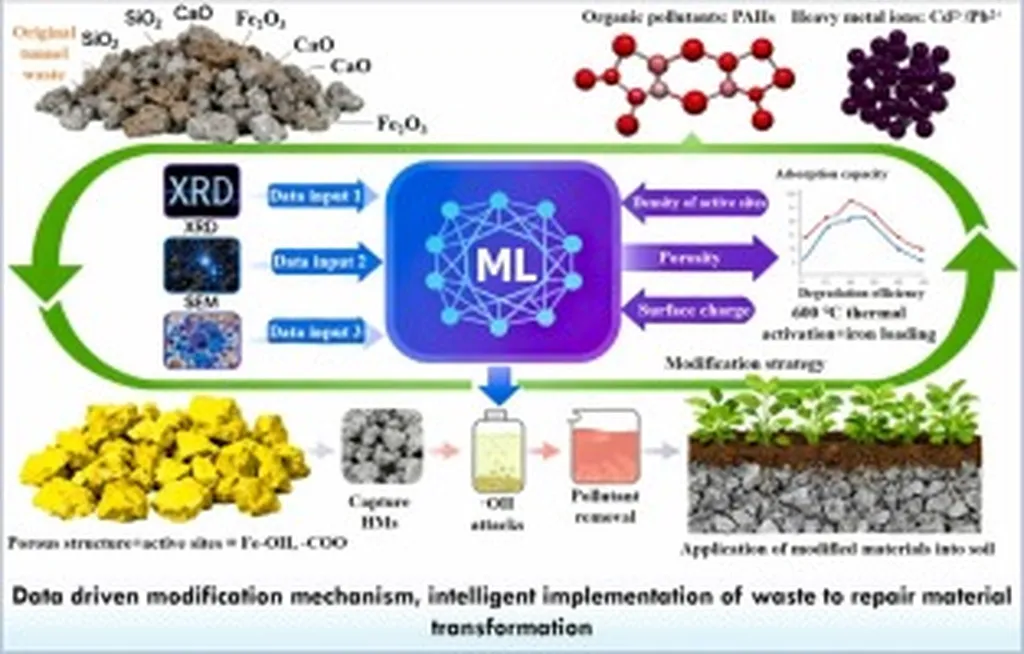
In the quest for sustainable agriculture, researchers are turning to innovative technologies to transform agricultural waste into valuable resources while minimizing environmental impact. A recent study published in *Industrial Crops and Products* introduces a groundbreaking approach that combines machine learning (ML) with life cycle assessment (LCA) to optimize hydrothermal carbonization (HTC) of agro-waste. This method not only enhances soil remediation but also paves the way for more sustainable and profitable agricultural practices.
Hydrothermal carbonization is a process that converts organic waste into a carbon-rich material called hydrochar, which can improve soil quality. However, traditional LCA methods often struggle to account for the complex interactions between various factors, such as feedstock variability, process parameters, and environmental impacts. This is where machine learning comes into play.
The study, led by Liang Pei of the Xinjiang Key Laboratory of Environmental Pollution and Bioremediation at the Chinese Academy of Sciences, proposes an ML-enhanced LCA framework. This framework dynamically models the nonlinear relationships in HTC systems, allowing for the optimization of process conditions to minimize environmental burdens while maximizing the benefits of hydrochar.
“By integrating machine learning algorithms like random forest and neural networks, we can better understand and predict the environmental impacts of HTC,” Pei explains. “This approach enables us to make data-driven decisions that enhance the sustainability of agricultural practices.”
The research highlights the critical role of renewable energy integration and process water management in achieving a net-negative carbon footprint. This is a significant advancement for the agriculture sector, as it offers a way to turn waste into a valuable resource while reducing environmental impact.
The commercial implications of this research are substantial. Farmers and agricultural businesses can adopt HTC technologies to manage waste more effectively, reduce costs, and even generate additional revenue streams from the sale of hydrochar. Moreover, the use of machine learning in LCA provides a powerful tool for continuous improvement, allowing businesses to stay ahead of regulatory changes and consumer demands for sustainability.
As the agriculture sector faces increasing pressure to adopt sustainable practices, this research offers a promising solution. By bridging computational innovation with sustainable practices, the ML-HTC-LCA framework enables data-driven decision-making for climate-smart agriculture.
Looking ahead, the study suggests that future research should focus on long-term hydrochar stability and the development of scalable ML-LCA tools. These advancements will be crucial in ensuring the robust environmental validation of HTC technologies.
In the words of Pei, “This research is just the beginning. As we continue to refine our models and gather more data, we can unlock even greater potential for sustainable agriculture.”
With its potential to revolutionize waste management and soil remediation, this research is a significant step forward in the pursuit of sustainable agriculture. As the agriculture sector continues to evolve, the integration of machine learning and LCA in HTC processes will undoubtedly play a pivotal role in shaping the future of the industry.