
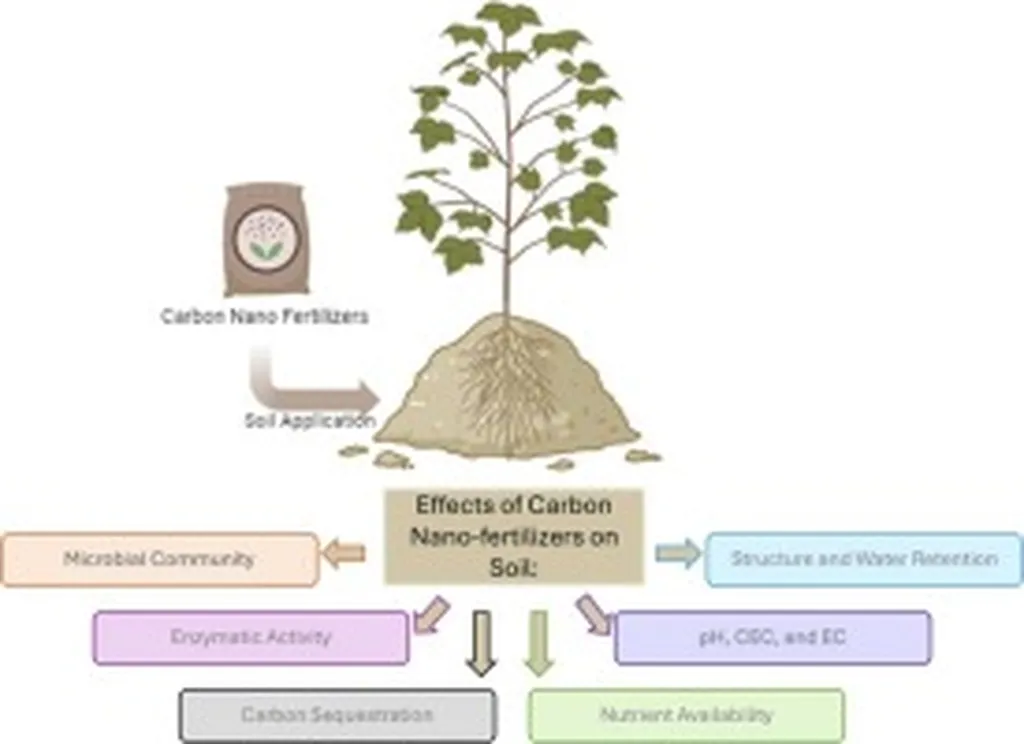
In the quest to mitigate the environmental impact of conventional fertilizers, a groundbreaking study published in *Industrial Crops and Products* offers a glimmer of hope. Researchers led by Zhenhui Jiang from the State Key Laboratory for Development and Utilization of Forest Food Resources at Zhejiang A&F University have developed a novel fertilizer that not only enhances crop productivity but also promotes soil carbon stability. This innovation could revolutionize the agriculture sector, particularly in phosphorus-limited subtropical regions.
The study focuses on a nano-zeolite-coupled biochar-based phosphate fertilizer (NanoBP), which has shown promising results in reducing soil CO2 emissions compared to conventional phosphate (CP) and biochar-based phosphate (BP) fertilizers. Over a 56-day incubation period, the researchers observed that NanoBP reversed the positive priming effect of soil organic carbon (SOC) mineralization to a negative one, despite increasing microbial biomass carbon. This is a significant finding, as it suggests that NanoBP can help conserve soil carbon while still providing essential nutrients for plant growth.
“Our findings highlight that NanoBP offers a promising pathway to achieve nutrient–carbon co-optimization in phosphorus-limited subtropical soils,” said lead author Zhenhui Jiang. This co-optimization is crucial for sustainable agriculture, as it addresses both the need for increased crop productivity and the urgent demand for reduced greenhouse gas emissions.
The study revealed that NanoBP reduced hydrolase activities and down-regulated the expression of SOC-degrading genes, which are typically responsible for breaking down soil organic matter and releasing CO2. Instead, NanoBP enhanced oxidative metabolism and selectively preserved the aromatic carbon fraction, which is more stable and less likely to be decomposed. This selective preservation is driven by the slow release of phosphorus from NanoBP, pH buffering, and improved microhabitat conditions, which collectively alleviate microbial nutrient stress and reduce SOC mineralization.
Moreover, NanoBP shifted microbial communities toward carbon-conserving taxa, further promoting soil carbon stability. This shift is a testament to the fertilizer’s ability to create a more favorable environment for beneficial microbes that contribute to long-term soil health.
The commercial implications of this research are substantial. As the agriculture sector grapples with the dual challenges of feeding a growing population and mitigating climate change, innovative solutions like NanoBP offer a viable path forward. By reducing CO2 emissions and enhancing soil carbon stability, NanoBP can help farmers meet productivity goals while also contributing to global efforts to combat climate change.
The study’s findings suggest that NanoBP could be particularly beneficial in subtropical bamboo plantations, where phosphorus is often a limiting nutrient. However, the principles underlying NanoBP’s effectiveness could be applied to a wide range of agricultural systems, making it a versatile tool for sustainable farming practices.
As the agriculture sector continues to evolve, the development of climate-smart fertilizers like NanoBP will play a pivotal role in shaping the future of farming. By prioritizing both nutrient delivery and carbon conservation, these innovations offer a holistic approach to agriculture that benefits both farmers and the environment.
In the words of Zhenhui Jiang, “Our findings highlight that NanoBP offers a promising pathway to achieve nutrient–carbon co-optimization in phosphorus-limited subtropical soils.” This research not only advances our understanding of soil carbon dynamics but also paves the way for more sustainable and productive agricultural practices. As the world looks to the future of farming, innovations like NanoBP will be at the forefront of the green revolution.