
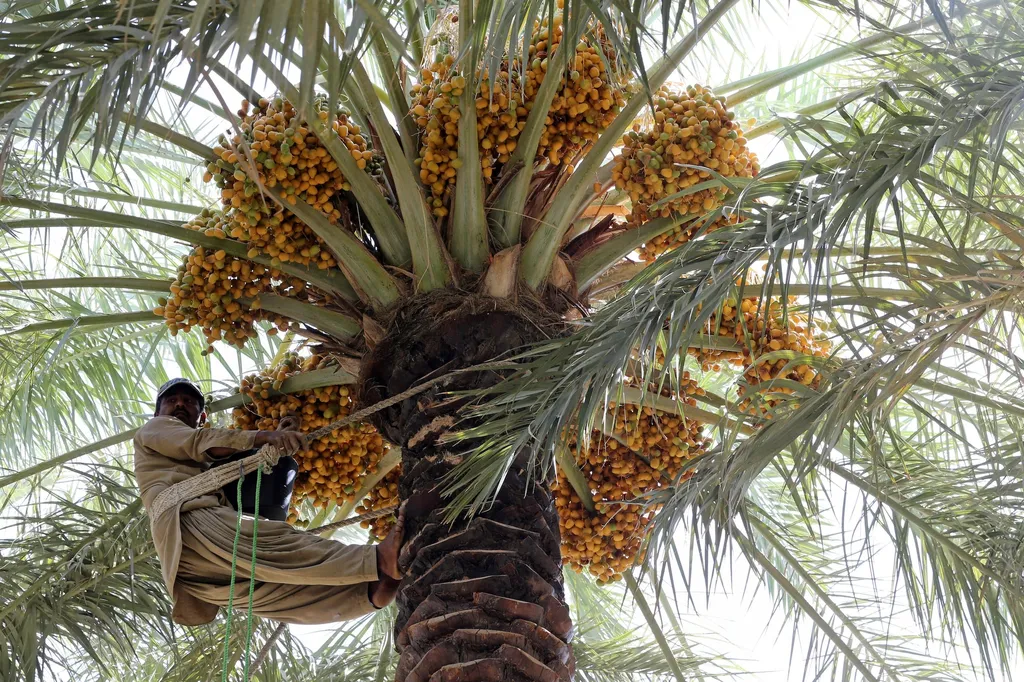
In the ever-evolving landscape of precision agriculture, a groundbreaking development has emerged that promises to revolutionize pest detection in date palm cultivation. Researchers have introduced PalmNeXt, a deep learning model designed to identify pests on date palm leaves with remarkable accuracy. This innovation, detailed in a study published in *Frontiers in Plant Science*, could significantly enhance crop monitoring and pest management, offering substantial benefits to the agriculture sector.
The model, developed by Mahmood Ashraf from the Department of Computer Science and Artificial Intelligence at the University of Jeddah, leverages the ConvNeXt-Tiny architecture, a lightweight and efficient neural network. What sets PalmNeXt apart is its tailored preprocessing pipeline, which enhances feature quality and overall performance. This is crucial for addressing the challenges posed by small and variable datasets, a common issue in agricultural applications.
“Our goal was to create a model that is not only accurate but also scalable and computationally efficient,” Ashraf explained. “By incorporating a specialized preprocessing pipeline, we were able to significantly improve the model’s performance, making it a viable solution for real-world applications in precision agriculture.”
The study evaluated PalmNeXt on a dataset of 3,000 RGB images of date palm leaves, categorized into four classes: Bug, Dubas, Healthy, and Honey. The model’s performance was benchmarked against custom baselines like CNN-Attention and ResNet13-Attention, as well as state-of-the-art models such as ViT and ECA-Net. The results were impressive, with PalmNeXt achieving the highest accuracy, precision, recall, and F1-score across all metrics.
“This research demonstrates the potential of deep learning models in transforming pest detection and management in agriculture,” Ashraf noted. “By providing timely and accurate pest detection, farmers can make informed decisions, leading to better crop yields and reduced environmental impact.”
The commercial implications of this research are substantial. Automated pest detection can streamline crop monitoring, reducing the need for manual inspections and minimizing the use of pesticides. This not only cuts costs but also promotes sustainable farming practices. As the agriculture sector continues to embrace technology, models like PalmNeXt could become integral tools in the fight against crop pests, ensuring food security and economic stability.
Looking ahead, the success of PalmNeXt paves the way for further advancements in agricultural technology. Future research could explore the application of similar models to other crops, expanding the scope of automated pest detection and management. Additionally, integrating these models with other precision agriculture technologies, such as drones and IoT sensors, could create a comprehensive system for monitoring and managing crop health.
In conclusion, the introduction of PalmNeXt represents a significant step forward in the field of precision agriculture. By combining advanced deep learning techniques with tailored preprocessing, this model offers a powerful solution for pest detection in date palm cultivation. As the agriculture sector continues to evolve, innovations like PalmNeXt will play a crucial role in shaping the future of sustainable and efficient farming practices.