
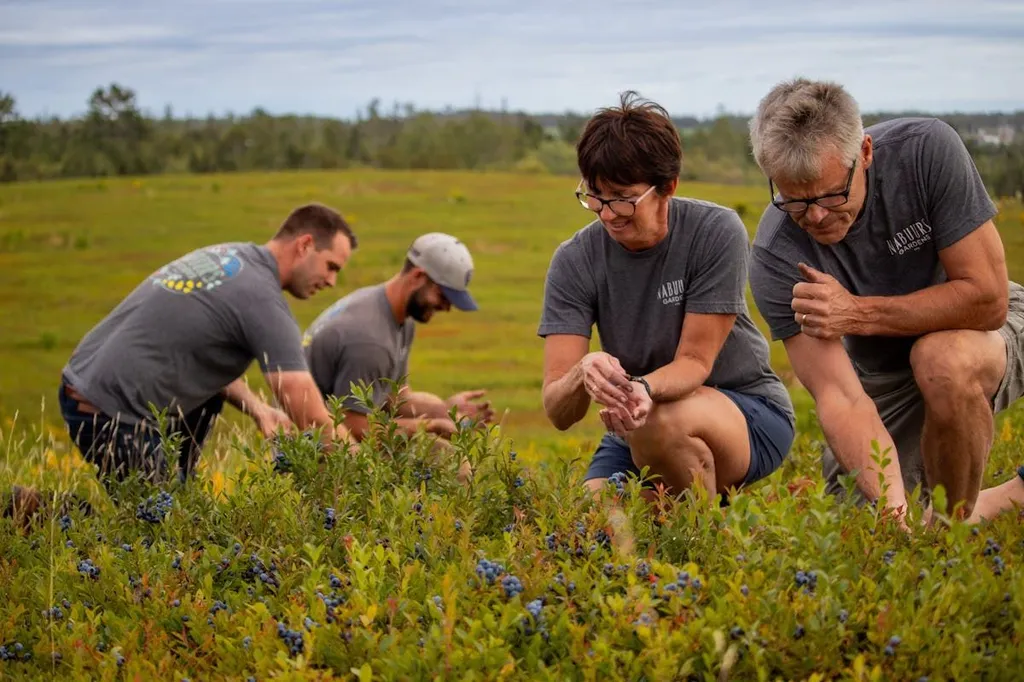
In the rolling landscapes of wild lowbush blueberry fields, farmers face a unique challenge: the terrain and soil conditions vary greatly, creating a patchwork of growing conditions that can make fertilization a guessing game. But a recent study published in the *International Journal of Fruit Science* offers a promising approach to this age-old problem, using precision agriculture to tailor nitrogen fertilization to specific areas within a field.
The research, led by Jean Lafond from Agriculture and Agri-Food Canada’s Research Farm in Normandin, Quebec, focused on wild lowbush blueberry (Vaccinium angustifolium Ait.) production. These crops thrive on sandy, acidic, and nutrient-poor soils, making efficient fertilization crucial for yield and profitability. Lafond and his team used topographic data and soil apparent electrical conductivity (ECa) measurements to create management zones within two fields—one undulated and one flat.
“By dividing the fields into management zones based on elevation and soil ECa, we could target nitrogen fertilization more precisely,” Lafond explained. The team applied four rates of ammonium sulfate (ranging from 0 to 90 kg N ha−1) in the sprout year and measured fruit yield in the production year. The results were striking: fruit yields increased by 72% in the undulated field and 54% in the flat field with nitrogen fertilization.
The study revealed that the greatest response to nitrogen fertilizer occurred in management zones with high elevation, regardless of the field. However, the specific conditions that yielded the best results varied between the two fields. In the undulated field, the best response was seen in areas with low ECa and high elevation, while in the flat field, the optimal conditions were high ECa and high elevation.
“This research highlights the importance of site-specific management in agriculture,” Lafond noted. “By understanding the unique conditions of each part of a field, farmers can apply fertilizers more efficiently, reducing costs and environmental impact while increasing yields.”
The commercial implications of this research are significant. Precision agriculture technologies, such as the Veris 3100 used in this study, can help farmers create detailed maps of their fields, allowing for targeted fertilization and other management practices. This approach not only improves yield but also promotes sustainable farming by reducing the overuse of fertilizers.
As the agriculture sector continues to evolve, the integration of precision technologies and data-driven decision-making will likely become standard practice. Lafond’s research paves the way for more efficient and sustainable wild lowbush blueberry production, offering a blueprint for other crops and regions.
“Our findings suggest that by leveraging topographic and soil ECa data, farmers can optimize their fertilization strategies, leading to better yields and more profitable operations,” Lafond concluded. This study not only advances our understanding of precision agriculture but also underscores its potential to transform the way we grow crops.