
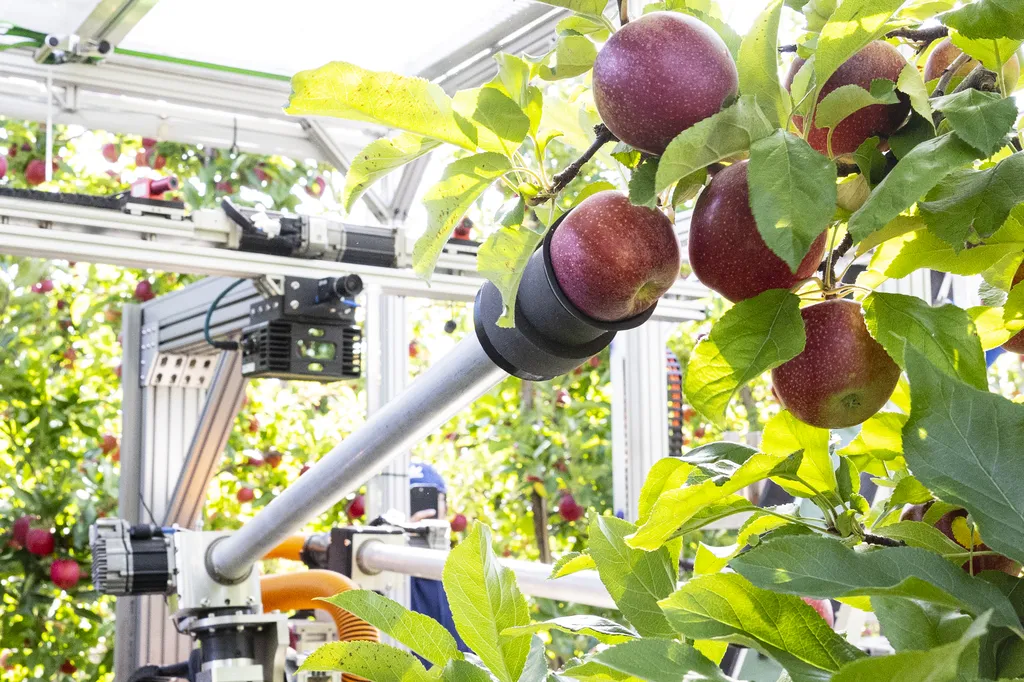
In the ever-evolving landscape of precision agriculture, a groundbreaking study published in *Measurement: Sensors* is set to revolutionize the way we approach orchard harvesting. The research, led by Changdong Yin from the School of Electrical and Automation at Wuhu Institute of Technology, introduces a collaborative framework that promises to enhance the reliability and efficiency of apple recognition systems in robotic harvesting.
The study addresses a critical challenge in agricultural automation: achieving robust fruit detection under complex orchard conditions. Variable illumination, occlusions, and phenotypic diversity have long posed significant hurdles for visual recognition systems. Yin and his team propose a solution that integrates adaptive image processing with heterogeneous model inference, ensuring high accuracy and real-time performance.
The methodology is both innovative and practical. It begins with a conversion to Lab color space to ensure illumination invariance, followed by dual-threshold HSV segmentation to handle both red and green apples. Morphological optimization with elliptical structuring elements addresses occlusion issues effectively. The novel architecture allocates real-time screening to an embedded Random Forest (RF) classifier and precise localization to a host-based lightweight YOLOv5 model through fused color-morphological features.
The results are impressive. The models with dual-feature input achieve optimal performance, with the RF classifier attaining an accuracy of 83.35% and the lightweight YOLOv5 reaching 98.90%. Quantitative analysis reveals that dual-feature fusion improves all metrics by over 3% compared to non-enhanced baselines. “The observed accuracy improvement exceeded the sum of gains from individual features, confirming a synergistic effect and proving the necessity of feature fusion,” Yin explains.
The commercial implications for the agriculture sector are substantial. Robust and reliable apple recognition systems can significantly enhance the efficiency of orchard harvesting, reducing labor costs and improving yield quality. As precision agriculture continues to evolve, the integration of advanced machine vision and deep learning technologies will play a pivotal role in shaping the future of the industry.
This research not only provides a computationally viable solution for reliable apple recognition in unstructured environments but also sets the stage for further advancements in the field. As Yin notes, “This work provides a computationally viable solution for reliable apple recognition in unstructured environments.” The study’s findings are a testament to the potential of synergistic feature fusion in enhancing the capabilities of agricultural robots, paving the way for more efficient and sustainable farming practices.
In the broader context, this research highlights the importance of interdisciplinary collaboration in driving technological innovation. By combining expertise in machine vision, feature fusion, and deep learning, Yin and his team have developed a solution that addresses a critical need in the agriculture sector. As the industry continues to embrace automation and precision technologies, the insights gained from this study will undoubtedly shape future developments in the field.
The study, published in *Measurement: Sensors*, underscores the transformative potential of advanced technologies in agriculture. With the leadership of Changdong Yin from the School of Electrical and Automation at Wuhu Institute of Technology, this research marks a significant step forward in the quest for more efficient and reliable orchard harvesting systems. As the agriculture sector continues to evolve, the integration of cutting-edge technologies will be key to meeting the challenges of the future.