
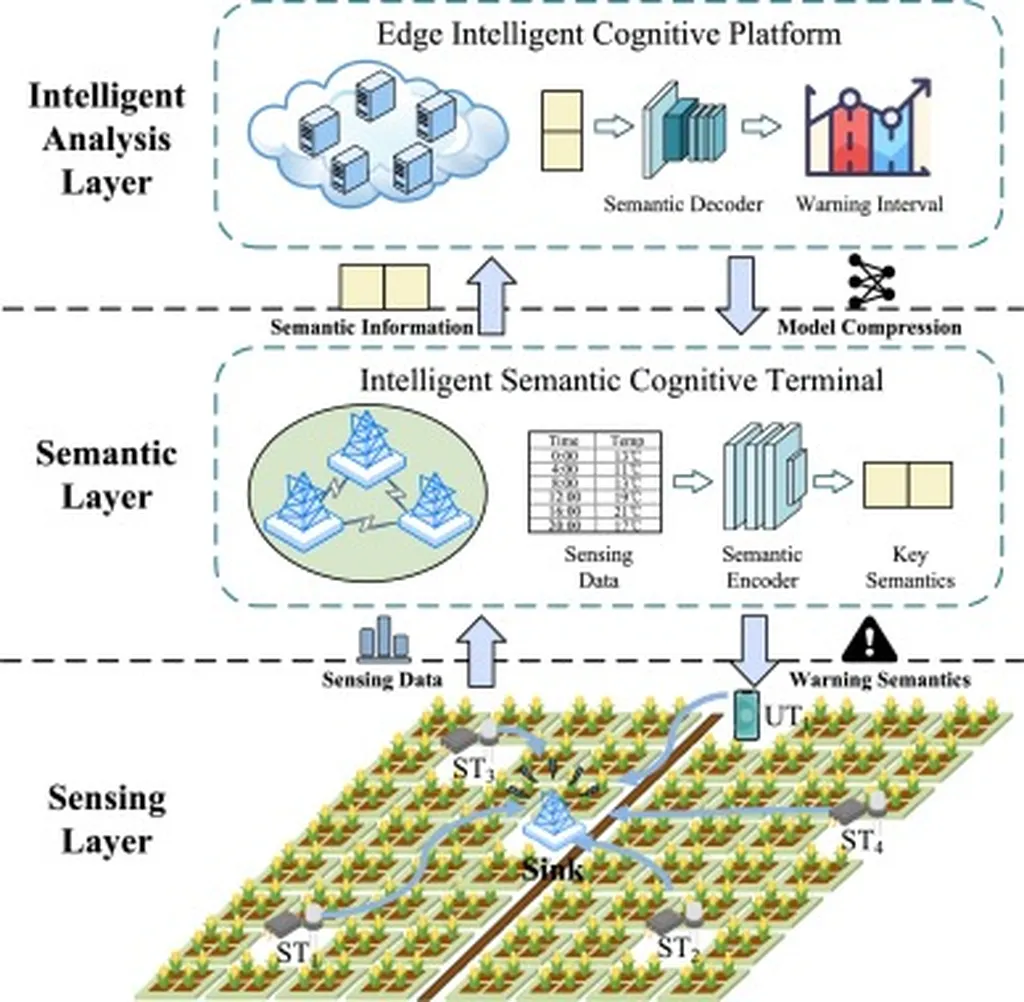
In the ever-evolving landscape of agriculture, technology continues to play a pivotal role in enhancing sustainability and productivity. A recent study published in *Digital Communications and Networks* introduces a groundbreaking framework that could revolutionize how farmers predict and manage crop temperatures, ultimately leading to more efficient and sustainable agricultural practices.
The research, led by Hao Liu from the College of Informatics at Huazhong Agricultural University in Wuhan, China, presents the Semantic Communication-enabled Cognitive Agriculture Framework (SC-CAF). This innovative approach aims to address the challenges faced by the Agricultural Internet of Things (AIoT), which, despite its effectiveness, is often hampered by high computational and communication costs.
Traditional AIoT systems rely on a vast network of sensors to collect meteorological data, which is then transmitted to cloud servers for analysis and prediction. However, this process can be resource-intensive and inefficient. The SC-CAF framework seeks to mitigate these issues by incorporating an intelligent analysis layer that performs temperature prediction and model training, along with a semantic layer that transmits only the essential semantic information extracted from raw data.
One of the key innovations within the SC-CAF is the Light Temperature Semantic Communication (LTSC) model. This model utilizes skip-attention and semantic compression techniques to avoid unnecessary computations and repetitive information, thereby reducing communication overheads. Additionally, the researchers developed a Semantic-based Model Compression (SCMC) algorithm to further alleviate computational and bandwidth burdens.
The results of the study are impressive. The SC-CAF framework achieved the lowest prediction error while significantly reducing Floating Point Operations (FLOPs) by 95.88%, memory requirements by 78.30%, Graphics Processing Unit (GPU) power by 50.77%, and time latency by 84.44%. These improvements represent a substantial leap forward in the efficiency and effectiveness of temperature prediction systems for agriculture.
“The potential impact of this research on the agriculture sector is immense,” said Hao Liu. “By reducing the computational and communication overheads, we can make temperature prediction more accessible and affordable for farmers, ultimately leading to better crop management and increased sustainability.”
The commercial implications of this research are far-reaching. Farmers can benefit from more accurate and timely temperature predictions, enabling them to make informed decisions about irrigation, fertilization, and pest control. This can lead to higher crop yields, reduced water usage, and lower operational costs. Furthermore, the reduced computational and communication requirements can make the technology more accessible to small-scale farmers and those in resource-constrained regions.
As the agriculture industry continues to embrace digital transformation, the SC-CAF framework could pave the way for more advanced and efficient AIoT systems. The research not only addresses current challenges but also sets the stage for future developments in cognitive agriculture and semantic communication.
In the words of Hao Liu, “This is just the beginning. The integration of semantic communication and cognitive agriculture has the potential to transform the way we approach farming, making it more sustainable and resilient in the face of climate change.”
With the growing demand for sustainable and efficient agricultural practices, the SC-CAF framework offers a promising solution that could shape the future of farming. As the technology continues to evolve, it will be exciting to see how it is adopted and adapted by the agriculture sector to meet the challenges of the 21st century.