
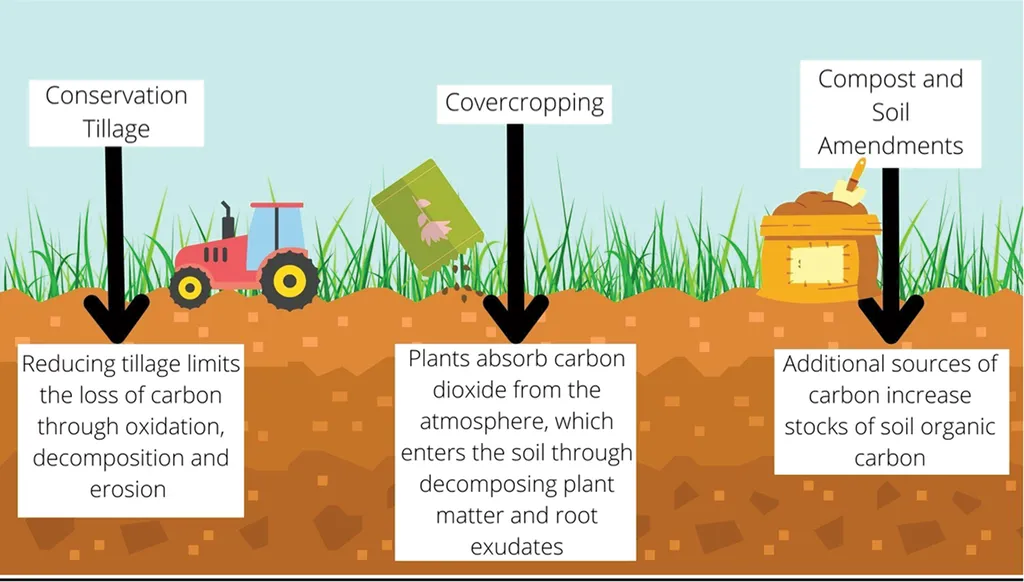
In the pursuit of sustainable agriculture, a recent study published in *Farming System* sheds light on the complex environmental trade-offs associated with carbon farming practices. Led by Stefano Spotorno of the University of Genoa and the University School for Advanced Studies IUSS Pavia, the research integrates soil organic carbon (SOC) modeling with life cycle assessment (LCA) to evaluate the broader environmental impacts of carbon farming (CF) practices.
The European Union’s commitment to reducing greenhouse gas (GHG) emissions and promoting sustainable soil management has spurred interest in CF, a set of practices aimed at sequestering carbon in soils. While these practices are known to increase SOC stocks, their broader environmental impacts have often been overlooked. Spotorno and his team sought to change that by applying the RothC model to simulate SOC dynamics under different CF practices—reduced tillage (RT), farmyard manure (FYM) application, and cover crops (CC)—on arable land in Northern Italy.
The results were revealing. FYM application emerged as the most effective method for carbon sequestration, storing an impressive 4.89 tonnes of carbon per hectare over 20 years. However, the LCA results told a more nuanced story. “While FYM maximizes carbon sequestration, it substantially increases acidification, marine eutrophication, terrestrial eutrophication, and photochemical ozone formation compared to conventional agriculture,” Spotorno explained. This finding underscores the potential trade-offs in pursuing carbon sequestration through FYM application.
In contrast, reduced tillage and cover crops offered a more balanced profile. RT and CC contributed to carbon sequestration at lower rates (1.34 and 1.73 tonnes of carbon per hectare, respectively) but demonstrated significant environmental benefits. RT, in particular, showed improvements across all acidification and eutrophication indicators, making it a more sustainable option overall.
The commercial implications for the agriculture sector are substantial. Farmers and agribusinesses must weigh the benefits of carbon sequestration against the broader environmental impacts. “This research underlines the critical need for comprehensive system assessment of agricultural sustainability,” Spotorno emphasized. “Carbon farming may place too much emphasis on carbon sequestration without fully considering other environmental impacts requiring mitigation.”
As the agriculture sector navigates the complexities of sustainable practices, this study serves as a crucial guide. It highlights the importance of a holistic approach to environmental assessment, ensuring that the pursuit of carbon sequestration does not come at the expense of other critical ecological indicators. For farmers, agribusinesses, and policymakers, the message is clear: sustainable agriculture requires a balanced and comprehensive strategy that considers the full spectrum of environmental impacts.