
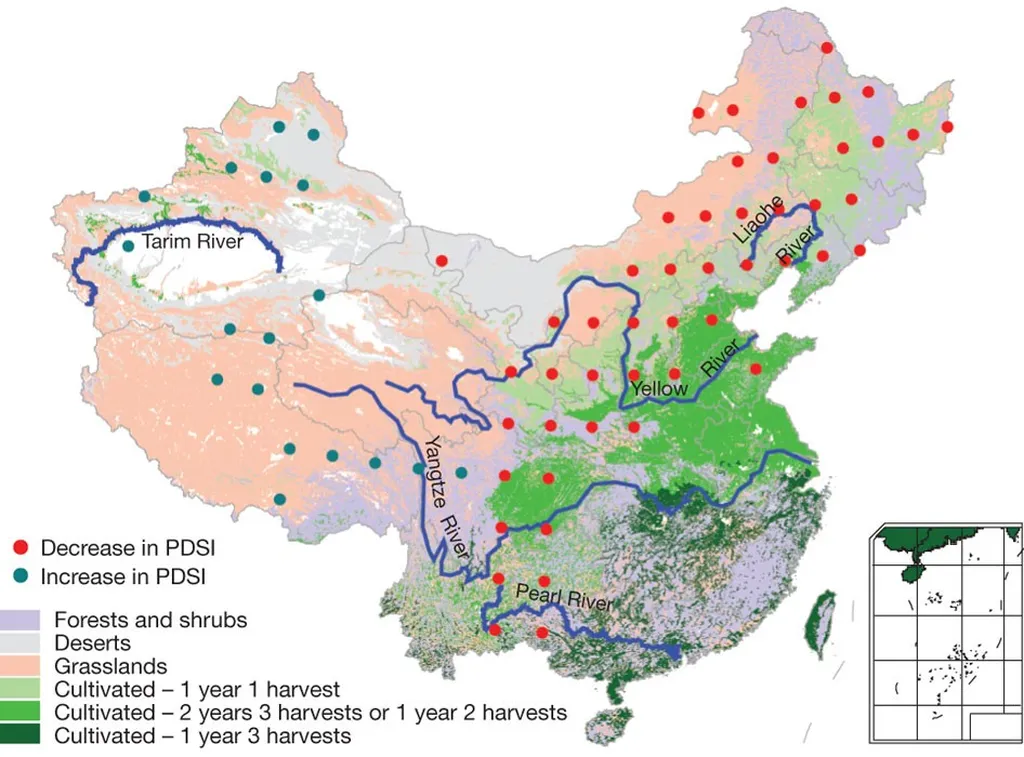
In the heart of China’s Loess Plateau, a region known for its unique ecosystem and significant agricultural output, a new study is shedding light on how water and energy dynamics influence runoff changes, with potential implications for water management and agricultural practices. The research, led by Changwu Cheng from the State Key Laboratory of Soil and Water Conservation and Desertification Control, and published in the Journal of Hydrology: Regional Studies, introduces a more appropriate framework for attributing hydrological changes in the water-energy partitioning space.
The study focuses on 15 catchments in the Chinese Loess Plateau (CLP), a region where both precipitation and potential evapotranspiration play dominant roles in catchment-scale hydrological processes. The research builds upon existing Budyko-based and orthogonality-based graphical attribution methods (BGA and OGA, respectively), which visually separate the direct effect of dryness index and the regulating effect of the land-atmosphere system.
However, the study identifies significant limitations in the OGA method, particularly in its path section and accuracy. “The orthogonality-induced linearization in OGA may fail to capture nonlinear Budyko relationships, potentially leading to violations of the water and energy boundaries,” explains Cheng. This finding is crucial as it highlights the need for more accurate methods to attribute hydrological changes, which are essential for effective water management and agricultural planning.
The research proposes a new graphical attribution method in the water-energy partitioning (WEP) space, which addresses the inconsistencies between OGA and BGA in both decomposition orders and paths. By mapping Budyko curves in the WEP space, the study elucidates the differences between the two methods and introduces the two-path BGA as a more appropriate attribution framework.
The improved method reveals that, on average, the direct effect of the dryness index and the regulating effect of the land-atmosphere system contributed 18% and 82%, respectively, to runoff change for the 15 CLP catchments. This insight is particularly relevant for the agriculture sector, as it provides a more accurate understanding of how water and energy dynamics influence runoff, which is critical for irrigation and water resource management.
The study’s findings contribute to the advancement of hydrological change attribution methods, offering a more precise tool for understanding and predicting runoff changes. This, in turn, can inform better water management practices and agricultural strategies, ultimately enhancing the sustainability and productivity of the region’s agricultural sector.
As the world grapples with the impacts of climate change and increasing water scarcity, the need for accurate and reliable hydrological models becomes ever more pressing. This research not only advances our understanding of hydrological processes but also provides practical tools for managing water resources in a changing climate. The study’s implications extend beyond the Chinese Loess Plateau, offering valuable insights for other regions facing similar challenges.
In the words of Changwu Cheng, “This study contributes to the advancement of hydrological change attribution methods, which are essential for effective water management and agricultural planning in the face of climate change.” As we look to the future, the insights gained from this research will be instrumental in shaping more sustainable and resilient agricultural practices, ensuring food security and water sustainability for generations to come.