
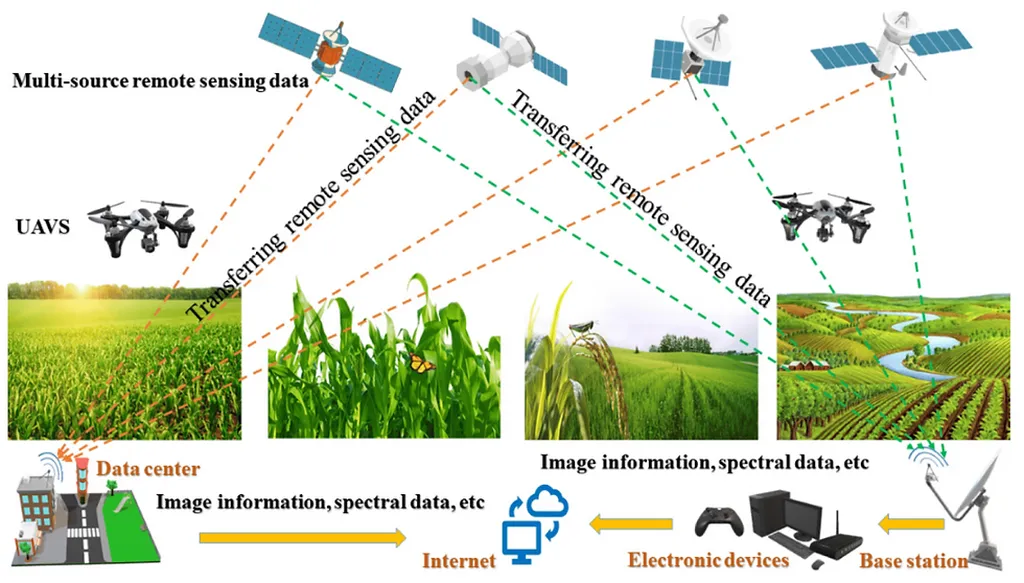
In the quest for precise weather data to drive agricultural decisions, a team of researchers has developed a novel approach to enhance the spatial resolution of satellite-based precipitation measurements. This advancement, published in the *IEEE Journal of Selected Topics in Applied Earth Observations and Remote Sensing*, could significantly impact the agriculture sector by providing more accurate and localized precipitation data, crucial for irrigation management, crop monitoring, and yield prediction.
The study, led by Zhaozhao Zeng from the School of Computer Science at China University of Geosciences in Wuhan, introduces the landcover similarity and distance weighted regression with residual correction model (LDWRR). This model leverages vegetation indices and topography to downscale precipitation data from coarse to fine spatial resolutions. Specifically, the researchers used data from the Integrated MultisatellitE Retrievals for Global Precipitation Measurement (IMERG) to downscale precipitation estimates from 10 km to 1 km resolution over the Pearl River Basin in Southern China.
“Our model incorporates an adaptive lag phase in the vegetation index and includes a residual correction procedure combined with ground observations,” Zeng explained. “This allows us to capture the intricate patterns of precipitation with much higher accuracy.”
The validation of the downscaled precipitation data using ground observations revealed impressive results. The LDWRR model achieved correlation coefficients larger than 0.7 at daily resolution, indicating a strong agreement between the downscaled data and actual ground measurements. Moreover, the accuracy of the downscaled precipitation data improved by more than 4% on average compared to the original IMERG data.
For the agriculture sector, the implications are substantial. Accurate and high-resolution precipitation data are essential for effective water resource management, particularly in regions where water scarcity is a growing concern. Farmers can use this data to optimize irrigation schedules, reduce water waste, and enhance crop yields. Additionally, precise precipitation forecasts can aid in pest and disease management, as many agricultural pests are influenced by moisture levels.
“The ability to downscale precipitation data with such precision opens up new possibilities for agricultural applications,” said Zeng. “From improving irrigation strategies to enhancing crop monitoring, this technology can support farmers in making data-driven decisions that ultimately lead to more sustainable and productive agriculture.”
The LDWRR model’s versatility is another key advantage. As Zeng noted, “Our model is general and can be applied to other regions and any remote sensing device, making it a valuable tool for a wide range of environmental and agricultural studies.”
Looking ahead, this research could pave the way for further advancements in remote sensing technology. As the demand for high-resolution environmental data continues to grow, innovative models like LDWRR will play a crucial role in meeting these needs. By integrating vegetation indices and topography, researchers can continue to refine their approaches, leading to even more accurate and reliable precipitation estimates.
In summary, the development of the LDWRR model represents a significant step forward in the field of remote sensing and precipitation downscaling. Its potential to enhance agricultural practices underscores the importance of continued research and innovation in this area. As Zeng and his team have demonstrated, the integration of advanced technologies and data-driven approaches can yield substantial benefits for both the environment and the agriculture sector.