
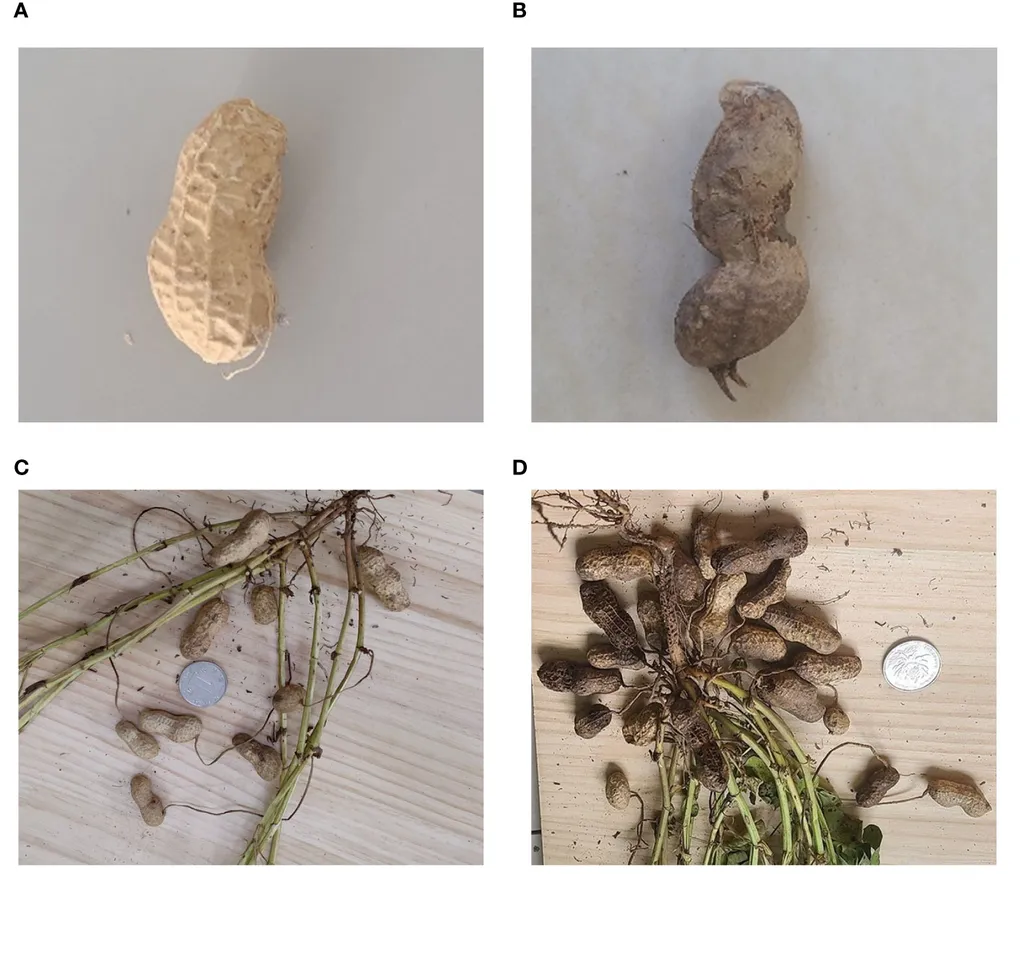
In the heart of China’s Shandong province, researchers have developed a groundbreaking solution to a longstanding challenge in the peanut industry. Xueke An, a researcher at Qingdao Agricultural University, and his team have created a lightweight, efficient neural network tailored for peanut pod classification, accelerated on a low-cost Field-Programmable Gate Array (FPGA). This innovation, published in *Industrial Crops and Products*, promises to revolutionize post-harvest visual grading, a process that has remained largely manual, slow, and error-prone.
The peanut pod appearance recognition network (PPRNET) is a 12-layer Convolutional Neural Network (CNN) that combines depthwise separable convolutions with structured pruning and post-training quantization. The result is a network with a mere 382,918 parameters and 0.09 floating-point operations (GFLOPs), making it exceptionally lightweight and efficient. The team’s accelerator uses an NC4HW4 memory layout to enhance data processing, and High-Level Synthesis (HLS) techniques such as UNROLL, PIPELINE, ARRAY_PARTITION, and DATAFLOW, along with ping-pong buffering, help speed up computation and memory access.
The deployed system processes one image in just 13 milliseconds and attains an impressive 99.16% classification accuracy on the peanut pod dataset. Compared to MobileNetV2, PPRNET reduces parameters by 82.84% and GFLOPs by 47.06%, with only a 0.42-percentage-point accuracy drop. When compared to MobileNetV3-Small, it uses just 25.13% of the parameters. “This is a significant achievement,” says An. “We’ve managed to create a system that is not only highly accurate but also incredibly efficient and cost-effective.”
The choice of FPGA is particularly noteworthy. Fine-grained parallelism and dataflow pipelining provide deterministic low latency and high energy efficiency under strict memory/compute budgets. Compared with CPU-class boards such as Raspberry Pi and embedded Graphics Processing Unit (GPU) platforms such as Jetson Nano, the ZYNQ-7020 achieves faster inference at lower cost and better portability.
The commercial implications for the agriculture sector are substantial. Post-harvest visual grading is a critical step in ensuring quality and consistency in peanut production. Traditional manual methods are time-consuming and prone to human error, leading to potential losses and inconsistencies. The PPRNET system offers a faster, more accurate, and cost-effective solution, enabling on-site grading that can significantly improve efficiency and reduce waste.
This research also opens up new avenues for future developments in the field. The algorithm–hardware co-design approach demonstrated by An and his team could be applied to other crops and agricultural processes, paving the way for more intelligent, efficient, and sustainable farming practices. As the agriculture sector continues to embrace technology, innovations like PPRNET will play a crucial role in shaping the future of food production.
The work, led by Xueke An from the College of Mechanical and Electrical Engineering at Qingdao Agricultural University, represents a significant step forward in the intersection of agriculture and technology. As the world grapples with the challenges of feeding a growing population, such advancements are not just beneficial but essential. The research, published in *Industrial Crops and Products*, underscores the potential of FPGA-accelerated convolutional methods to transform the agriculture sector, making it more efficient, sustainable, and resilient.