
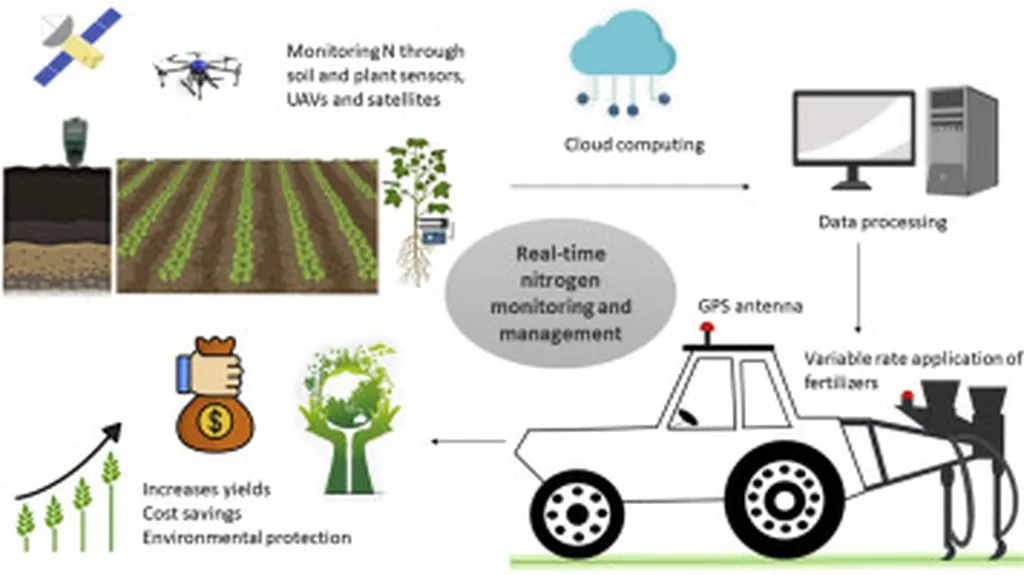
In the quest to minimize nitrogen (N) losses from agricultural practices, a new study published in *Earth Critical Zone* offers a promising hybrid approach that could revolutionize how farmers and agronomists manage fertilizers. The research, led by Shu Kee Lam from the School of Agriculture, Food and Ecosystem Sciences at The University of Melbourne, combines traditional process-based models with machine learning (ML) to create a more accurate and scalable framework for predicting N losses.
Nitrogen is a critical nutrient for plant growth, but excessive use of fertilizers can lead to significant environmental degradation, including water pollution and greenhouse gas emissions. Traditional process-based models have been the go-to tools for estimating N losses, but they often struggle with calibration and validation across diverse agricultural datasets. “These models are foundational, but they can be limited by their reliance on predefined processes and the challenges of scaling up to large, complex datasets,” Lam explains.
Enter machine learning. With agriculture entering the big data era, ML-based data analytics presents an opportunity to overcome these limitations. By leveraging vast amounts of data from diverse agricultural settings, ML algorithms can identify patterns and relationships that traditional models might miss. “Machine learning can handle the complexity and variability of real-world agricultural data, providing more accurate and localized predictions,” Lam adds.
The study proposes a hybrid model framework that integrates process-based and data-driven ML models. This approach leverages the strengths of both methods: the robustness of process-based models in understanding fundamental biological and chemical processes, and the adaptability of ML in handling large, diverse datasets. “By combining these two approaches, we can enhance the accuracy and scalability of N loss predictions, ultimately leading to better fertilizer management decisions,” Lam says.
The commercial implications for the agriculture sector are significant. More accurate predictions of N losses can help farmers optimize fertilizer use, reducing costs and minimizing environmental impact. This is particularly important as the agriculture industry faces increasing pressure to adopt sustainable practices. “Agriculture is at a crossroads,” Lam notes. “We need innovative solutions that can balance productivity with environmental stewardship. This hybrid approach offers a pathway to achieve that balance.”
The research also highlights the potential for future developments in agroecosystem modeling. As data collection and processing technologies continue to advance, the integration of ML with traditional models could become more widespread, leading to even more sophisticated and accurate predictive tools. “This is just the beginning,” Lam says. “As we gather more data and refine our algorithms, the possibilities for improving agricultural practices are endless.”
The study, published in *Earth Critical Zone* and led by Shu Kee Lam from The University of Melbourne, represents a significant step forward in the quest to minimize nitrogen losses in agriculture. By combining the best of traditional and modern approaches, it offers a promising solution for a more sustainable and productive future.