
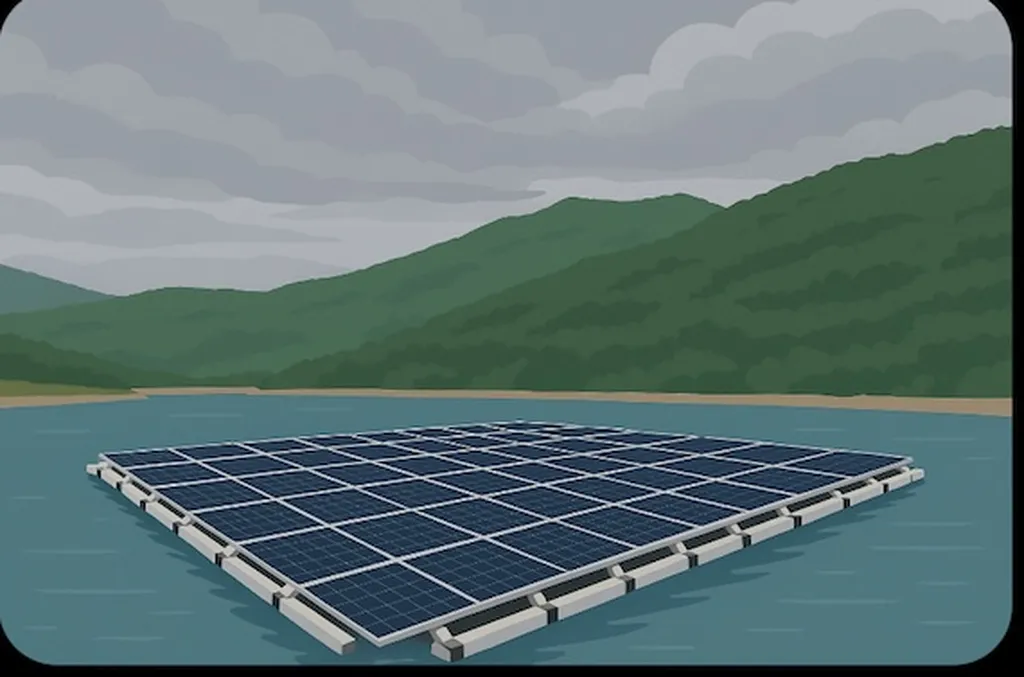
In the heart of Morocco’s Béni Mellal-Khénifra region, a novel approach to tackling water evaporation is making waves in the agricultural sector. As climate change tightens its grip, Morocco faces severe water stress, with evaporation from dams and water bodies posing a significant challenge. Enter Ouchkir Insaf and her team from the Data Science for Sustainable Earth Laboratory at Sultan Moulay Slimane University, who are experimenting with photovoltaic covers to reduce evaporation and generate energy.
The team’s innovative approach involves covering water bodies with solar panels, creating a dual-purpose solution that not only reduces evaporation but also generates electricity. “This new approach, which is part of the integrated management of water resources, is a promising solution with a dual role: on the one hand, it will help us generate electricity, and on the other, it will preserve the maximum amount of water stored in water bodies,” says Ouchkir.
The experiment, detailed in a recent article published in ‘BIO Web of Conferences’, involves two rectangular tanks of the same dimensions. One tank is covered by a solar panel, while the other remains open to the air. The team measures various parameters daily, including water level, TDS, air temperature, water temperature, and air humidity. Initial results are promising, with a 16.5% reduction in evaporation rate observed in the covered tank over a 33-day period. This percentage increases to 20% during the summer season, highlighting the potential of this approach in intense sunlight.
The team has also developed predictive models using Support Vector Regression (SVR), Random Forest, and Gradient Boosting to better understand the evaporation phenomenon. These models demonstrate the ability to accurately capture the dynamics of evaporation under both experimental conditions, paving the way for future developments in the field.
The commercial impacts for the agriculture sector are significant. With water scarcity becoming an increasingly pressing issue, farmers are in dire need of innovative solutions to conserve water and reduce costs. Photovoltaic covers offer a promising solution, allowing farmers to reduce water loss through evaporation while also generating electricity for various uses, such as pumping, lighting, and localized irrigation.
As climate change continues to exacerbate water stress, the need for innovative solutions in water management is more pressing than ever. This research offers a glimmer of hope, demonstrating the potential of photovoltaic covers to reduce evaporation and generate energy. With further development and implementation, this approach could revolutionize water management in the agriculture sector, helping to mitigate the impacts of climate change and ensure food security for future generations.
The research, led by Ouchkir Insaf from the Data Science for Sustainable Earth Laboratory at Sultan Moulay Slimane University, was published in ‘BIO Web of Conferences’. As we look to the future, the potential of this approach is vast, offering a sustainable and innovative solution to the challenges posed by climate change.