
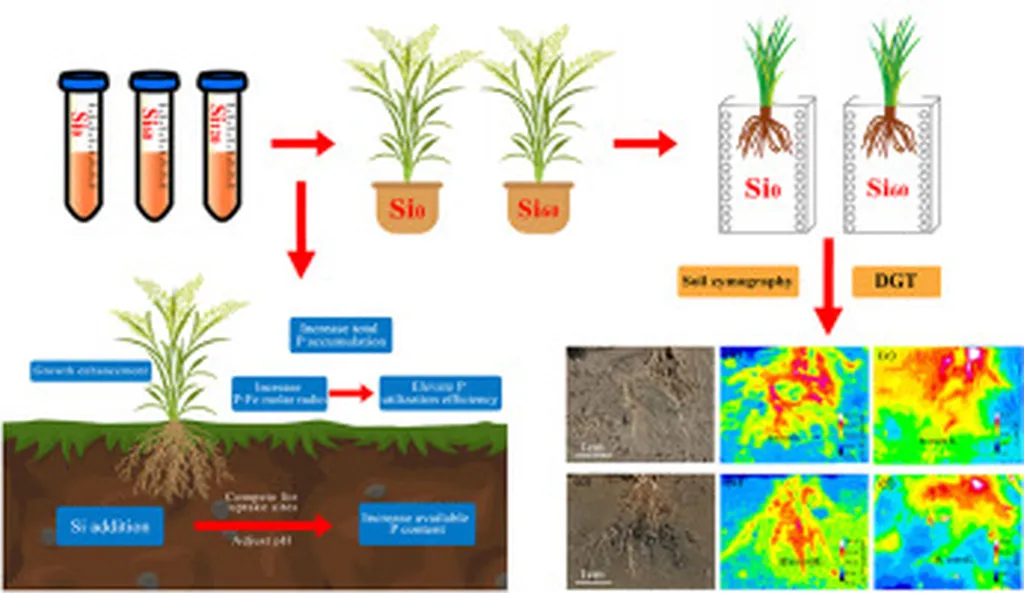
In the quest to feed a growing global population, rice remains a staple crop, yet its productivity is often hindered by phosphorus (P) deficiencies in soil. A recent study published in *Earth Critical Zone* sheds light on how silicon (Si) can enhance phosphorus uptake in rice, offering promising avenues for improving crop yields and soil health. The research, led by Jia-Lu Gao from the State Key Laboratory of Soil Pollution Control and Safety at Zhejiang University, explores the dynamic processes in the rhizosphere—the narrow region of soil influenced by root secretions and associated microorganisms—that could revolutionize agricultural practices.
The study investigated how silicon application affects soil phosphorus availability and rice phosphorus uptake across different soil types. Laboratory trials revealed that applying silicic acid increased available phosphorus content, particularly in phosphorus-deficient soils. This finding is significant because phosphorus is a critical nutrient for plant growth, and its limited availability can severely constrain rice yields.
In pot experiments, silicon application led to notable improvements. For instance, in Fluvisol, silicon increased acid phosphatase activity by 37.5% and biomass by 23.0%. In Anthrosol, silicon boosted rice total phosphorus accumulation by 49.6% and the root phosphorus-to-iron molar ratio by 31.0%. These results suggest that silicon can play a pivotal role in enhancing nutrient uptake and overall plant health.
One of the most intriguing aspects of the study was the use of high-resolution imaging techniques to visualize rhizosphere processes. “Imaging revealed silicon-induced changes in root architecture, including increases in maximum vertical extension and root angle,” explained Gao. These changes were accompanied by expanded acid phosphatase activity hotspots, which accelerated phosphorus depletion in the rhizosphere. This detailed understanding of rhizosphere dynamics could pave the way for more targeted and effective agricultural practices.
The commercial implications of this research are substantial. Farmers could potentially enhance rice yields by applying silicon to phosphorus-deficient soils, thereby improving crop productivity and economic returns. Additionally, the study highlights the importance of understanding rhizosphere processes, which could lead to the development of new agricultural technologies and practices aimed at optimizing nutrient uptake and soil health.
As the global demand for food continues to rise, innovative solutions like those explored in this study are crucial. By leveraging the synergistic relationship between silicon and phosphorus, agritech companies and farmers alike can work towards more sustainable and productive agricultural systems. The research not only advances our scientific understanding but also offers practical insights that could shape the future of agriculture.
The study, led by Jia-Lu Gao and published in *Earth Critical Zone*, underscores the potential of silicon application to improve phosphorus uptake in rice, offering a promising strategy for enhancing crop yields and soil health. As the agricultural sector continues to evolve, such research will be instrumental in meeting the challenges of feeding a growing population while promoting sustainable practices.