
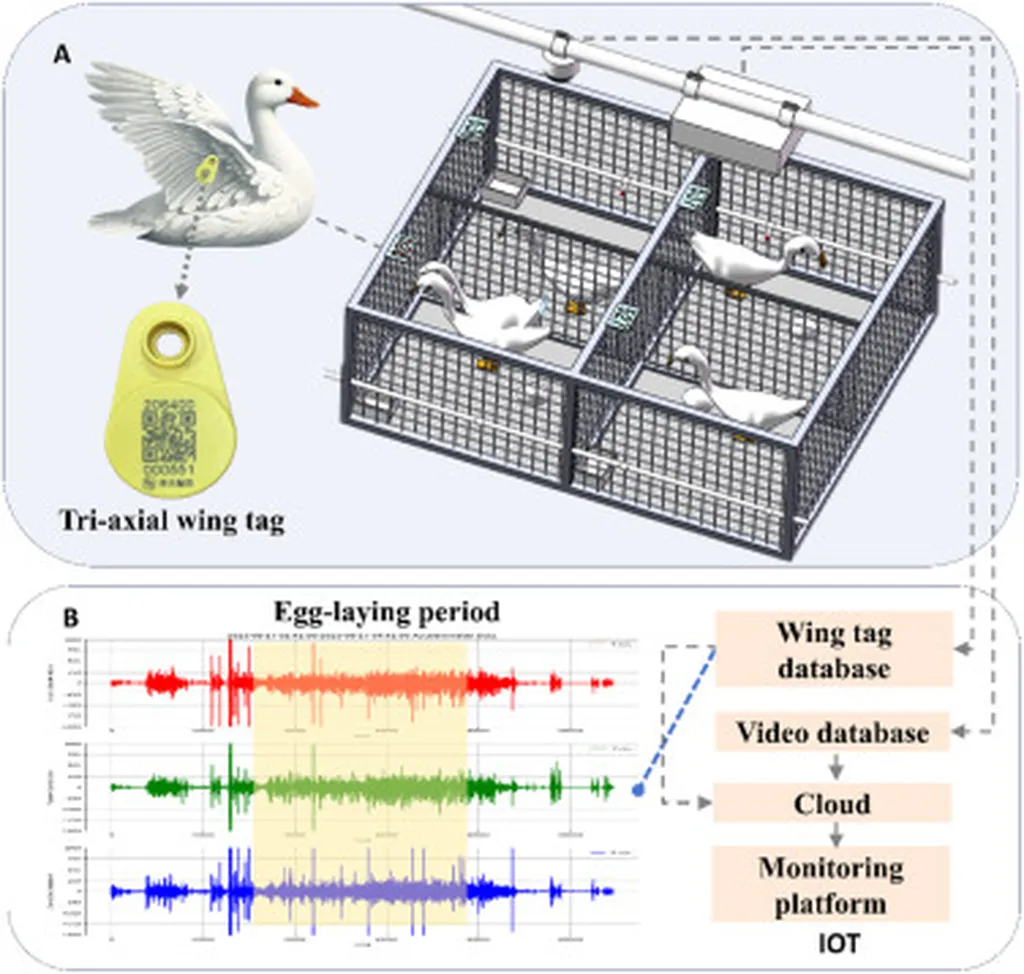
In the realm of precision agriculture, a groundbreaking study published in *Poultry Science* is set to revolutionize the way farmers monitor and manage egg production in cage-reared ducks. Led by Dakang Guo from the College of Mathematics Informatics at South China Agricultural University, the research introduces an innovative edge-intelligent lightweight vision system that promises to optimize breeding management and enhance productivity.
The stereoscopic cage-rearing system, while efficient, has long faced challenges in accurately monitoring individual egg production. Traditional methods involving multi-sensor monitoring or fixed cameras have proven costly and limited in coverage. Guo and his team have addressed these issues by developing a mobile camera-based video monitoring method that automatically detects duck eggs, recognizes cage QR codes, and performs egg-cage matching counting.
At the heart of this system is the Lightweight Duck Egg and QR Code Detection model (LDEQ-OD), built on an improved YOLOv11 framework. By integrating a Dual Detection Head (DH), a C3-DDF module, and a SENet attention mechanism, the model significantly enhances small-object detection accuracy and real-time inference performance on edge devices. “Our model achieves an impressive balance between precision and speed, making it ideal for deployment in real-world farming environments,” Guo explains.
The system’s efficiency is further bolstered by the OC-SORT algorithm, which establishes spatiotemporal associations between eggs and QR codes, and the Cascade Robust QR Code Decoding (CRQD) algorithm, which improves decoding accuracy under motion blur and uneven illumination. Compared to traditional decoders, CRQD boosts the overall Code Identification Rate from 72.7% to 99.3%, demonstrating remarkable robustness.
One of the most notable aspects of this research is the dynamic matching strategy based on the Minimum Aspect Ratio Deviation (MARD). This strategy compensates for geometric distortion caused by camera tilt, achieving a Mean Absolute Error (MAE) of 0.017 eggs per cage and an Egg–Cage Matching Accuracy (ECMA) of 98.3%. “This level of accuracy is crucial for farmers to make informed decisions and optimize their breeding strategies,” Guo notes.
The system’s deployment on the Jetson Nano platform at 10 frames per second, coupled with real-time data acquisition and visualization modules, enables intelligent and real-time monitoring of individual egg production. This innovation has significant commercial implications for the agriculture sector, as it allows for precision breeding management, ultimately leading to increased productivity and profitability.
The research not only addresses current challenges but also paves the way for future developments in the field. As Guo and his team continue to refine their system, the potential for similar applications in other areas of agriculture becomes increasingly apparent. The integration of edge computing and computer vision technologies holds promise for transforming various aspects of farming, from livestock management to crop monitoring.
In conclusion, this study represents a significant step forward in the realm of precision agriculture. By leveraging advanced technologies, Guo and his team have developed a system that enhances monitoring capabilities, improves decision-making, and ultimately benefits the entire agriculture sector. As the industry continues to evolve, the insights and innovations from this research will undoubtedly play a pivotal role in shaping the future of farming.