
In the rolling hills of Songyang County, Zhejiang Province, a quiet revolution is brewing—one that could reshape the way China’s tea industry tackles its environmental impact. A recent study published in *Earth Critical Zone* has shed light on the greenhouse gas (GHG) footprint of tea production, offering a roadmap for a more sustainable future. Led by Fei Ding of the Research Center for Rural Economy, Ministry of Agriculture and Rural Affairs of China, the research provides a comprehensive life cycle inventory of tea production, revealing both the challenges and opportunities that lie ahead.
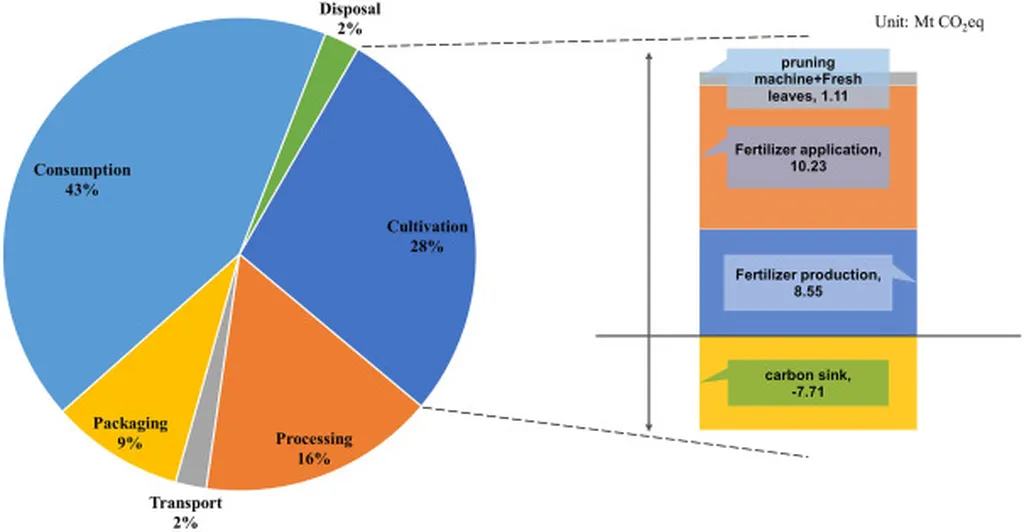
The study found that the average GHG footprint of fresh tea leaves is 3.5 kgCO₂e per kilogram, with nitrogen fertilizer emerging as the primary culprit. “Nitrogen fertilizer is a significant contributor to emissions, but it’s also a critical input for tea growers,” Ding explained. “The key is to find a balance—optimizing its use to maintain productivity while reducing environmental impact.”
For the “from cradle to factory gate” scope, the GHG footprint was found to be 23.5 kgCO₂e per kilogram, while for the “from cradle to grave” scope, it was a mere 0.04 kgCO₂e per cup. These findings highlight the complexity of the tea industry’s carbon footprint and the need for targeted interventions.
The research also delved into the statistical variation among tea growers and the spatial distribution of the GHG footprint, providing a nuanced understanding of the challenges faced by different stakeholders. “There’s a lot of variability among tea growers, and this variability affects their GHG footprint,” Ding noted. “Tailored solutions are needed to address these differences and ensure that all growers can contribute to the industry’s decarbonization efforts.”
The study’s exploration of decarbonization potential is particularly noteworthy. It highlights key strategies such as optimizing nitrogen fertilizer usage, advancing energy transformation, and establishing a personalized emission trading system for smallholders. These measures are not just environmentally beneficial; they also hold significant commercial potential.
For the agriculture sector, the implications are profound. As consumers increasingly demand sustainable and low-carbon products, tea producers who can demonstrate a reduced GHG footprint will be well-positioned to capture market share. Moreover, the study’s findings could pave the way for new policies and incentives that support sustainable tea production, further driving the industry’s transition to a low-carbon future.
The research also underscores the importance of data quality and uncertainty management in life cycle assessments. The data quality pedigree matrix used in the study indicated an acceptable level of uncertainty, providing a solid foundation for decision-making. This emphasis on data quality is crucial for ensuring that the industry’s decarbonization efforts are based on robust and reliable information.
As the tea industry grapples with the dual challenges of environmental sustainability and commercial viability, this study offers a beacon of hope. By providing a comprehensive and nuanced understanding of the GHG footprint of tea production, it lays the groundwork for a more sustainable and profitable future. The research, led by Fei Ding of the Research Center for Rural Economy, Ministry of Agriculture and Rural Affairs of China, and published in *Earth Critical Zone*, is a testament to the power of science in driving positive change. As the industry moves forward, the insights gleaned from this study will undoubtedly shape its trajectory, guiding it towards a greener and more prosperous future.