
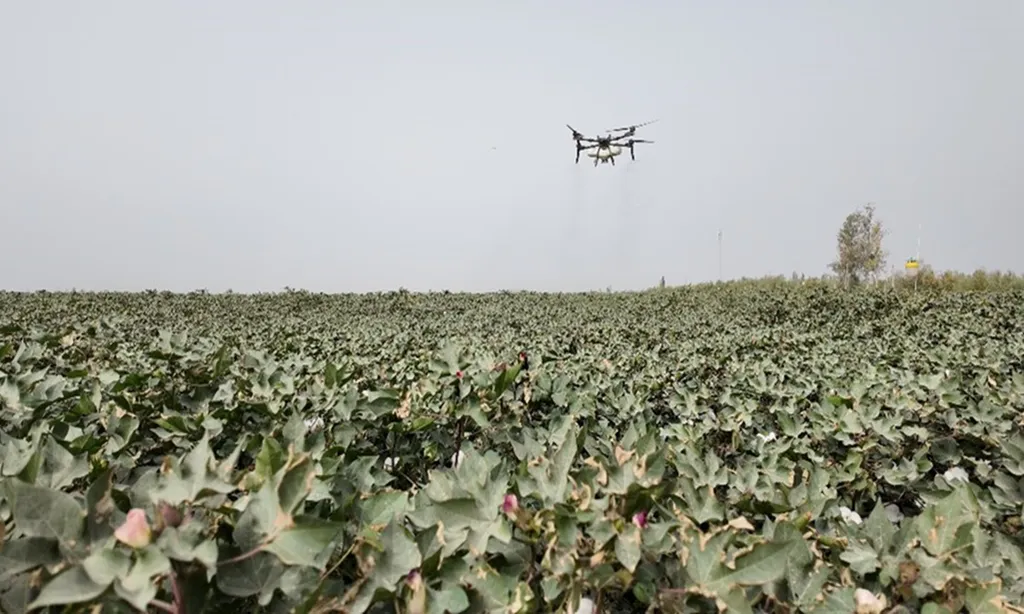
In the heart of China’s Xinjiang region, researchers have developed a cutting-edge solution to a persistent challenge in cotton farming: the automated detection of cotton terminal buds. These tiny but crucial plant parts play a pivotal role in regulating plant architecture and yield formation. However, their minuscule size and the complex, often harsh conditions of cotton fields have made their detection a formidable task. Enter CTB-YOLO, a lightweight, robust detection framework designed to transform intelligent cotton cultivation.
The CTB-YOLO framework, developed by a team led by Yuxin Cui at Shihezi University, integrates three complementary modules to tackle the unique challenges of cotton terminal bud detection. The MSCA-FPN module prevents the dilution of small-target features, ensuring that even the tiniest buds are not overlooked. The wConv2d module enhances the framework’s robustness to varying illumination conditions, a common challenge in outdoor field environments. Lastly, the C2PSA-EDFFN module addresses severe occlusion, a frequent issue in cluttered field backgrounds.
“Our goal was to create a practical, efficient, and easily deployable framework that could withstand the real-world conditions of cotton fields,” said Cui. “We believe CTB-YOLO delivers on this promise, offering a significant leap forward in intelligent cotton management.”
The results speak for themselves. On a self-constructed cotton terminal bud dataset, CTB-YOLO achieved a mean Average Precision (mAP50) of 85.3%, outperforming the YOLOv11n baseline by 2.3%. Impressively, it did so with 28.3% fewer parameters and 34.9% lower GFLOPs, making it a lightweight yet powerful solution. Furthermore, CTB-YOLO delivered comparable accuracy to the transformer-based RT-DETR-R50 while requiring only 3.2% of its computational cost.
The commercial implications for the agriculture sector are substantial. Accurate, real-time detection of cotton terminal buds can enable precision agriculture practices, optimizing yield and reducing resource waste. This can translate to significant cost savings and increased profitability for cotton farmers. Moreover, the framework’s robustness under strong sunlight, heavy occlusion, and low-contrast conditions ensures its reliability in diverse and challenging environments.
The research, published in the journal ‘Smart Agricultural Technology’, also demonstrated strong performance on the public Global Wheat Detection dataset, suggesting its potential applicability beyond cotton cultivation. This versatility could open doors to a wide range of precision agriculture applications, from crop monitoring to automated harvesting.
As the agriculture sector continues to embrace digital transformation, innovations like CTB-YOLO are set to play a pivotal role. By enabling more precise, efficient, and intelligent cultivation practices, such technologies can help meet the growing global demand for food while promoting sustainable agriculture. The future of farming is here, and it’s looking increasingly automated, data-driven, and precise.
In the rapidly evolving field of agritech, CTB-YOLO stands as a testament to the power of targeted innovation. By addressing a specific challenge with a tailored solution, the researchers have not only advanced the state-of-the-art in small-target detection but also paved the way for more intelligent, efficient, and sustainable agriculture. As the sector continues to grapple with the complexities of feeding a growing population in a changing climate, such innovations will be invaluable. The journey towards smarter, more precise agriculture is underway, and CTB-YOLO is a significant milestone along the way.