
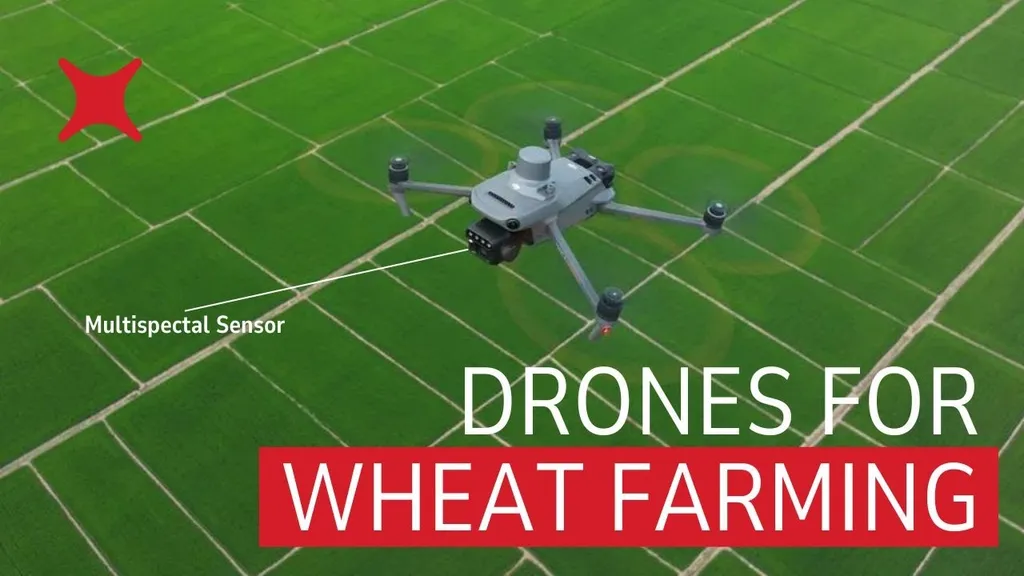
In the heart of China’s Henan Province, a groundbreaking study is reshaping how farmers monitor and manage water stress in winter wheat crops. Led by Xiaohui Kuang of the Institute of Farmland Irrigation at the Chinese Academy of Agricultural Sciences, the research leverages Unmanned Aerial Vehicles (UAVs) and machine learning to provide a timely, accurate, and non-destructive solution to a longstanding agricultural challenge. Published in *Smart Agricultural Technology*, the findings could significantly impact global agriculture, particularly in regions where water scarcity is a pressing concern.
Water stress is a critical issue for winter wheat growers, as it can severely impact both yield and quality. Traditional monitoring methods often fall short due to their time-consuming nature and the delays in providing actionable data. Kuang’s study addresses these limitations by harnessing the power of UAV-based multi-modal remote sensing and machine learning algorithms.
The experiment, conducted at the Xinxiang Experimental Base, involved 120 plots under four different irrigation levels. Data was collected during three critical growth stages: heading, flowering, and filling. Vegetation indices (VIs) and thermal infrared (TIR) features were extracted from the UAV imagery, providing a comprehensive view of the crop’s health.
Unlike previous studies that focused on single growth stages or sensor types, this research evaluated the fusion of VI and TIR data across multiple stages under controlled irrigation gradients. The team systematically compared three machine-learning classifiers: Random Forest (RF), eXtreme Gradient Boosting (XGBoost), and Support Vector Machine (SVM).
The results were promising. “We found that classification performance varied across single growth stages, but multi-source sensor data fusion consistently achieved the highest classification accuracy,” Kuang explained. The SVM model, in particular, stood out, achieving an impressive accuracy of 97.22% during the flowering stage. When data from multiple growth stages were merged, the SVM model still performed best, with an overall accuracy of 82.41%.
The commercial implications of this research are substantial. For farmers, the ability to accurately and rapidly monitor water stress can lead to more informed irrigation decisions, optimizing water use and potentially increasing yields. In an era of climate change and water scarcity, such tools are invaluable.
Moreover, the study’s findings could pave the way for broader applications in precision agriculture. As Kuang noted, “This study effectively achieved non-destructive, accurate, and rapid monitoring of winter wheat water stress, providing technical support for precision agriculture and water management.”
The integration of UAV technology and machine learning in agricultural monitoring is still in its infancy, but studies like this one are driving the field forward. As the technology becomes more accessible and affordable, we can expect to see it adopted more widely, transforming how farmers manage their crops and resources.
In the words of Kuang, “The future of agriculture lies in smart, data-driven solutions. Our research is just the beginning of what’s possible.” With continued innovation and investment, the vision of precision agriculture—where every drop of water and every input is optimized for maximum yield and sustainability—could soon become a reality for farmers worldwide.