
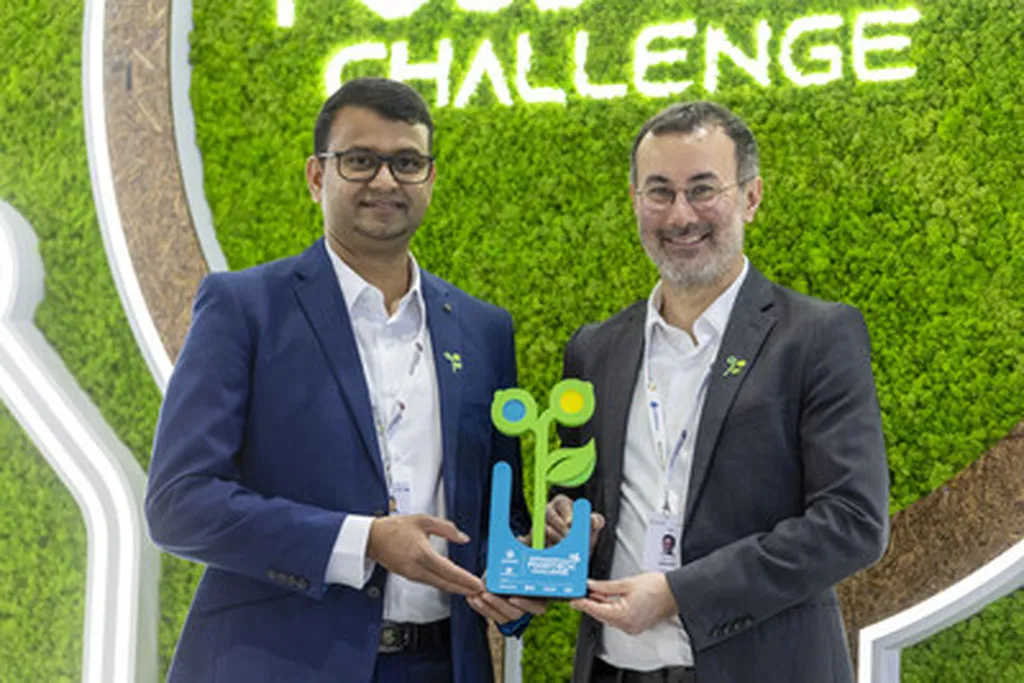
Permia Sensing, a spinout from the Dyson School of Design Engineering at Imperial College London, has emerged as one of the four winners of the 2026 UAE FoodTech Challenge. This prestigious competition, organized by the government of the United Arab Emirates, aims to foster innovative agricultural technology companies. The prize, amounting to $500,000, will enable Permia Sensing to expand its precision agriculture technology into new markets and crops, particularly in the Middle East and India.
The UAE FoodTech Challenge prize is a significant boost for Permia Sensing, allowing the company to establish its base in Abu Dhabi. This strategic location will serve as a hub for the Middle East and North Africa region, providing access to key stakeholders, research institutes, governments, and universities. Efrem de Paiva, the company’s chief executive, emphasized the importance of this opportunity, stating, “The FoodTech Challenge prize allows us to set up our base in Abu Dhabi. This will serve the other countries of the Middle East and North Africa region, and give us access to stakeholders, research institutes, governments and universities, so that we can bring in the best talent to help us take our technology further.”
Permia Sensing’s technology leverages artificial intelligence, bioacoustic sensors, and drone imaging to monitor tree health and recommend interventions at the level of individual plants. This approach, known as precision agriculture, has already shown promising results in Sri Lanka, where the company covers over 15,000 hectares of coconut and palm oil plantations. By detecting stress factors such as dehydration and pest infestations early, farmers can boost yields and reduce waste.
Professor Thrishantha Nanayakkara, founder and R&D director of Permia Sensing, highlighted the potential impact of their technology on coconut yields in Sri Lanka. “In Sri Lanka, the average coconut yield now is 36 nuts per tree per year. With precision agriculture improving the health of the trees, they have the potential to go up to 120 nuts per tree,” he said. This significant increase in yield not only benefits farmers economically but also has implications for nature conservation. “With static yields, the only way to increase profits is to expand into natural rain forests. Our system gives growers a way of increasing yields and so reduces the threat of deforestation,” Professor Nanayakkara explained.
The technology’s roots trace back to a project for the Coconut Research Institute of Sri Lanka around 2005, where Professor Nanayakkara and his colleagues developed a sensor to detect red palm weevil larvae. The initial device was costly and not commercially viable, but advancements in smartphone technology changed the game. By 2017, Professor Nanayakkara returned to the idea at Imperial College London, where the Morph Lab at the Dyson School of Design Engineering provided the necessary support. The smartphone’s advanced sound processor eliminated the need for separate circuit processing, drastically reducing production costs.
Permia Sensing was spun out in 2020 to commercialize the technology, with Hasitha Wegiriya, a Sri Lankan PhD student, becoming the co-founder and chief technology officer. The company initially focused on detecting weevil infestations but soon expanded to monitor overall tree health. By integrating drone-based multispectral imaging and other sensors, Permia Sensing can now assess hydration, transpiration, and other critical factors affecting tree health.
The implications of Permia Sensing’s technology are vast. By mapping plantations using satellite and drone data, the company can identify struggling trees and dispatch ground crews for targeted interventions. This approach reduces the need for costly and environmentally harmful blanket use of fertilizers and pesticides. “This reduces the uncertainty in agriculture and increases yield, because each tree gets what it needs,” Professor Nanayakkara explained. “In order to do this, you need data-driven approaches, but the incremental investment you make in that is recoverable, in our case, within three years.”
With the support of the UAE FoodTech Challenge, Permia Sensing is poised to bring its innovative technology to new markets, potentially revolutionizing agriculture in the Middle East and beyond. The company’s focus on high-value crops such as date palm and oil palm in the UAE region, Egypt, and India underscores its commitment to enhancing agricultural productivity and sustainability. As Permia Sensing continues to grow, its technology could play a crucial role in addressing global food security challenges and promoting sustainable farming practices.