
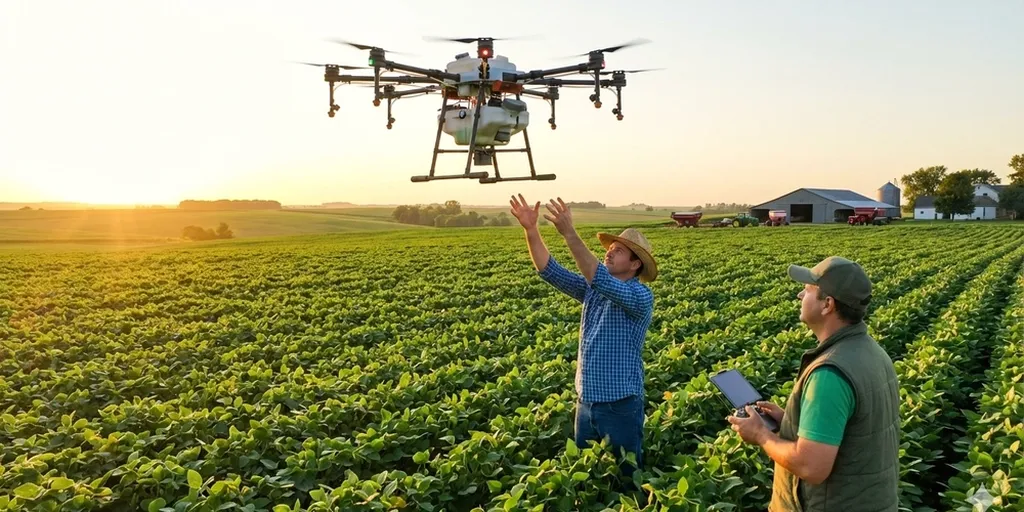
In the vast, sprawling fields of modern agriculture, detecting crop diseases early can mean the difference between a bountiful harvest and a devastating loss. Yet, the sheer scale and variability of these fields make timely detection a formidable challenge. Enter AgroVisionNet, a cutting-edge AI-driven drone technology that promises to revolutionize early disease detection in large agricultural areas.
Developed by a team led by H M Manoj from the Department of Artificial Intelligence and Machine Learning at BMS Institute of Technology and Management, AgroVisionNet combines high-resolution drone imagery with in-field IoT/environmental sensor data. This fusion of technologies enables more accurate and timely disease detection, even in the face of illumination, weather, and crop-stage variations.
At the heart of AgroVisionNet lies a hybrid CNN-Transformer backbone, which extracts spatial and contextual data from drone images. An adaptive fusion layer then integrates time-aligned sensor readings, providing a comprehensive decision-making tool that leverages both visual and environmental evidence. “This approach not only enhances detection accuracy but also ensures that the system remains interpretable and useful for agronomists,” Manoj explains.
The study, published in Scientific Reports, demonstrates that AgroVisionNet outperforms widely used deep learning models like VGG16, ResNet50, Inception V3, and DenseNet121 in terms of classification accuracy and F1-score. Moreover, its efficiency allows it to run on an NVIDIA Jetson Nano using TensorFlow Lite, making it feasible for edge computing applications.
The commercial implications for the agriculture sector are substantial. Early and accurate disease detection can lead to more targeted and effective use of pesticides, reducing costs and environmental impact. It can also improve crop yields and quality, directly benefiting farmers’ livelihoods. “This technology has the potential to transform precision agriculture by making it more robust and field-ready,” Manoj adds.
Looking ahead, the integration of drone imagery, sensor fusion, and edge computing could pave the way for even more advanced agricultural technologies. Imagine drones equipped with AI that can not only detect diseases but also apply precise treatments, or systems that can predict and prevent outbreaks before they occur. The possibilities are as vast as the fields they aim to protect.
As the agriculture sector continues to embrace digital transformation, innovations like AgroVisionNet will play a pivotal role in shaping the future of farming. By harnessing the power of AI and IoT, we can create a more sustainable and productive agricultural landscape, ensuring food security for generations to come.