
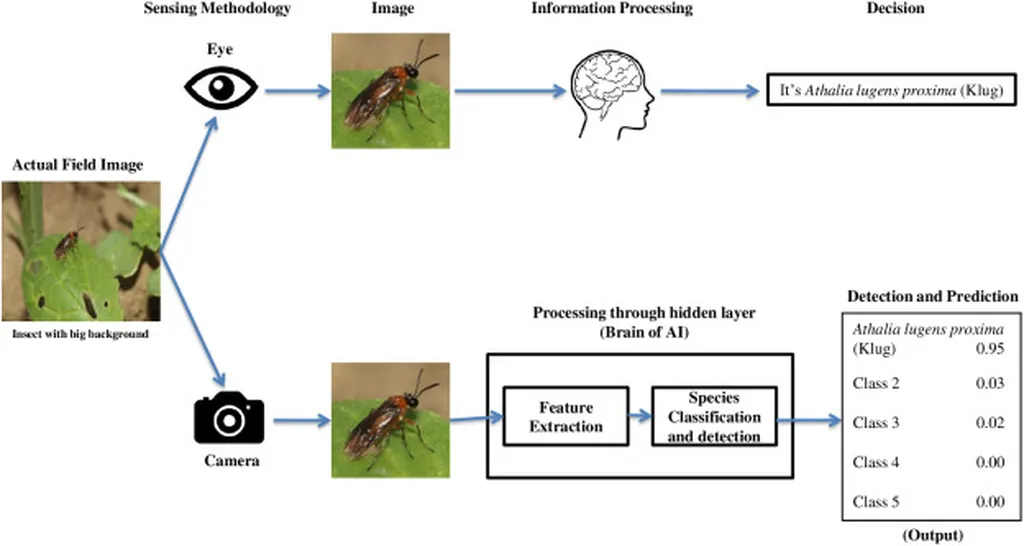
In the ever-evolving landscape of precision agriculture, researchers are continually seeking innovative solutions to enhance pest management and promote ecological balance. A recent study published in *Scientific Reports* introduces a groundbreaking approach that combines cutting-edge machine learning techniques with explainable AI to identify and classify agricultural pests and beneficial insects with remarkable accuracy.
The research, led by Nibedita Deb from the Department of Biotechnology Engineering at the International Islamic University Malaysia, addresses a critical challenge in modern agriculture: the reliable identification of pests and beneficial insects. Traditional vision-based models often struggle with high-dimensional data and lack interpretability, making them less practical for real-world applications.
Deb and her team propose a hybrid insect-classification framework that integrates convolutional neural network (CNN) feature extraction with a dual explainable AI (XAI) feature selection strategy. By applying SHapley Additive exPlanations (SHAP) and Permutation Feature Importance (PFI) in parallel, the researchers rank both handcrafted and CNN-derived features, ultimately selecting a compact, biologically meaningful subset for final classification.
“This approach not only improves accuracy but also enhances the interpretability of the model, which is crucial for practical deployment in the field,” Deb explains. The selected features are evaluated using lightweight classifiers and a hybrid ensemble, enabling accurate inference even under variable field conditions.
The study’s experiments were conducted on a curated, balanced dataset of four classes: Colorado potato beetle, green peach aphid, seven-spot ladybird, and healthy leaves. Collected under diverse lighting and background conditions, the dataset provided a robust testing ground for the new model. The results were impressive, achieving an overall accuracy of 96.7%, with precision, recall, and F1-scores all above 96%. Notably, the model retained at least 90% accuracy using only the top 11 hybrid-selected features, demonstrating its efficiency and potential for real-world applications.
The implications of this research are significant for the agriculture sector. Accurate and interpretable pest identification can lead to more targeted and effective pest management strategies, reducing the need for broad-spectrum pesticides and promoting sustainable crop protection. “This technology has the potential to revolutionize precision agriculture by providing farmers with reliable, real-time information about pest populations and beneficial insects,” Deb adds.
The integration of SHAP and PFI not only improves the robustness and interpretability of the model but also supports practical deployment for automated pest monitoring. As the agriculture industry continues to embrace digital transformation, such advancements in agricultural informatics will play a pivotal role in shaping the future of farming.
This research paves the way for further developments in hybrid models, feature selection, and machine learning applications in agriculture. By combining the strengths of different AI techniques, researchers can create more efficient, accurate, and interpretable models that address the complex challenges of modern agriculture. As the field continues to evolve, the integration of explainable AI and machine learning will undoubtedly become a cornerstone of sustainable and precision agriculture.