
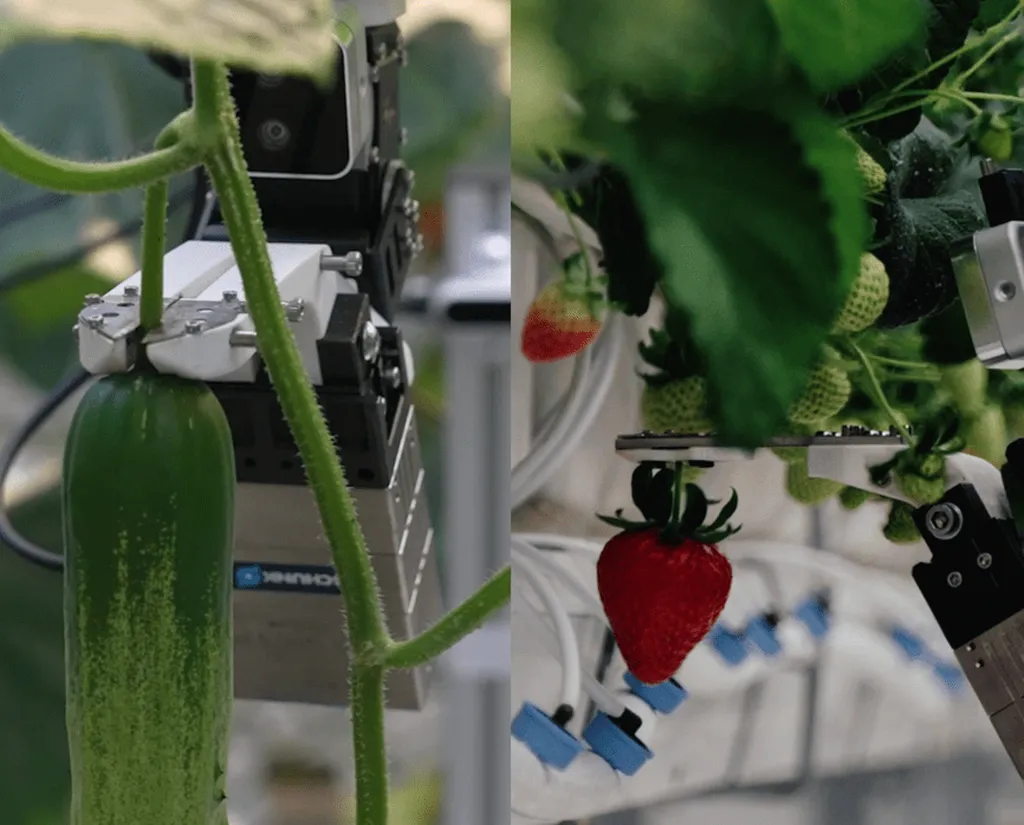
In the ever-evolving landscape of precision agriculture, a groundbreaking development has emerged that promises to revolutionize how we monitor and manage crop health. Researchers have introduced an advanced robotic system capable of real-time, non-invasive inspection of strawberry crops, leveraging deep learning to detect foliar diseases with remarkable accuracy. This innovation, detailed in a study published in *BMC Plant Biology*, could significantly enhance productivity and sustainability in the agriculture sector.
The system, dubbed Strawberry Leaf Disease Inspection (SLDI), is a testament to the power of modern machine vision and deep learning. At its core, SLDI employs a sophisticated algorithm that integrates Receptive Guided Channel Attention (RGCA) and a Deep Context Aggregator (DCA). These components work in tandem to improve the characterization and representation of feature sets, thereby boosting the accuracy and efficiency of disease identification. “The key innovation here is the ability to capture disease symptoms promptly and accurately, even under varying field conditions,” explains Asim Khan, lead author of the study and a researcher at the Khalifa University Center for Autonomous Robotic Systems (KUCARS).
One of the standout features of the SLDI system is its Multi-Scale Feature Fusion Module (MSFF), which facilitates a comprehensive multi-level representation of the data. This allows the model to process information at different scales, ensuring that even subtle symptoms of disease are not overlooked. The system is deployed on a robotic platform equipped with an RGB camera, enabling real-time, in-field inspection of strawberry crops. This capability is particularly valuable in controlled environments like greenhouses, where consistent monitoring can be challenging due to varying conditions.
The implications for the agriculture sector are profound. Traditional methods of disease detection often rely on manual inspection, which is time-consuming, labor-intensive, and prone to human error. The SLDI system offers a more efficient, automated solution that can operate continuously, reducing labor dependency and enhancing early disease detection. This not only improves crop yields but also promotes sustainability by minimizing the use of pesticides and other chemical treatments.
In experimental field inspections, the SLDI system demonstrated impressive performance, achieving a precision of 91.10% and a recall of 88.50%, while maintaining a real-time processing speed of 76.50 frames per second (fps). These results highlight the system’s potential to outperform existing approaches in both accuracy and efficiency. “The ability to process data in real-time is crucial for timely intervention and treatment,” notes Khan. “This can make a significant difference in preventing the spread of diseases and ensuring the health of the crops.”
The study’s findings were validated using two publicly available datasets, PlantDoc and PlantVillage, ensuring the robustness and reliability of the model. The integration of advanced deep learning techniques with robotic systems represents a significant step forward in the field of precision agriculture. As the technology continues to evolve, it is likely to become an indispensable tool for farmers and agronomists, enabling them to make data-driven decisions that enhance productivity and sustainability.
This research not only underscores the potential of deep learning in agriculture but also paves the way for future developments in smart farming. As the agriculture sector continues to embrace technological advancements, systems like SLDI could become a cornerstone of modern farming practices, ensuring that crops are monitored and managed with unprecedented precision and efficiency. The study, led by Asim Khan and his team at Khalifa University Center for Autonomous Robotic Systems (KUCARS), marks a significant milestone in the journey towards smart farming, offering a glimpse into a future where technology and agriculture converge to create a more sustainable and productive world.