
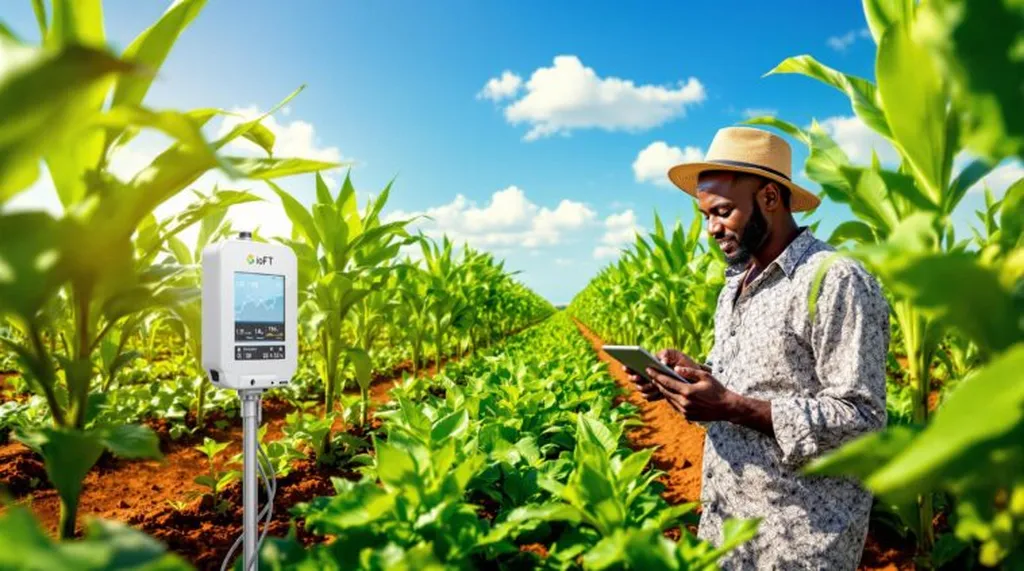
In the heart of Algeria, a team of researchers has developed a smart irrigation system that could revolutionize agriculture, particularly for small to medium farmers operating in resource-limited areas. The system, detailed in a recent study published in *Applied Water Science*, leverages the power of the Internet of Things (IoT) to reduce water usage and operational costs, offering a sustainable solution to modern farming challenges.
The research, led by Yousra Boukri from the Department of Electrical Systems Engineering at the University of M’hamed Bougara of Boumerdes, addresses two critical issues in global agriculture: water resource depletion and high operational expenses due to outdated irrigation systems. The team’s affordable IoT-based smart irrigation system uses an ESP32 microcontroller, a capacitive soil moisture sensor, a DHT11 sensor for environmental data, and the Blynk IoT platform for live monitoring and remote operation.
The system is designed to start irrigation when soil moisture drops to 20% and stops when it reaches 80%. Field tests demonstrated a significant reduction in water usage—between 25% and 35%—compared to traditional fixed-schedule irrigation systems. This efficiency translates to substantial cost savings, making the system an attractive option for farmers looking to optimize their resources.
“Our goal was to create a system that is not only efficient but also accessible to small and medium farmers,” said Boukri. “The success of our field tests shows that this system can be a game-changer in sustainable farming practices.”
The commercial impact of this research is profound. As water scarcity becomes an increasingly pressing issue, the demand for smart irrigation systems is expected to rise. This system offers a cost-effective solution that can be easily replicated, providing farmers with a tool to enhance productivity while minimizing environmental impact.
The integration of IoT in agriculture is not new, but the affordability and simplicity of this system set it apart. By using readily available components and open-source platforms, the researchers have made smart irrigation accessible to a broader audience. This could spur further innovation in the field, encouraging more farmers to adopt precision agriculture technologies.
The study’s findings suggest that the future of agriculture lies in the integration of technology and sustainability. As Boukri and her team have demonstrated, even small changes can lead to significant improvements in water usage and operational efficiency. This research not only provides a practical solution for farmers but also paves the way for future developments in smart agriculture.
In a world where resources are increasingly strained, the need for sustainable and efficient farming practices has never been greater. This research offers a glimpse into a future where technology and agriculture work hand in hand to create a more sustainable world.