
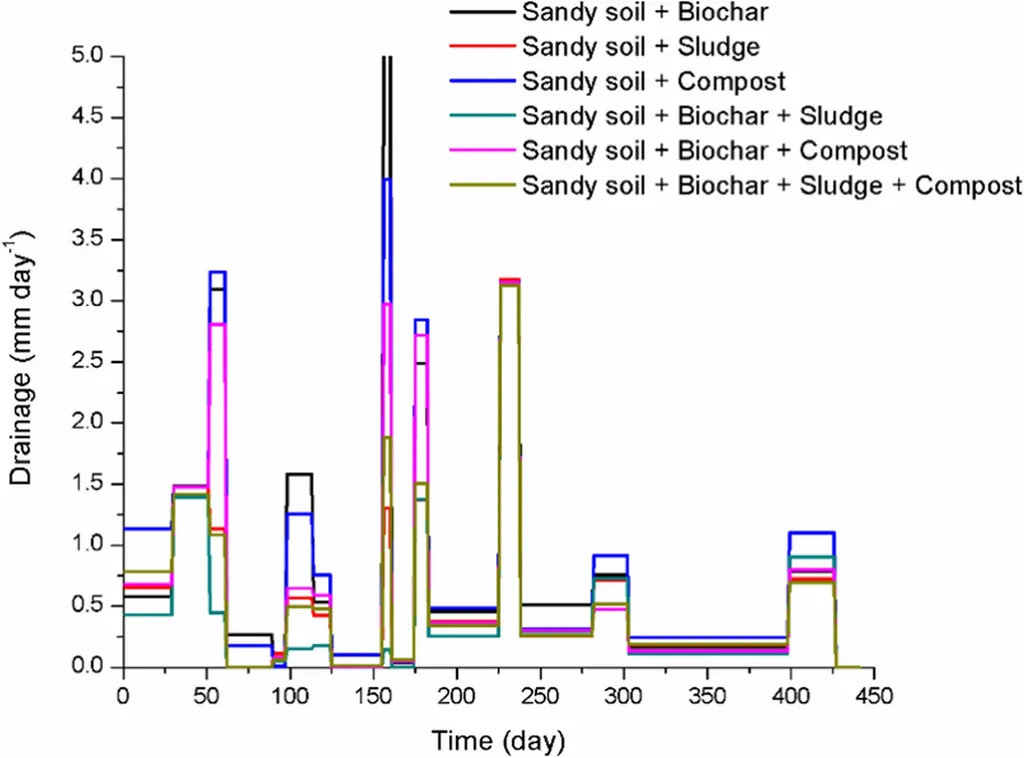
In the quest for sustainable agriculture, particularly in water-scarce regions, researchers have made a significant breakthrough in improving the water retention capabilities of sandy soils. A recent study published in the journal *Biochar* reveals that combining biochar, compost, and sludge can dramatically enhance soil water dynamics, offering a promising solution for farmers grappling with water-limited conditions.
Sandy soils, known for their low water retention and poor hydraulic properties, pose substantial challenges for agriculture. To address this, a team of researchers led by Slaven Tenodi from the University of Novi Sad Faculty of Sciences conducted a 441-day lysimeter experiment. The study evaluated six different soil amendments: biochar (A), sludge (B), compost (C), biochar + sludge (D), biochar + compost (E), and biochar + sludge + compost (F).
The results were striking. The combined treatments, particularly the trio of biochar, sludge, and compost (treatment F), showed the most significant improvements. “We found that the combined treatment reduced cumulative drainage by over 40% compared to individual amendments,” Tenodi explained. “This treatment also exhibited higher average soil water content and more stable water storage across seasonal fluctuations.”
Biochar played a crucial role in enhancing soil porosity and water-holding capacity, while compost and sludge contributed to improved water retention through organic matter input and fine particle additions. Treatments containing biochar reduced drainage and increased actual evaporation, indicating better soil water retention and availability.
The study also highlighted the importance of saturated hydraulic conductivity, field capacity, and plant available water in understanding drainage behavior. Statistical analyses, including one-way ANOVA and Tukey’s HSD, confirmed the significance of these findings.
For the agriculture sector, these results could be a game-changer. “Integrating biochar, compost, and sludge can synergistically enhance water retention, reduce drainage, and stabilize soil water contents in sandy soils,” Tenodi noted. This could lead to more efficient water use and increased resilience in arid and semi-arid agroecosystems.
The implications for commercial agriculture are vast. Farmers in water-scarce regions could potentially improve crop yields and reduce water waste by adopting these soil amendment strategies. The study suggests that a multi-faceted approach to soil management, rather than relying on single amendments, could be the key to sustainable agriculture in challenging environments.
As the world faces increasing water scarcity and climate change, innovative solutions like these are more important than ever. This research not only provides practical insights for farmers but also paves the way for future developments in soil science and agricultural technology. By leveraging the synergistic effects of biochar, compost, and sludge, we can move towards a more sustainable and resilient future for agriculture.