
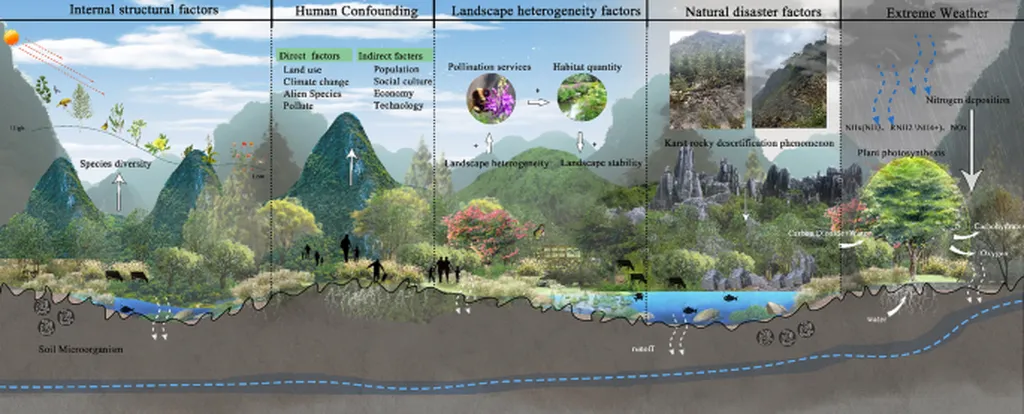
In the heart of China’s karst plateau, a region known for its unique geological features and ecological significance, a recent study has shed light on the intricate dance between landscape patterns and ecosystem service values (ESV). The research, led by Jiaying Tan from the School of Karst Science at Guizhou Normal University and the State Engineering Technology Institute for Karst Desertification Control, offers valuable insights that could reshape sustainable agricultural practices and regional development strategies.
The study, published in *Ecological Indicators*, analyzed multitemporal remote sensing data from 2005 to 2020 to understand how changes in landscape patterns impact ESV. The findings reveal a stark contrast between the eastern and central-western regions of the karst plateau. “The landscape pattern was characterized by ‘east–west divergence and central–west linkage’,” Tan explained. “The central and western regions formed a high fragmentation–high dominance–high complexity pattern, while the eastern region shifted to a low dominance–low complexity–concentration pattern.”
This divergence has significant implications for the agricultural sector. The total ESV increased by 5.595 billion yuan from 2005 to 2020, with regulating and support services accounting for 89% of the total ESV. However, provisioning services, which include agricultural outputs, decreased by 752 million yuan due to the reduction in cultivated land. “The value of cultural services showed a fluctuating trend of ‘first increasing then decreasing’,” Tan noted, highlighting the dynamic nature of ecosystem services in the region.
The study identified four categories of service bundles based on economic value: agricultural production, ecological vulnerability, core ecology, and ecological protection. These bundles reveal the dominance of regulating services and the vulnerability of support services, offering a nuanced understanding of the region’s ecological landscape.
The research also uncovered significant type-specific heterogeneity in the impacts of landscape pattern indices on ESV. For instance, the largest patch index (LPI) dominated regulating services, while patch density (PD) suppressed provisioning services. The Shannon diversity index (SHDI) and evenness index (SHEI) promoted support and cultural services. These findings provide a crucial basis for optimizing ESV and sustainable management on the karst plateau.
The implications for the agricultural sector are profound. Understanding the interplay between landscape patterns and ESV can help farmers and policymakers make informed decisions about land use and conservation strategies. By optimizing ecosystem services, the region can enhance its agricultural productivity while preserving its unique ecological features.
As we look to the future, this research underscores the importance of integrating ecological understanding with agricultural practices. It calls for a holistic approach that balances economic development with environmental sustainability. “These results provide an important basis for optimizing ESV and sustainable management on the karst plateau,” Tan concluded, emphasizing the potential for this research to shape future developments in the field.
In an era where climate change and environmental degradation pose significant threats, studies like this one are more critical than ever. They offer a roadmap for sustainable development, ensuring that we can meet the needs of the present without compromising the ability of future generations to meet their own needs. As we continue to explore the intricate relationships between landscape patterns and ecosystem services, we pave the way for a more sustainable and resilient future.