
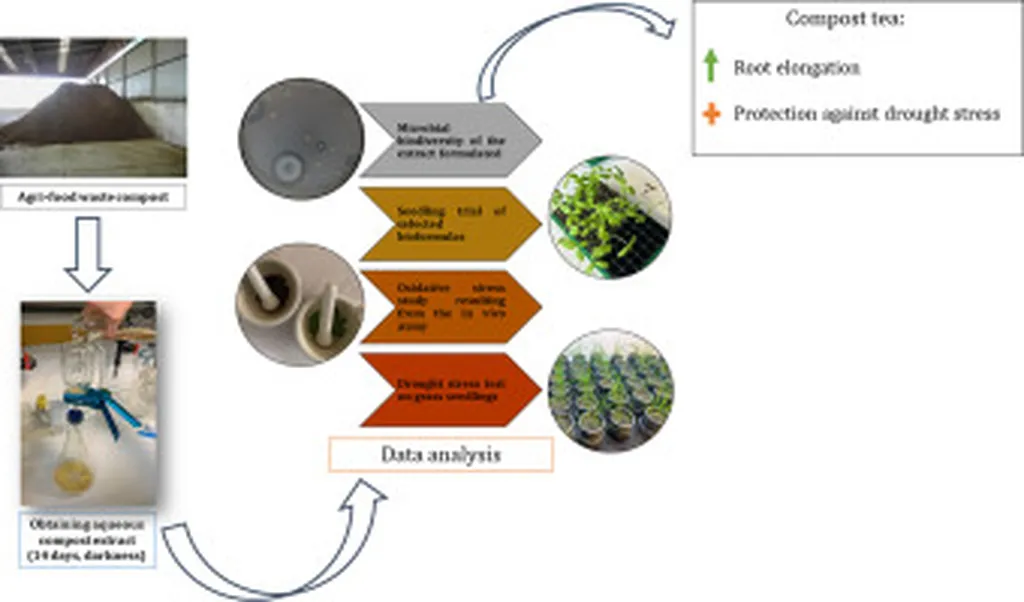
In the quest for sustainable agriculture, researchers are increasingly turning to natural solutions to combat plant diseases. A recent study published in *Scientific Reports* has shed light on the potential of non-aerated compost extracts to suppress phytopathogenic fungi, offering a promising avenue for eco-friendly disease management in crops. The research, led by Raja Jarboui from the Department of Biology at Jouf University, explores how fermentation conditions can be optimized to enhance the antifungal properties of compost extracts, potentially revolutionizing biocontrol strategies in agriculture.
The study focused on two commercial composts, C1 and C2, collected from different regions in Saudi Arabia and prepared using distinct methods. The researchers employed a full factorial design to evaluate the individual and interactive effects of key parameters on the antifungal potential of these compost extracts. Parameters such as temperature, compost concentration, glucose concentration, and fermentation time were varied to determine their impact on the suppression of four molecularly identified fungi: *Syncephalastrum racemosum*, *Paramyrothecium roridum*, *Fusarium oxysporum*, and *Penicillium italicum*.
The findings revealed that most compost extracts inhibited the growth of all studied fungi. Notably, fermentation time significantly affected the growth inhibition of *S. racemosum*, while the concentration of compost and glucose, along with fermentation time, significantly influenced the growth inhibition of *P. italicum*. “The optimal conditions for the highest inhibition rate against *S. racemosum* were 25 °C, a compost concentration of 1/8, glucose supplementation at 1 g/l, and a fermentation time of 3 days,” explained Jarboui. “In contrast, the optimal conditions for *P. italicum* were 25 °C, a compost concentration of 1/8, without glucose addition, and fermentation times of 3 and 8 days.”
The study also highlighted the importance of microbial abundance, phenolic content, and nitrogen parameters (NTK, NH₄⁺) in enhancing the antifungal efficacy of the compost extracts. Autoclaving and filtration were found to reduce fungal inhibition compared to non-sterile extracts, suggesting that the microbial composition and biochemical profile of the compost extracts play a crucial role in their antagonistic effects against phytopathogenic fungi.
The implications of this research for the agriculture sector are substantial. By optimizing the fermentation process of compost extracts, farmers and agronomists can develop more effective and sustainable biocontrol agents. This approach not only reduces the reliance on chemical fungicides but also promotes environmental sustainability by utilizing natural resources. “The microbial flora and organic/inorganic compounds in compost extracts offer a robust and eco-friendly solution for managing plant diseases,” noted Jarboui.
As the agricultural industry continues to seek innovative and sustainable solutions, the findings of this study provide a valuable foundation for future research and development. The optimization of fermentation conditions for compost extracts could lead to the creation of tailored biocontrol agents that are highly effective against specific phytopathogenic fungi. This could pave the way for more targeted and efficient disease management strategies, ultimately enhancing crop yields and food security.
In conclusion, the research led by Raja Jarboui from the Department of Biology at Jouf University, published in *Scientific Reports*, offers a promising glimpse into the future of sustainable agriculture. By harnessing the power of non-aerated compost extracts, the agricultural sector can move towards more eco-friendly and effective disease management practices, ensuring a healthier and more productive future for crops worldwide.