
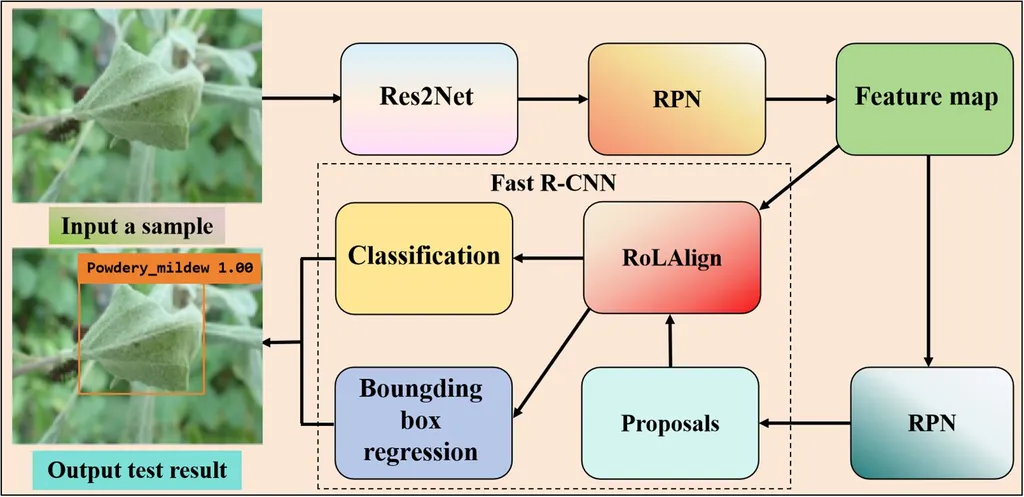
In the ever-evolving landscape of agricultural technology, a recent study published in *Scientific Reports* has shed light on the potential of deep learning models to revolutionize plant disease detection. The research, led by Utkarsh Mishra from the Vellore Institute of Technology, compared the efficacy of four deep learning architectures—Convolutional Neural Networks (CNN), AlexNet, Residual Networks (ResNet), and EfficientNet—in identifying diseases in potato and mango leaves.
The study utilized publicly available datasets, including the PlantVillage Potato Leaf Disease dataset and the Kaggle Mango Leaf Disease dataset, to train and test the models. The images were pre-processed, augmented, and split into training and testing datasets to ensure robust model performance. The results were striking, with EfficientNet emerging as the top performer, achieving a training accuracy of 98.2% and a validation accuracy of 97.8%. This model demonstrated exceptional generalization ability with minimal overfitting, making it a promising candidate for real-world applications.
“EfficientNet surpassed all other architectures, reaching a training accuracy of 98.2% and a validation accuracy of 97.8%, with very small loss (≈ 0.015) and no overfitting,” noted Mishra. “This indicates that EfficientNet has the best generalization ability, which is crucial for real-time disease detection in diverse agricultural settings.”
The implications for the agriculture sector are profound. Timely and accurate disease detection is critical for minimizing crop losses and ensuring food security. Traditional methods of disease identification often rely on manual inspection, which can be time-consuming and prone to human error. Deep learning models, on the other hand, offer a scalable and efficient solution that can be integrated into precision agriculture practices.
“Deep learning models can be adapted for real-time and accurate plant disease diagnosis, establishing a pathway for early remediation and supporting precision agriculture,” explained Mishra. “This research establishes the opportunity for EfficientNet to be considered a promising solution for scalable smart farming.”
The study also highlighted the strengths of other models. ResNet, for instance, demonstrated efficient convergence and achieved a validation accuracy of 96.7% in just a few epochs, showcasing the advantages of residual connections in deeper learning architectures. AlexNet and the baseline CNN also performed well, with moderate accuracy and minimal overfitting.
The findings suggest that deep learning models can be deployed in the field to provide farmers with real-time insights into plant health, enabling them to take proactive measures to prevent disease spread. This could lead to significant improvements in crop yields and economic benefits for the agriculture sector.
As the world grapples with the challenges of climate change and increasing food demand, the integration of deep learning in agriculture offers a beacon of hope. The research by Mishra and his team not only advances our understanding of plant disease detection but also paves the way for innovative solutions that can transform the future of farming. With further development and deployment, these models could become an indispensable tool in the fight against crop diseases, ensuring a more sustainable and food-secure future.