
In the heart of China’s Fujian province, a quiet revolution is brewing in the fields where Polygonatum cyrtonema Hua, a valuable medicinal plant, is cultivated. The plant, known for its rhizomes used in traditional Chinese medicine, has been facing a formidable foe: Fusarium oxysporum, a soil-borne fungus causing root rot disease. This challenge has been significantly impacting the production and commercial viability of P. cyrtonema Hua. However, a recent study published in *BMC Plant Biology* offers a glimmer of hope, demonstrating how a specific transcription factor, PcWRKY33, can enhance the plant’s resistance to this devastating pathogen.
The research, led by Yuqing Niu from the Institute of Crop Sciences at the Fujian Academy of Agricultural Sciences, sheds light on the crucial role of WRKY transcription factors in plant defense mechanisms. By analyzing full-length transcriptome sequencing data post-F. oxysporum infection, Niu and her team identified 271 WRKY transcription factors, with PcWRKY33 emerging as a key player in the plant’s response to the pathogen.
“Our findings indicate that PcWRKY33 is not just responsive to F. oxysporum infection but also plays a pivotal role in enhancing the plant’s tolerance to the disease,” Niu explained. The team’s experiments showed that overexpressing PcWRKY33 in both P. cyrtonema Hua and Nicotiana benthamiana significantly boosted their resistance to F. oxysporum. Moreover, the study revealed that PcWRKY33 regulates the expression of 20 disease-resistance genes containing the TGAC motif, further underscoring its importance in the plant’s defense arsenal.
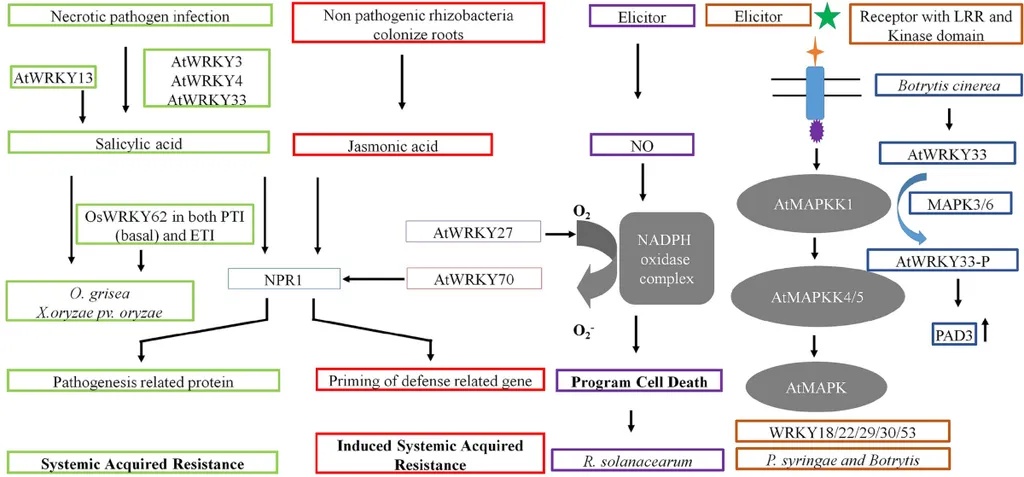
One of the most intriguing aspects of this research is the role of salicylic acid (SA) in mediating PcWRKY33’s effects. The study found that F. oxysporum infection increased both the endogenous SA content and the expression of disease-resistant genes in PcWRKY33-overexpressing plants. This suggests that PcWRKY33 influences SA signaling, a critical pathway in plant immunity.
The commercial implications of this research are substantial. Fusarium oxysporum is a widespread pathogen that affects numerous crops, leading to significant yield losses and economic damage. By understanding and harnessing the power of PcWRKY33, farmers and agritech companies could develop more resilient P. cyrtonema Hua varieties and potentially other crops, reducing the need for chemical pesticides and improving overall productivity.
“This research opens up new avenues for developing disease-resistant plant varieties,” Niu noted. “By leveraging the natural defense mechanisms of plants, we can create more sustainable and profitable agricultural practices.”
Looking ahead, the study’s findings could pave the way for further research into WRKY transcription factors and their role in plant immunity. As the global population continues to grow, the demand for sustainable and efficient agricultural practices will only increase. Research like Niu’s, published in *BMC Plant Biology*, offers a promising path forward, combining scientific innovation with practical agricultural solutions.