
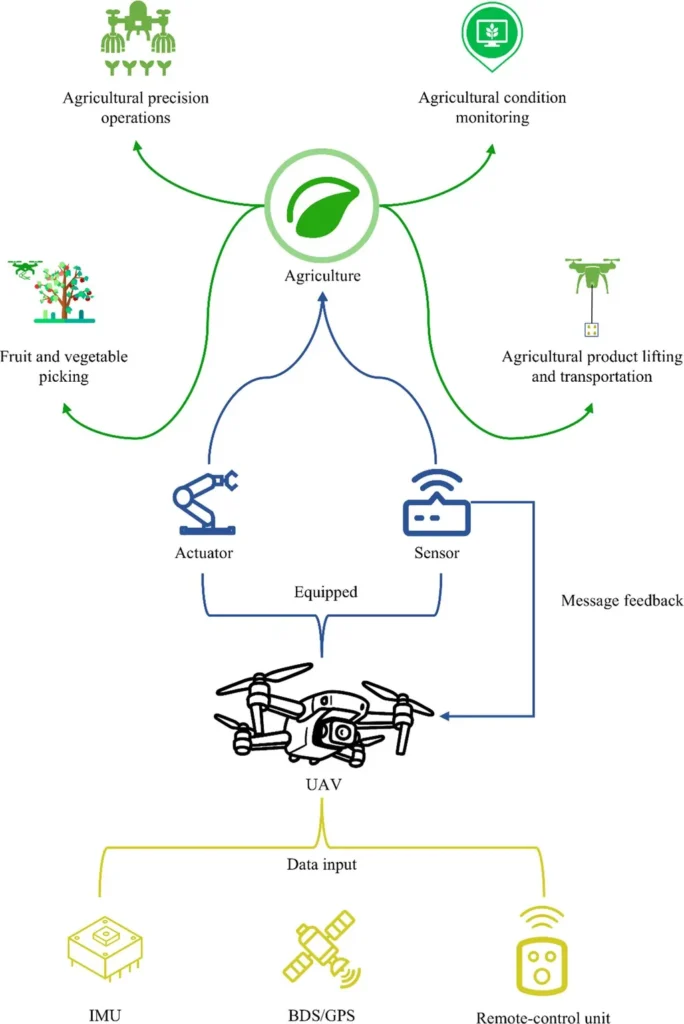
In the ever-evolving landscape of precision agriculture, a groundbreaking development has emerged that promises to revolutionize the way we manage irrigation systems. Researchers have introduced an advanced lightweight semantic segmentation network, dubbed GEA-UNet, designed to enhance the accuracy and efficiency of irrigation canal inspections using unmanned aerial vehicles (UAVs). This innovation addresses longstanding challenges such as complex background textures, vegetation occlusions, and varying lighting conditions, which often lead to blurred canal boundaries and discontinuous features in UAV images.
The GEA-UNet model incorporates several cutting-edge components to achieve its impressive performance. A direction perception attention module enhances orientation sensitivity, while an edge detection auxiliary module refines boundary learning. Additionally, a context-aware segmentation module captures both local and global features of irrigation canals. The results are nothing short of remarkable: the model achieves an accuracy of 98.9%, a mean Intersection over Union of 85.4%, and an F1-score of 92.2%, outperforming other mainstream semantic segmentation models.
“Our goal was to create a robust and efficient solution for autonomous UAV-based canal inspection,” said lead author Jianjun Ni from the College of Artificial Intelligence and Automation at Hohai University. “The GEA-UNet model not only improves the accuracy of canal segmentation but also significantly enhances navigation efficiency, which is crucial for intelligent decision-making and precision management in modern irrigation systems.”
The commercial impacts of this research are substantial. Accurate and efficient canal inspection is vital for optimizing water usage, reducing costs, and improving crop yields. With the GEA-UNet model, agricultural UAVs can navigate with greater precision, reducing the average angular error to just 1.27 degrees and the average fitting time to 3.67 milliseconds. This level of accuracy and efficiency can lead to significant savings in water and operational costs, making it a game-changer for the agriculture sector.
The research, published in the journal ‘Complex & Intelligent Systems’, opens up new possibilities for future developments in the field. As the demand for sustainable and efficient agricultural practices grows, innovations like the GEA-UNet model will play a pivotal role in shaping the future of precision agriculture. By leveraging advanced technologies, farmers and agricultural managers can make more informed decisions, leading to improved productivity and sustainability.
This breakthrough not only highlights the potential of AI and machine learning in agriculture but also underscores the importance of interdisciplinary collaboration. As we continue to explore the boundaries of what is possible, the integration of cutting-edge technologies into traditional agricultural practices will undoubtedly drive the industry forward, paving the way for a more efficient and sustainable future.