
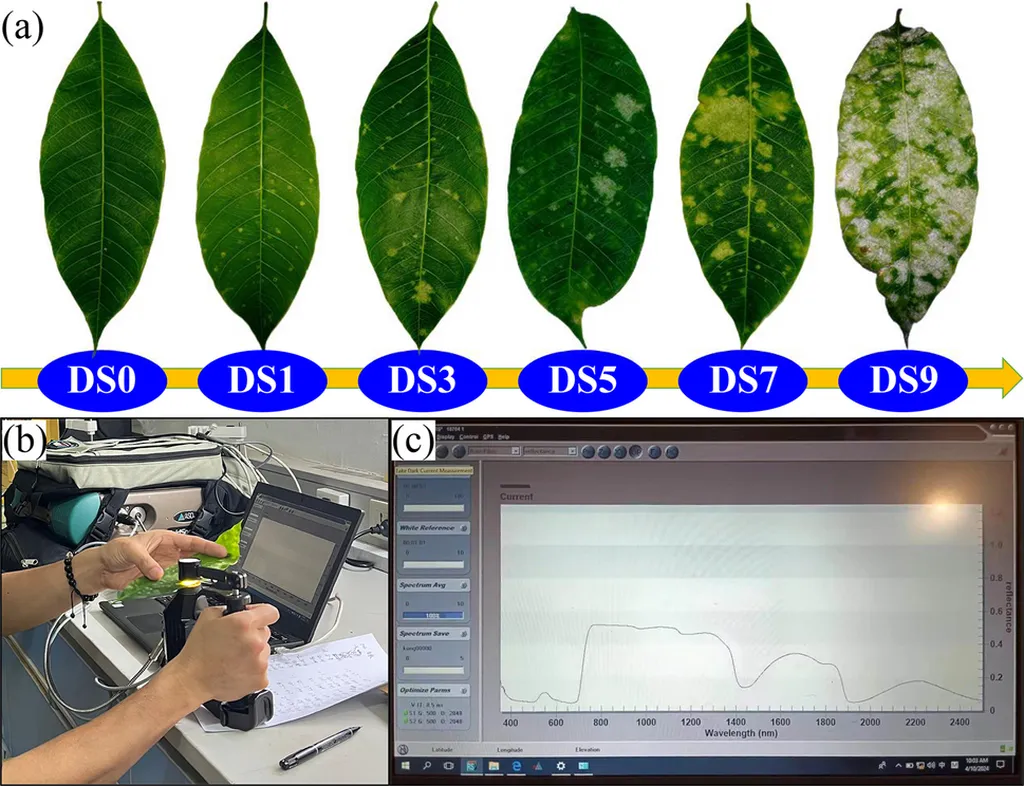
In the ever-evolving landscape of agricultural technology, a groundbreaking study has emerged that promises to revolutionize the way we monitor and manage one of the most devastating plant diseases: rubber leaf powdery mildew. This research, published in the esteemed journal *Plant Methods*, introduces a novel classification model that leverages hyperspectral multi-dimensional feature fusion to assess the severity of the disease with unprecedented accuracy.
The lead author of this transformative study, Donghua Wang from the College of Water Resources Science and Engineering at Taiyuan University of Technology, explains the significance of their work: “Our model integrates multiple spectral features, providing a comprehensive and nuanced understanding of disease severity. This approach not only enhances diagnostic precision but also offers a scalable solution for large-scale agricultural monitoring.”
The implications of this research for the agriculture sector are profound. Powdery mildew is a pervasive fungal disease that affects a wide range of crops, including rubber plants, leading to significant yield losses and economic impacts. Traditional methods of disease detection often rely on visual inspections, which are time-consuming, labor-intensive, and prone to human error. The new model, however, utilizes hyperspectral imaging technology to capture detailed spectral data from plant leaves, which is then analyzed using advanced machine learning algorithms to classify the severity of the disease.
“This technology has the potential to transform disease management practices,” says Wang. “By providing real-time, accurate assessments of disease severity, farmers and agronomists can make informed decisions about treatment strategies, optimizing resource use and minimizing crop losses.”
The commercial impact of this research is substantial. For instance, large-scale rubber plantations can deploy drones equipped with hyperspectral sensors to survey vast areas of crops quickly and efficiently. The data collected can then be processed using the new classification model to generate detailed maps of disease severity, enabling targeted applications of fungicides and other treatments. This precision agriculture approach not only reduces the environmental impact of chemical treatments but also enhances overall productivity and profitability.
Moreover, the versatility of the model means it can be adapted for use with other crops and diseases, opening up new avenues for research and development in the agritech sector. As Wang notes, “The principles underlying our model are widely applicable, and we are already exploring its potential for other plant diseases and environmental monitoring applications.”
The study’s findings also highlight the importance of interdisciplinary collaboration in driving agricultural innovation. By combining expertise in spectral imaging, machine learning, and plant pathology, the research team has developed a tool that addresses a critical need in modern agriculture. This holistic approach is likely to inspire further advancements in the field, fostering a new era of data-driven farming practices.
In conclusion, the research led by Donghua Wang represents a significant step forward in the fight against plant diseases. By harnessing the power of hyperspectral imaging and machine learning, the new classification model offers a robust, scalable solution for disease monitoring and management. As the agriculture sector continues to embrace technological innovation, this research is poised to shape the future of precision agriculture, benefiting farmers, consumers, and the environment alike.