
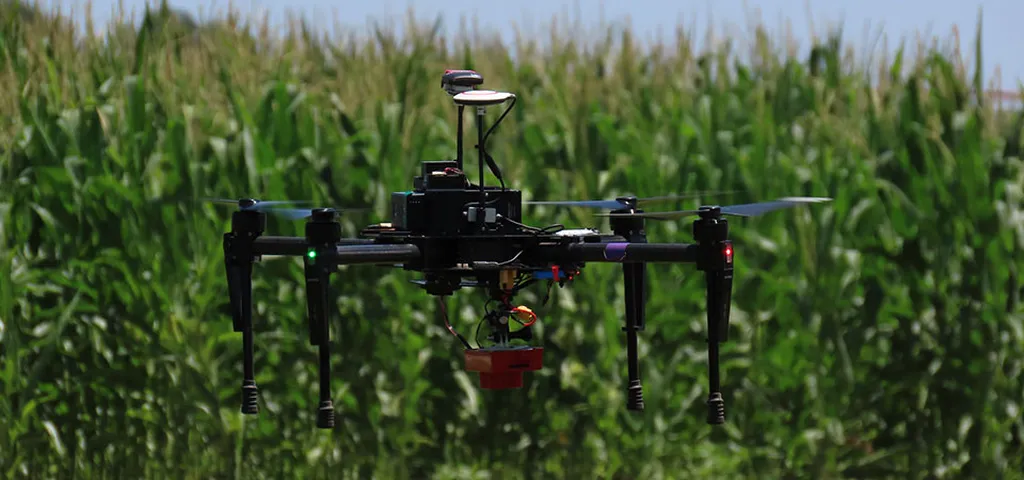
In the heart of Kansas, a dynamic collaboration is unfolding that promises to revolutionize the agricultural landscape. Kansas State University’s Institute for Digital Agriculture and Advanced Analytics (ID3A) has joined forces with Kelly Hills Unmanned Systems to pioneer the next generation of precision agriculture. This partnership is not just about technological advancements; it’s about empowering farmers with the tools they need to thrive in an ever-evolving industry.
At the helm of Kelly Hills Unmanned Systems is Lukas Koch, a visionary who understands the importance of blending cutting-edge technology with the practical needs of farmers. Koch, a K-State alumnus, emphasizes that while drones and other unmanned aerial systems (UAS) represent the next frontier in agricultural technology, the human element remains irreplaceable. “Drones are simply the next frontier in agricultural technology,” Koch said. “But it’s still a farmer’s calloused hands that sort through soil, steer a tractor’s wheel or guide a drone’s controls.”
The collaboration between K-State and Kelly Hills is built on three key pillars: research and development, community engagement, and industry demonstration and technology transfer. Through these pillars, the partners aim to optimize aerial spraying for crop protection, develop remote sensing methods, integrate data analytics, and advance autonomous navigation. This research is not conducted in isolation; it is deeply rooted in the needs and feedback of the agricultural community.
Community engagement is a cornerstone of this partnership. By engaging agricultural communities, policymakers, and industry stakeholders through educational outreach, drone demonstration events, and technology awareness programs, K-State and Kelly Hills are promoting the safe, effective, and sustainable adoption of unmanned aerial systems in farming operations. “They’re creating a lot of excitement around what they’re doing,” said Brian McCornack, an ID3A director at K-State. “They have the ears of the producers in their area, and they’re growing excitement beyond that.”
One of the standout features of this collaboration is the use of the Pyka Pelican 2, the world’s largest autonomous agricultural aircraft and the largest uncrewed aerial system authorized by the FAA for commercial use. This aircraft, along with Kelly Hills’ nearly 50,000-square-mile test range, provides a robust platform for real-world demonstrations and field trials. These efforts are crucial for encouraging the adoption and commercialization of emerging UAS technologies within the agricultural sector.
The partnership also focuses on creating an uncrewed aerial systems pipeline. K-State’s expertise in agriculture and unmanned aerial systems, combined with Kelly Hills’ industry connections, aims to scale up the technology and reduce costs. “Farmers are looking to spend smarter, and this is a perfect spot for us to help make a business case for this technology,” said Ajay Sharda, professor of biological and agricultural engineering and an ID3A director.
Long-term, the collaboration will result in resources, tools, and education that familiarize, train, and encourage farmers and other interested industry partners in the use of uncrewed aerial systems at scale. This initiative is particularly important in Kansas, where agriculture constitutes a significant portion of the state’s GDP. “It’s crucial to have a pipeline of folks who can provide additional support in industry areas like fertility, pest protection, or crop monitoring — all those services that help support an industry that is half of Kansas’ GDP,” McCornack said.
For Koch, this partnership is personal. Having grown up on a technology-forward farm, he has witnessed firsthand the transformative power of next-generation agricultural technology. “We’re early in it, but with a relationship like this, we can build on K-State’s mission to serve people across Kansas and the world as a land-grant university,” Koch said. “It’s a unique state and position for K-State to be in to do research that benefits farmers across the wide variety of regions in Kansas, and I see a future where we can work together and bring that value back for everyone.”
As the agricultural industry continues to evolve, the collaboration between Kansas State University and Kelly Hills Unmanned Systems stands as a beacon of innovation and progress. By combining the strengths of academia and industry, this partnership is poised to unlock new possibilities for farmers, ensuring that they can continue to feed the world while embracing the technologies of the future.