
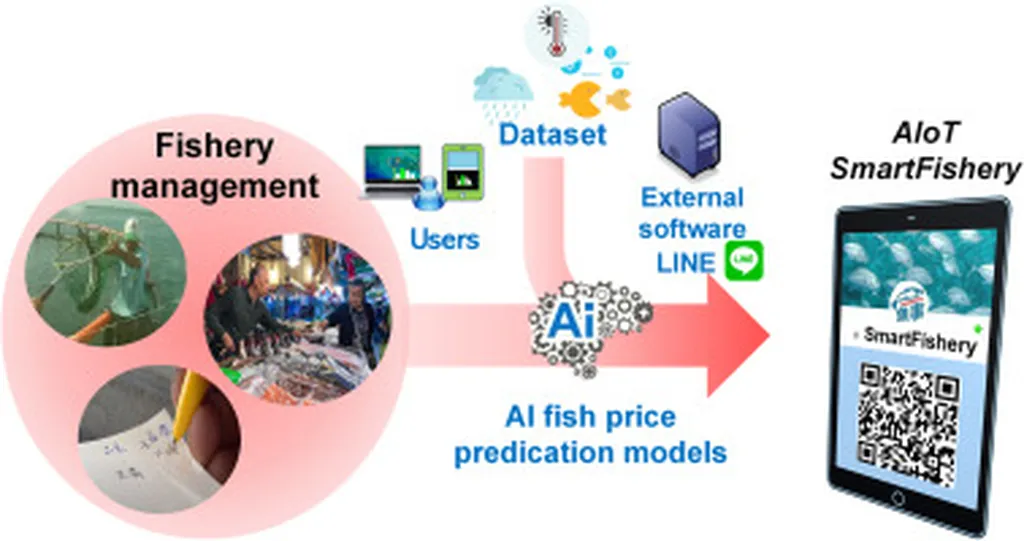
In the vast, data-rich world of fisheries management, a new study published in *Ecological Indicators* is making waves by merging traditional fishery knowledge with cutting-edge machine learning techniques. The research, led by Runze Shi from the College of Oceanography and Ecological Science at Shanghai Ocean University, introduces a framework that could revolutionize how we predict fish stock abundance, with significant implications for the agriculture and aquaculture sectors.
Catch per unit effort (CPUE) is a critical metric for assessing fish stock abundance. However, the data derived from fishery logbooks are often plagued by noise and missing entries, leading to biased estimates. Shi and his team tackled this challenge by developing a knowledge-guided machine learning (KGML) framework. This approach integrates fishery expertise with machine learning to enhance the accuracy and ecological consistency of spatial CPUE predictions.
The study focused on neon flying squid (Ommastrephes bartramii) in the Northwest Pacific from 2002 to 2019. By incorporating ocean environmental variables such as sea surface temperature, salinity, height, and chlorophyll-a, the researchers aimed to create a more robust model. “We started by refining the dataset, removing implausible outliers and likely false-zero records,” Shi explained. “This initial step alone substantially improved model performance.”
However, the team encountered an unexpected hurdle. Initial experiments revealed that spatial information dominated the feature importance rankings, suggesting the model was merely memorizing locations rather than learning from environmental drivers. To address this, the researchers introduced a cost-aware loss function, assigning greater weight to the loss incurred by non-zero CPUE samples. This refinement shifted the model’s focus from spatial memorization to environmental factors, ensuring a more ecologically consistent prediction.
The implications of this research extend beyond fisheries management. In the agriculture sector, where data quality and consistency are paramount, similar KGML frameworks could be applied to improve crop yield predictions, pest management, and resource allocation. By integrating domain-specific knowledge with machine learning, farmers and agronomists could make more informed decisions, ultimately enhancing productivity and sustainability.
“This two-stage KGML approach not only maximizes predictive accuracy and robustness but also strengthens species distribution models by ensuring theoretical consistency in feature contributions,” Shi noted. The study provides a practical and robust framework for improving ecological indicators and supporting ecosystem-based fishery management, particularly in data-limited contexts.
As the agriculture sector continues to embrace technology, the fusion of traditional knowledge with advanced machine learning techniques could pave the way for more precise and sustainable practices. The research by Shi and his team serves as a testament to the power of interdisciplinary collaboration, offering a glimpse into a future where data-driven decisions are both accurate and ecologically sound.