
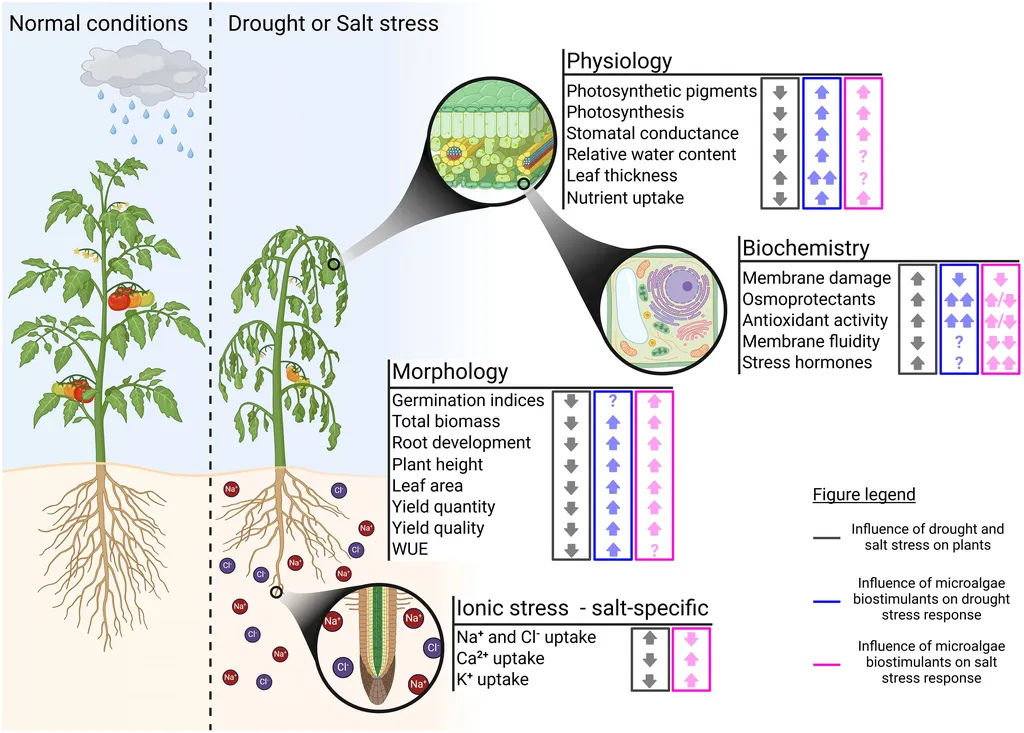
In the quest for sustainable agriculture, farmers and scientists are increasingly turning to biostimulants—substances that enhance plant growth and resilience. However, understanding how these biostimulants interact with environmental stressors like salinity has been a complex puzzle. A recent study published in *Plant Stress* sheds light on this interplay, offering insights that could revolutionize how we use biostimulants in agriculture.
The research, led by Giandomenico Corrado from the Department of Agricultural Sciences at the University of Naples Federico II, investigated the effects of an aqueous extract from the microalga *Chlamydomonas reinhardtii* (MA) on tomato plants under both saline and non-saline conditions. Using a fully factorial design and high-throughput RNA-sequencing, the team uncovered nuanced molecular interactions that could pave the way for more targeted and effective use of biostimulants.
The study found that the application of MA significantly improved vegetative growth, increasing leaf area by 16% and enhancing leaf hydration, regardless of salinity. This is a promising finding for farmers, as it suggests that MA could be a valuable tool in both stressed and non-stressed environments. “The fact that MA improves growth under both conditions is a strong indicator of its potential as a broad-spectrum biostimulant,” Corrado noted.
However, the real intrigue lies in the transcriptomic analysis, which revealed that MA’s effects are highly context-dependent. Under saline conditions, MA suppressed typical osmotic and oxidative stress-response genes, suggesting that it reduces the plant’s perception of stress and the associated costly defenses. This could mean that plants treated with MA under salinity stress are not only growing better but also conserving energy that would otherwise be spent on stress responses.
In non-saline conditions, MA triggered a “priming” effect, upregulating genes involved in temperature response while downregulating genes related to energy-heavy ribosome biogenesis. This anticipatory mechanism prepares the plant for future challenges while conserving resources, a strategy that could be particularly beneficial in unpredictable climates.
The study’s findings highlight the importance of understanding the specific interactions between biostimulants and environmental stressors. “This research provides a conceptual framework for developing next-generation tools to enhance crop resilience through context-aware biostimulant application,” Corrado explained. This could lead to more tailored and effective use of biostimulants, ultimately improving crop yields and sustainability.
For the agriculture sector, the implications are significant. As climate change continues to pose new challenges, the ability to enhance crop resilience through targeted biostimulant use could be a game-changer. Farmers may soon have access to tools that not only improve growth under optimal conditions but also prepare plants for future stressors, ensuring more stable and productive harvests.
The study’s publication in *Plant Stress* underscores its relevance to the field of plant science and agriculture. As researchers continue to unravel the complex interactions between biostimulants and environmental stressors, the potential for innovative solutions to enhance crop resilience grows. This research is a step forward in that journey, offering valuable insights that could shape the future of sustainable agriculture.