
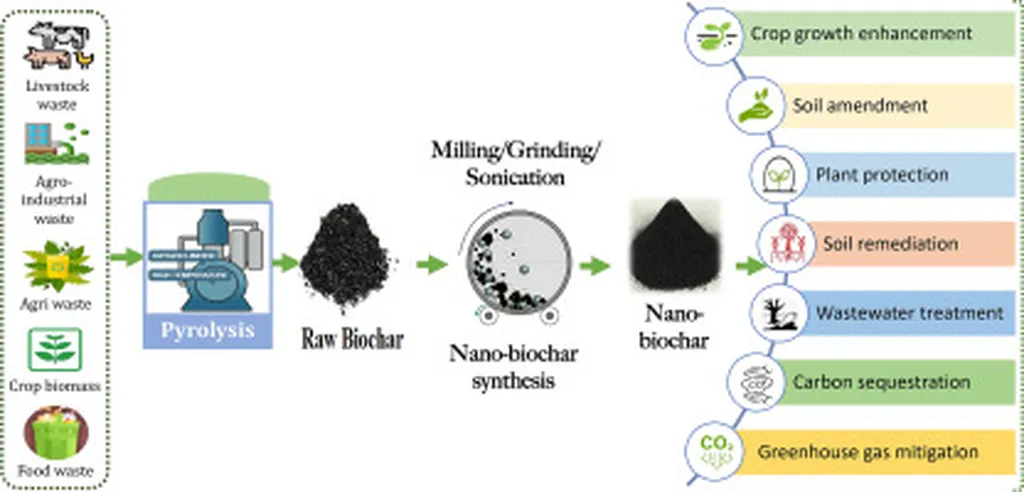
In the quest for sustainable solutions to global crises, a new frontier in materials science is emerging, one that could revolutionize industries from healthcare to agriculture. At the heart of this innovation is nanobiochar and its composite counterparts, which are gaining traction as versatile biomaterials with far-reaching applications. A recent review published in the journal ‘Biochar’ delves into the potential of these materials, highlighting their role in shaping a more sustainable future.
Nanobiochar, a nanoscale biochar produced through pyrolysis and subsequent modifications, has already made waves in environmental applications. However, its potential extends far beyond this realm. “The unique properties of nanobiochar and biochar nanocomposites make them a promising candidate for healthcare applications, aligned with the One Health approach,” says Pooja Singh, lead author of the review and a researcher at the Symbiosis Centre for Waste Resource Management, Symbiosis International (Deemed University). This approach recognizes the interconnection between human, animal, and environmental health, emphasizing the need for holistic solutions.
The review explores the potential of these materials in various sectors, including energy, construction, and agriculture. In the context of resource depletion and climate change, nanobiochar and biochar nanocomposites offer promising alternatives for energy storage solutions and sustainable construction. For instance, they could be used to develop supercapacitors and batteries, addressing the growing demand for efficient energy storage systems.
In the agriculture sector, the commercial impacts could be significant. Nanobiochar and biochar nanocomposites could enhance soil health, improve water retention, and promote sustainable farming practices. “In times of resource depletion and climate change, such composite materials show promise as a valuable resource for climate-smart agriculture,” Singh notes. This could lead to increased crop yields, reduced environmental impact, and improved economic outcomes for farmers.
However, the review also underscores the need for further research. “Further research is needed on the biocompatibility and extended ecotoxicity of these hybrid materials,” Singh cautions. Understanding these aspects is crucial for ensuring the safe and effective use of nanobiochar and biochar nanocomposites in various applications.
The integration of these materials into underexplored sectors could address knowledge gaps and expand the use of emerging technologies for a sustainable and low-carbon future. As we stand on the brink of a materials science revolution, the potential of nanobiochar and biochar nanocomposites is vast and exciting. The review published in ‘Biochar’ by Pooja Singh and her team at the Symbiosis Centre for Waste Resource Management, Symbiosis International (Deemed University), serves as a call to action for interdisciplinary research, urging us to fully leverage the potential of these composite resources and facilitate the transition to a more resilient and resource-efficient future.