
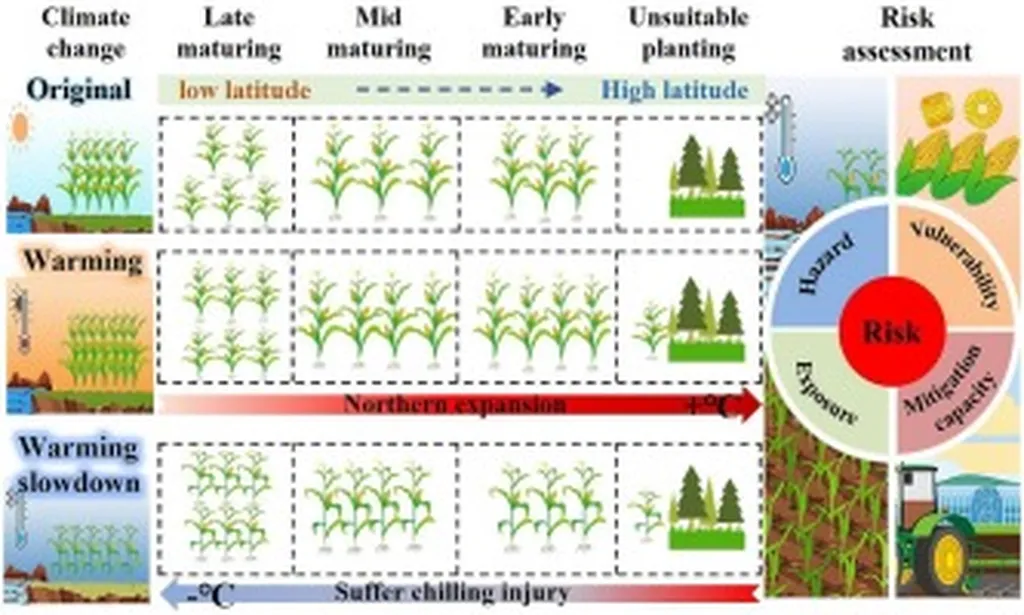
In the heart of Northeast China’s maize belt, a groundbreaking study is reshaping how we understand and combat drought disasters. Researchers, led by Zhang Jiani from the Key Laboratory of Geographical Processes and Ecological Security in Changbai Mountains at Northeast Normal University, have developed a dynamic, growth-stage-specific drought risk assessment framework tailored for maize crops. This innovative approach, published in the Journal of Hydrology: Regional Studies, integrates multi-source remote sensing data to monitor drought via the Temperature Vegetation Dryness Index (TVDI), offering a nuanced perspective on drought risk that could significantly impact agricultural planning and disaster management.
The study, focusing on the maize-producing regions of Changchun and Siping in Jilin Province, reveals that drought risk in this area is more heavily influenced by socio-agricultural exposure factors, such as maize planting area and agricultural population, than by the immediate climatic hazard. This finding underscores the region’s inherent vulnerability due to its intensive farming system. “We found that the risk peaks during the early growth stages of maize and exhibits an east-west gradient,” explains Zhang. “This stage-specific, multi-dimensional assessment shifts our perspective from tracking drought events to diagnosing composite risk landscapes.”
The research highlights the critical role of river network density in enhancing emergency response capacity, emphasizing the importance of surface water availability and irrigation infrastructure in mitigating drought impacts. This insight could drive significant developments in agricultural infrastructure and water management strategies, ultimately bolstering the resilience of the region’s maize production.
The commercial implications of this research are substantial. By providing a targeted scientific basis for precision drought mitigation, the study offers farmers and agricultural stakeholders a powerful tool to optimize crop management practices and minimize losses during drought events. “This framework allows us to anticipate and prepare for drought risks more effectively,” says Zhang. “It’s a step towards climate-resilient agricultural planning that can safeguard food security and economic stability in the region.”
As the agriculture sector grapples with the increasing frequency and severity of droughts due to climate change, this research offers a beacon of hope. By shifting the focus from reactive disaster response to proactive risk assessment and mitigation, it paves the way for more sustainable and resilient agricultural practices. The study’s findings could inspire similar frameworks in other maize-producing regions worldwide, fostering a global shift towards climate-resilient agriculture.
In an era where climate change is reshaping agricultural landscapes, this research stands as a testament to the power of innovative science in addressing real-world challenges. As Zhang and her team continue to refine their framework, the agricultural sector can look forward to more precise, effective, and sustainable drought mitigation strategies, ensuring the future of maize production in Northeast China and beyond.