
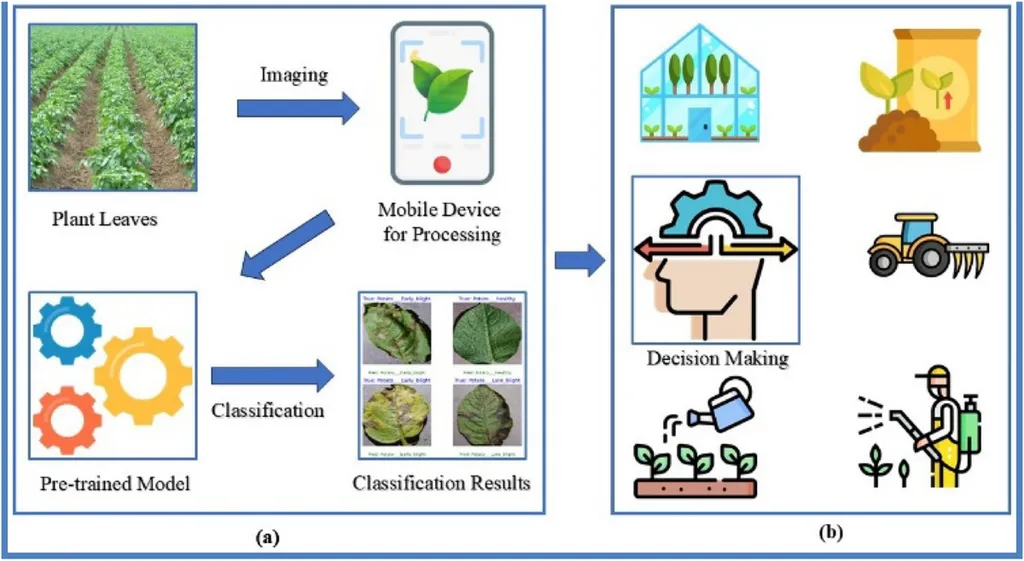
In the ever-evolving landscape of smart agriculture, the ability to accurately classify plant diseases is a game-changer. It can lead to timely interventions, reduced crop losses, and ultimately, improved yields. However, the task is fraught with challenges, particularly when dealing with fine-grained disease manifestations. Enter Chunmao Li and colleagues from the Faculty of Information Engineering at Quzhou College of Technology, who have developed an innovative approach to tackle this very issue.
Their research, published in the Journal of King Saud University: Computer and Information Sciences, introduces a novel framework called Spatial Feature Fusion with Brownian Distance Covariance (SFF-BDC). This framework is a significant departure from traditional methods that rely on metrics like Euclidean distance or cosine similarity. “These metrics often fall short in capturing the intricate, non-linear relationships in plant diseases,” explains Li. “Our approach, on the other hand, incorporates joint distribution modeling, enabling us to measure various statistical dependencies between query and support samples more effectively.”
The SFF-BDC framework consists of two main modules. The first is a deep Brownian Distance Covariance (BDC) metric, which measures statistical dependencies. The second is a Spatial Feature Fusion (SFF) module that enriches feature representations by incorporating directional spatial information. This spatial information is crucial for optimizing the input for subsequent BDC computation.
The results speak for themselves. Evaluations on various splits of the public PlantVillage dataset show remarkable accuracies ranging from 79.28% to 93.43%. The framework’s superior performance in challenging, fine-grained classification scenarios strongly validates the researchers’ core hypothesis.
The commercial implications for the agriculture sector are substantial. Accurate and timely disease classification can lead to more efficient use of pesticides, reduced environmental impact, and improved crop yields. It can also aid in the development of disease-resistant plant varieties, further boosting agricultural productivity.
This research is a significant step forward in the field of smart agriculture. As Li puts it, “Our work opens up new avenues for exploring joint distribution modeling in plant disease classification.” The future of agriculture is smart, and with advancements like SFF-BDC, it’s also looking increasingly precise and efficient. The research, led by Chunmao Li from the Faculty of Information Engineering at Quzhou College of Technology, was published in the Journal of King Saud University: Computer and Information Sciences, underscoring the global relevance and impact of this work.